The Gift of Sacrifice

This is God’s gift to us. The opportunity to unite our sufferings, our frustrations, our inconveniences, to His in Love. Throughout our lives as Children of God, we are offered an infinite number of “rungs” which to climb upon the ladder of the Cross. When taken in love, the result is beautiful, both in Heaven and on earth.

“Greater love hath no man than to lay down his life for his friends” (John 15:13).

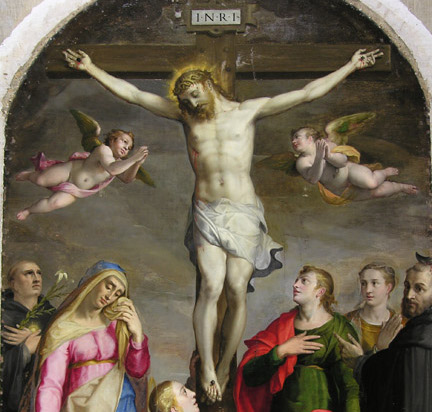
We speak often of the gift of redemption that Christ offers us via His death on the cross. But through His Passion and death, He gives us another gift as well. One that we often overlook. He offersSabatini_santi crucifixion us an opportunity to experience first-hand that “greater love” of which He speaks. Not through His sacrifice. But through our own.
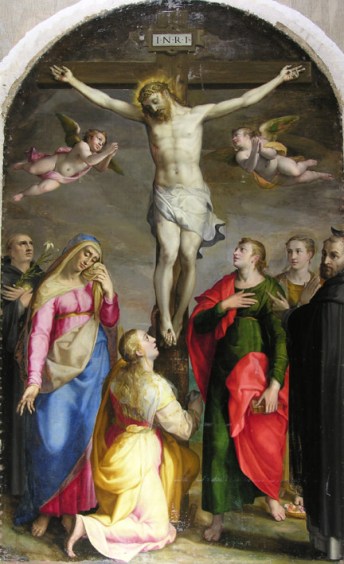
Of all the imaginable plans for redemption that one could have conceived, it seems the one God chose is most peculiar. After all, His only Son didn’t come into the public realm until His 30th year, he surrounded Himself with devoted friends, walked with them, talked with them, and confided in them over the course of three years, only to allow leaders of the day to mock Him, scourge Him, strip Him of His dignity, nail Him to a cross in a most humiliating way and leave Him to hang for three hours until he breathed his last.

What about that makes sense? As a Protestant, I must admit I didn’t ask very many questions. I just accepted that He died, so I didn’t have to.

But after spending some time contemplating the cross, I began to think I wasn’t seeing the whole picture. I began asking. Thankfully, our Faith offers answers. And they are more profound and beautiful than I could have ever imagined.

My greatest question had to do with His manner of death. We understand that Christ redeemed us from the absolute misery and degradation of sin. But why in this way – through a humiliatingly public and  torturous death which reached its climax atop a mountain, upon a crude and rugged cross?

Why did Christ have to make redemption such a profound and gruesome process?

Most likely His goal was to give us an example to follow:

A new commandment I give to you, that you love one another; even as I have loved you, that you also love one another. By this all men will know you are my disciples, if you have love for one another (John 13:34-35).

With those six little words, “even as I have loved you,” Christ gives us everything.

By virtue of His cross, Christ re-opened the gates of heaven. Gates that had been closed for thousands of years as a consequence of the first sin. He demonstrated for us the power of that cross. And He calls us to follow his example:

“If any man would come after me, let him deny himself and take up his cross and follow me. For whoever would save his life will lose it, and whoever loses his life for my sake will find it” (Matthew 16:24-25),

This is that narrow gate about which we hear so often (Matthew 7:13).

Love is not a a pile of sentimental poems or a confetti of rose petals streaming from the heavens.

In reality, love looks a lot like suffering. It can be painful. It can be heart wrenching.

Indeed, love is a sacrifice.

A sacrifice first wrought by Christ, who came to show us The Way.

According to Pope Benedict XVI in Jesus of Nazareth: Holy Week,

He has truly gone right to the end, to the very limit and even beyond that limit. He has accomplished the utter fullness of love – he has given himself.

First Christ defined love.

And then He asked us to practice it.

You shall love the Lord your God with all your heart, and with all your soul, and with all your mind. This is the great and first commandment. And a second is like it, You shall love your neighbor as yourself” (Matthew 22: 36-39).

For God, love = sacrifice.

And what is a sacrifice, but suffering, wrapped in a beautiful package and offered as pure gift?

Through our participation in the Body of Christ, we have the opportunity to unite our suffering with His, as we truly are One Body – this is not mere concept and symbolism. Rather, the very gift of Self that Christ has given us is the grace that helps us to love as He has loved. As Paul explains, through our participation in The Body, we have the privilege of participating in redemption:

Now I rejoice in my sufferings for your sake, and in my flesh I complete what is lacking in Christ’s afflictions for the sake of his body, that is, the church….(Colossians 1:24)

Paul  bids us to offer ourselves as well, to worship God through our own participation in this new concept of sacrifice that Jesus has introduced by the cross:

I appeal to you therefore, brethren, by the mercies of God, to present you bodies as a living sacrifice, holy and acceptable to God, which is your spiritual worship.(Romans 12:1).

Benedict XVI expounds on this concept of sacrifice:

…it means the offering of one’s whole existence that must be penetrated by the word and must become a gift to God. Paul, who places so much emphasis on the impossibility of justification on the basis of one’s own morality, is doubtless presupposing that this new form of Christian worship, in which Christians themselves are the “living and holy sacrifice”, is possible only through sharing in the incarnate love of Jesus Christ, a love that conquers all our insufficiency through the power of his holiness…

…the greatness of Christ’s love is revealed precisely in the fact that he takes us up into himself in all our wretchedness, into his living and holy sacrifice, so that we truly become “his body.”

Later, he concludes,

In living out the Gospel and in suffering for it, the Church, under the guidance of the apostolic preaching has learned to understand the mystery of the Cross more and more, even though ultimately it is a mystery that defies analysis in terms of our rational formulae. The darkness and irrationality of sin and the holiness of God, too dazzling for our eyes, come together in the Cross, transcending our power of understanding. And yet in the message of the New Testament, and in the proof of that message in the lives of the saints, the great mystery has become radiant light.

This is God’s gift to us. The opportunity to unite our sufferings, our frustrations, our inconveniences, to His in Love. For the good of ourselves; for the good of the body of Christ, that is, the Church.

Throughout our lives as Children of God, we are offered an infinite number of “rungs” upon which to climb as we progress up the ladder of the Cross. When we ascend in love, the result is beautiful, both in Heaven and on earth.

When you look at a crucifix today, thank God for the gift of sacrifice.

And ask for the grace to answer His call.

Seven Words for Seven Days: Meditations and Sacrifices for Holy Week

Why not make this Holy Week the greatest one yet? Don’t worry. You needn’t drop everything and spend the week in a monastery (lovely thought, but not practical for most of us). Instead, spend some time meditating on the seven last words of Christ. Easter is seven days from now – just enough time to contemplate each. But if you read this later in the week, begin wherever you find yourself. In the interest of space, my words are few, meant only to inspire further contemplation on The Word.

We have come to the last stretch of Lent. Now we begin our journey through Holy Week, the most sacred week of the year, culminating in the magnificent celebration of the Resurrection on Easter Sunday.

it is finishedSo how fruitful has your Lent been thus far? Have you taken this time to repent of your sins and wring your soul of all its wretched ugliness? Have you purified your intentions, discarded your attachment to the material and focused your eyes on the goal of heaven? Have you taken additional time for prayer, fasting and almsgiving?  For some additional spiritual reading? Or do you sit on the cusp of Holy Week wishing you’d given just a bit more of yourself over the past several weeks?


Often we begin our Lenten journey with great intentions, full of courage regarding the road ahead. We are determined to tackle that narrow path. We seek God’s grace and we truly believe that we can do all things through Christ who strengthens us (Philippians 4:13). We set our sights far before us, planning to thrust off the world and claim our inheritance as children of God. But as the journey takes its toll, temptations stand tall and our view of heaven is obstructed once again. Earthly commitments tend to get in the way, and our resolve fades as the days grow long and the light at the end looms dim.

But Holy Week is a new beginning. Regardless of how we’ve faired in the desert, Christ asks us to walk with Him as He makes his way through Jerusalem and enters into His paschal mystery. What a privilege to solemnly unite ourselves to His Way for the final trek of his journey.

Why not make this Holy Week the greatest one yet? Don’t worry. You needn’t drop everything and spend the week in a monastery (lovely thought, but not practical for most of us). Instead, spend some time meditating on the seven last words of Christ. Easter is seven days from now – just enough time to contemplate each. But if you read this later in the week, begin wherever you find yourself. In the interest of space, my words are few, meant only to inspire further contemplation on The Word.

Sunday: “Father, Forgive them, for they know not what they do.” — Luke 23:24

Like Christ, who forgave the most evil of actions and actually prayed for His persecutors, take some time today to pray for someone who has persecuted you. Perhaps you don’t hold a grudge on the surface; but somewhere deep in your heart have you hardened yourself toward someone who just keeps on pushing – your spouse? Your teenager? Your best friend? Today is the day to release those who continue to sin toward you.

Action: Consider all the sins you’ve committed. Acknowledge that you would be lost without Christ’s grace. Go to Confession if at all possible; and regardless, pray an Act of Contrition. Then offer a penance today by denying yourself one of your favorite daily habits.

Monday: “Truly, I say to you, today you will be with me in Paradise.” —Luke 23:43

Remember that Christ showed mercy to even the most lost of souls. Extend yourself to someone who does not deserve it. And remember that before God, we are not more deserving than the lowest of the low who stands before us. We must love like Christ loves, that (like the good thief on the cross), we, too, might join Him in Paradise.

Action: Contemplate heaven. Think of your absolute favorite thing on this earth; and then consider it as nothing compared to the eternal joy of our Heavenly Father’s house. For others – pray for the poor souls in Purgatory. Consider adding the Saint Gertrude Prayer to your daily routine. For yourself or for a loved one – take the steps necessary today to obtain a plenary indulgence.

Tuesday: Jesus said to his mother: “Woman, behold your son.” Then he said to the disciple, “This is your mother.” — John 19:26-27

Mary is your mother. Just stop and inhale that thought for a moment. The Mother of God is your mother too! And just as your earthly mother desires only what’s best for you, your heavenly mother desires only to unite you to her Son, and will do whatever it takes to lead you to Him.

Action: Pray the rosary today. Contemplate the Sorrowful mysteries and spend time thinking both of Christ’s suffering for us, and also of the Sorrows of Mary that are part and parcel of her perfect motherhood.

Wednesday: “My God, my God, why have you forsaken me?” — Matthew 27:46 and Mark 15:34

Sometimes we feel completely abandoned by God. But even in your darkest hour, you can rest assured that “the Lord your God goes with you; he will never leave you nor forsake you” (Deuteronomy 31:6). There is no greater obedience than that which stems from trust. And we have God’s word that we can trust Him, “For I know the plans I have for you,” declares the Lord, “plans to prosper you and not to harm you, plans to give you hope and a future” (Jeremiah 29:11).

Action: Pray the Divine Mercy Chaplet today. If you haven’t already done so, consider making it part of your daily routine, . For a great discussion on God’s gift of Divine Mercy and how it is playing itself out in our world today, read The Second Greatest Story Ever Told by Father Michael Gaitley.

Thursday: I thirst. — John 19:28

As Blessed Mother Teresa often said, Christ’s greatest thirst is for souls. He doesn’t long for just any soul. He longs for your soul. He desires nothing more than to be united with you forever in His heavenly kingdom. And the most beautiful part? At your innermost core, you long to quench His thirst, for “As the heart longs for flowing streams, so longs my soul for thee, O God” (Psalms 42:1). Christ longs for us. We long for Him. A perfect match, disparaged only by the brokenness and obscurity of sin.

Action: When Mother Teresa was young, the very poor would knock on her family’s door asking for food. Her mother used to say, “Teresa, go and make a sandwich for Jesus.” Quench His thirst as did Blessed Mother Teresa. Today, offer your time, talent and or treasure to serve the poorest of the poor in your community. Also, deny yourself a meal today and offer your sacrifice for the poor among us. Do not simply give. Give with absolute joy and thanksgiving, recognizing those whom you serve for who they are – Christ, in your midst.

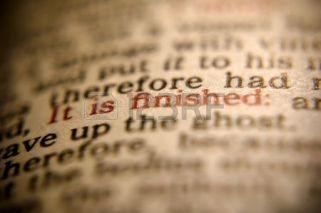
Friday: They put a sponge soaked in wine on a sprig of hyssop and put it up to his mouth. When Jesus had received the wine, he said, “It is finished;” and he bowed his head and handed over the spirit. Gospel of John 19:29-30

Oh, the thousands of pages that have been written to analyze these three words. Yes. It is finished. At the most simple level, His job is complete. We have been redeemed. Now, the question – as we force ourselves to contemplate his blood-soaked body, hanging helplessly upon the cross –  How are we going to respond to His gift?

Action: Attend The Stations of the Cross today, on this, the saddest and yet most beautiful day of the year. The Bible tells us that “greater love hath no man than this, that a man lay down his life for his friends” (John 15:13). Is there someone you would like to bring back to Christ? In addition to your Lenten fast, offer a particularly difficult sacrifice today for that person’s soul. Whether it be giving up coffee, complaining, or something else that reminds you of your sacrifice several times today, you will never regret offering such a loving gift. God hears your prayers and will not leave you alone. Elisabeth Leseur spent years offering prayers and sacrifices for the conversion of her atheist husband, even offering her life in the end. Her sacrifices were rewarded when her husband became a practicing Catholic, and then a Dominican priest.

Saturday: Jesus cried out in a loud voice,  “Father, into your hands I commend my spirit.” Gospel of Luke 23:46

At the end of your earthly life, we, too, will commend our spirits into God’s hands. It should be our greatest desire to do this with peace and joy, rather than fear and trepidation. Choosing daily to unite our wills to God’s, will bring great comfort, for we will never be unsure about what to expect when our time comes.

In handing your life over to God, you can be confident that upon your death, you will hear the words, “Well done, good and faithful servant; you have been faithful over a little, I will set you over much; enter into the joy of your Master” (Matthew 25:23). For you, Easter Sunday will be a reminder of the Hope that gives us the power to trust without fear.

Action: Spend an hour in adoration today. Contemplate His will. Know that in your sacrifice, you are uniting yourself to Him. Prepare yourself for the Resurrection that is to come, and think of the joy that will surpass all words when, upon leaving this earthly life, you find yourself in the arms of your Heavenly Father.

The root of all good works is the hope of the resurrection; for the expectation of the reward  [moves] the soul to good works. – Saint Cyril of Jerusalem


Note: If you like what you just read, please click the “follow” button to receive thought-provoking and action-oriented bi-weekly posts promoting the virtue of sacrifice. 

Lent – Where the Body Meets the Soul

Have you given anything up this Lent?

It seems everywhere I turn this year, I have found recommendations about “doing” things for Lent. I’ve seen flyers taped to church doors, I’ve received videos from Catholic chocolateapostolates, and I’ve heard discussions via Catholic radio. They don’t suggest that we not attempt a physical discipline; but while they encourage us to engage in spiritual reading, help the poor, perform the corporal and spiritual works for mercy or spend more time in prayer, they say virtually nothing about restraining our appetites in any way.

This “do something positive” trend seems to have increased in recent years. But while  the above suggestions are all laudable activities, we should remind ourselves that the saints would not have separated living out their faith in a positive way from disciplining themselves via abstinence, fasting and mortification. In fact, they considered the spiritual life to be deeply connected with the physical. They recognized that when we lack discipline in our physical lives, our spiritual lives suffer.

Here are just a few comments from the saints on physical discipline (or a lack thereof) and its relationship with the soul:

Do you not know that fasting can master concupiscence, lift up the soul, confirm it in the paths of virtue, and prepare a fine reward for the Christian? -Saint Hedwig of Silesia

Irrational feeding darkens the soul and makes it unfit for spiritual experiences. – St. Thomas Aquinas

As long as a single passion reigns in our hearts, though all the others should have been overcome, the soul will never enjoy peace. – St. Joseph Calasanctius

It is almost certain that excess in eating is the cause of almost all the diseases of the body, but its effects on the soul are even more disastrous. – St. Alphonsus Liguori

The more we indulge ourselves in soft living and pampered bodies, the more rebellious they will become against the spirit. – St. Rita of Cascia

Yes, of course we should engage in activities that help others or increase our spiritual knowledge and time with Christ. But we shouldn’t allow those things to excuse us from taming our passions and appetites.

Unfortunately, many times we allow our sacrifices to become ends in themselves. Perhaps this explains the “upswing” in recommendations for other Lenten activities. After all, things like prayer, spiritual reading, or even practicing works of mercy  directly impact our relationship with The Lord, whereas giving up cake could seem like a random and inconsequential activity. But the fact is that our faith is not either…or; it should be both…and.

We will not have a fruitful Lent just because we declare that we are “giving up _____.” Rather we should remember that those physical sacrifices are not ends in themselves. The end of all discipline must be love. We give up chocolate, – or whatever else – to remind ourselves that this world is fleeting. It is an expression of love that we lavish on Our Lord, passionately declaring that this television set, this candy bar, this ice cream, this cake, these cookies – any and all things which we enjoy in this life – are but nothing compared to Him.

This is the time of year when, as individuals united with the entire Church, we encourage ourselves to walk through the fires of discipline and denial for Our Beloved! This is our time in the desert. This is when, by God’s grace, we face the temptation of X, and we declare,

Man should not live by bread alone, but by every word that comes from the Father’s mouth. – Matthew 4:4.

It is when we look over all creation and remind ourselves,

You shall worship the Lord your God and him only shall you serve. – Matthew 4:10

There is great power in knowing that by Gods’ grace we can be in control. That our appetites do not rule us. Provided we always keep in mind the ultimate end of self-control:

The purpose of asceticism, self-denial and mortification is the growth in charity or love of God. Christian self-denial is not based on the idea that the world, or the flesh are intrinsically wicked, but on the conviction that God is intrinsically good. – Archbishop Fulton Sheen

We release the chains of this world so we can bind ourselves more closely to Christ. Doing so will help us to live our faith more fully. God’s grace helps us to feed the hungry, clothe the naked or visit the imprisoned. And that grace flows abundantly when one of His children demonstrates a commitment to God, the Father, in heaven over the material gods of the earth.

So – What have you given up this Lent? There’s still time…


Note: If you like what you just read, please click the “follow” button to receive thought-provoking and action-oriented bi-weekly posts promoting the virtue of sacrifice.