The Implacable Power of the WILL

Of all the lies being told by the world, perhaps the most dangerous are those that seek to convince us that will power is a myth. For upon our will depends our cooperation with the grace of the Good Lord in procuring our salvation.

Let’s talk about will power. What exactly is it, you might ask? Most of us know in our gut what it is. But for the purposes of this discussion, I looked up the definition:

cupid-overcoming-pan
According to Webster’s Dictionary, will power is the ability to control yourself : strong determination that allows you to do something difficult.

According to psychologists, will power consists of the following:

  • The ability to delay gratification, resisting short-term temptations in order to meet long-term goals.
  • The capacity to override an unwanted thought, feeling or impulse.
  • The ability to employ a “cool” cognitive system of behavior rather than a “hot” emotional system.
  • Conscious, effortful regulation of the self by the self.
  • A limited resource capable of being depleted.

Of late, our culture seems to reject the very notion of the will. Everywhere we turn, comments and references treat human beings as mere animals, with little but base instincts, as opposed to persons, each endowed with a will formed in the image and likeness of God.

Of all the lies being told by the world, perhaps the most dangerous are those that seek to convince us that will power is a myth. For upon the will depends our cooperation with the grace of our Good Lord in procuring our salvation.

But the lies persist nonetheless; just take a look at these excerpts from an article originally published in the The Roanoke Times, which refers to studies which denounce the very notion of will power:

Parents, teachers, coaches and ill-tempered sergeants had insisted that the disciplined exertion of willpower against the baser temptations of sloth, gluttony and other moral frailties was essential to building sufficient character to overcome most adversity. What adversity couldn’t be overcome should at least be borne with a modicum of quiet longsuffering, if not grace. Imagine my relief to read of the scientific evidence that willpower is really a myth, especially as it relates to such primal endeavors as dieting. A number of psychologists around the country consider the entire notion of willpower to be just another artifact of quaint but misguided folklore…

In other words, if you keep raiding the refrigerator every night for six extra scoops of megachocolate ice cream, you’re not a pathetic, undisciplined, weak-willed glutton. You’re merely cooperating with the brain-chemical imperative as nature intended. You can’t help it. The chemicals made you do it. 

The above is about as blatant as messages come. But there have been subtle messages going on for decades. And they are severely affecting private behavior as well as public policy. Case in point: How long have advocates been insisting that birth control be made readily available in the schools? Kids are going to do what kids are going to do; they don’t have any self-control – the least we can do is help them be prepared… (Arguably, students have lived up to expectations).

Then there are seemingly innocent memes like the following:

lose-weight-meme

Very cute; definitely funny; but is this the message that we should be sharing en mass on social media? And yet, countless are passed along day in and day out.

Examples abound. I’m sure you could add several to the few I’ve offered here. Regardless, the result of both subtle and not-so-subtle messages about the weakness of the will has been absolutely destructive. What one might call a self-fulfilling prophecy. Just think of a few statistics:

  • According to the Centers for Disease Control (CDC), more than a third of the adults in the U.S. suffer from obesity (36.5%). This number is up 10% since 2012 (26.2%).
  • Ashley Madison, a website that “caters to married people looking for an affair” boasts  a client list of 37,000,000. (Not a typo – that’s 37 million people that have registered with this web site!)
  • One in three Americans has absolutely no retirement savings (Time Magazine).
  • As of May 2016, consumer debt reached a whopping $3.6 trillion.

And in the world of religion,

  • According to Pew Research, across our nation, the number of people who pray and attend religious services consistently has dropped 3% across the board since 2007. And younger people observe religious practices significantly less than older populations.
  • On a more personal note, another Pew Research report shows that people are leaving the Catholic Church in droves – there are three million fewer Catholics today than in 2007 – could this have something to do with the notion that, unlike other Faiths, the will – particularly uniting our will to that of God – plays a key role in the in the teaching of the Catholic Church?

People point to this or that reason for declining participation in Christian churches, but isn’t there likely a huge correlation between the lack of interest in the area of religion and the decrease in control of our baser desires? And my point here is not that one has caused the other; but perhaps all areas have been driven by the deeper message that we’ve been hearing in the world – that we cannot control ourselves; whether eating, drinking, smoking, lust, language – you name it – we are destined to live with our own powerlessness, and must simply go along for the ride, despite that fact that both we and our progeny must find ways to cope with the devastation left in our wake.

What a tragedy.

God gave us free will out of respect and generosity, allowing us the opportunity to choose Him, rather than forcing our allegiance to a Supreme Being through His almighty power. That choice is not a momentary decision, but rather countless daily, even moment by moment decisions to grow in love and virtue; to participate in prayer and the sacraments, cooperating with the grace of God to become better versions of ourselves.

And those choices? Made every moment of our lives? They can only be made through continual acts of The Will.

It is often said that the devil’s greatest coup would be to convince the world that he doesn’t exist. That may be true. But his second greatest coup?

Could it be to convince you that you are helpless?

To make you believe that, in this moment, you cannot put down that doughnut. You will never lose that last ten pounds. You cannot limit your coffee intake to one cup a day. You cannot succeed long-term with an exercise routine. You cannot control that temper. You cannot resist that affair. You cannot afford to save for retirement. You cannot find the time to attend Mass today. You are too busy to pray the rosary. In fact, prayer in general is just too difficult. And the idea of making voluntary Sacrifices – are you kidding me?!

But these are all lies, lies, lies. The truth is that your will is in tact. In fact, according to Archbishop Fulton Sheen, it is the only thing you have that is truly yours:

There is only one thing in the world that is definitely and absolutely your own, and that is your will. Health, power, possessions and honor can all be snatched from you, but your will is irrevocably your own, even in hell. Hence, nothing really matters in life, except what you do with your will. — Archbishop Fulton Sheen, Seven Words of Jesus and Mary, p. 25

Despite what the media says, despite what the “professionals” in the world of psychology say, regardless of what your best friend tells you,

you can put down that doughnut. You can lose that last ten pounds. You can limit your consumption. You can find time to exercise today. You can control you temper. You can resist that affair. You can save for retirement. You can find time to pray. You can grow in virtue. You can become a saint!

In order to obtain heaven, two ingredients are required:

God’s grace.
Your will.

The world has done a great job of convincing us that neither exists.

But the world is wrong.

But my will is weak, you say. Yes. I’m sure it is. There is only One Perfect Will. And while we share in God’s image, our fallen nature, like a leaden weight, seems destined to keep us from soaring to great heights.  But your will is there. And God’s grace is the chisel that will cut away the lead; for through Him all things are possible (Matthew 19:26). And His power is made perfect in weakness (1 Corinthians 9).

By convincing us to disengage the will from our decisions, as opposed to actively directing the “self” toward the good, the devil has triumphantly succeeded in weakening it, if not destroying it altogether. (Ever heard the phrase, “use it or lose it“?) But just as not exercising the will causes it to become listless and weak, stepping up to the plate and engaging the will, even in small ways, will strengthen it. We can strengthen the will by actively pursuing good, and by developing habits and relationships that reinforce that pursuit and encourage us in our progress.

Freedom makes man responsible for his acts to the extent that they are voluntary. Progress in virtue, knowledge of the good, and ascesis enhance the  mastery of the will over its acts. (CCC #1734) (emphasis mine)

The will plays a pivotal role in both our physical and spiritual lives. Do not believe the lies. Not only does your health depend on your ability to see the lies for what they are; your salvation depends upon it as well. For how can you unite your will to God’s if you believe you have no power to do so? God is faithful. He has provided us with everything we need in order to pursue sanctity. And the gift of the will is a necessary component:

God does not require of us the martyrdom of the body; He requires only the martyrdom of the heart and the will. — St. John Vianney


Artwork: Cupid Overcoming Pan by David Teniers the Younger (1610-1690)

5 Things I Wish Someone Had Told Me About Raising Catholic Children

Like all parents, there are several things I wish someone had told me when I began parenting. I’m learning little by little; but perhaps some of my experiences might help those who are just getting started with little ones before they, too, look up and realize their time and influence may be fleeting.

Our oldest son is a senior year in high school this year. This is an exciting time for him. But as parents, we count the days we have left with him before he leaves for

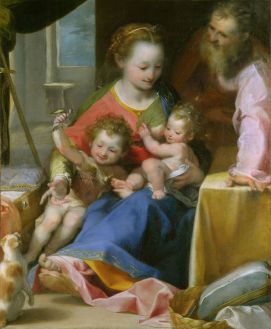
Holy Family - United Kingdomcollege. The next two kids won’t be far behind – in less than five years, half our children will have graduated from high school.


This time in our lives has been the impetus to much reminiscing on my part.

Like all parents, there are several things I wish someone had told me when I began parenting.  Particularly about how to raise kids who leave our home with a desire and will to follow Christ in their thoughts, words and deeds. I’m learning little by little; but perhaps some of my ups and downs might help those who are just getting started with little ones before they, too, look up and realize their time and influence may be fleeting.

The advice may be worth what you pay for it; but here are my top five tips to parents with little ones:

1. Don’t be so paranoid.

We kept our kids from things like Pokemon and from Harry Potter, etc. because I’d seen all the questionable articles. I wanted to play it safe. (I say “I” because my husband would have been a little more laid back about these things.) A few months ago, our family went out for ice cream, and the shop we were in was showing Harry Potter on TV (why there was a TV in an ice cream joint is a discussion for another time:)). My teens joked at the time about how I never let them read or watch anything when they were young; shortly thereafter, my 17-year-old read all the Harry Potter books. He said they were pretty good. Not worth all the hype, but enjoyable. I don’t remember what all the fuss was about years ago, but I’ve seen no repercussions thus far. And he’s already moved on to other things.

Shortly thereafter, Pokemon Go became all the rage. My boys were right in the middle of it all (I’ve lightened up in my “old” age). But their interest faded within a week and they’ve both moved on in this area as well.

When my kids were little, I drove myself crazy trying to make sure they weren’t involved in anything that might make them stray from the Faith or might lead to other dangers.  BUT… I knew other moms who let their kids do plenty of things that I restricted (within reason) and their kids grew out of them almost as soon as they tried them.  Now those kids are well-adjusted and seem to make good decisions where they count.

Not only have I noticed that a little bit of gentle “openness” on the part of moms doesn’t seem to have harmed their kids, I’ve also learned that a more anxious approach to the world can have damaging effects that I hadn’t anticipated.

Case in point, I think my oldest especially (17), but to a certain extent my second too (15), have sort of written me off as “paranoid” and not particularly the voice of reason about things related to the culture. They haven’t been disrespectful about it, but I’m definitely getting that vibe.

Not only am I not their “go-to” person regarding cultural issues, but I don’t know whether I’ve really prepared my older kids to confront the “big” issues they will face in the world.  Are they capable of discerning right from wrong on their own? Of saying “no” themselves when all their friends are saying “yes”? I hope they’re ready, but I am beginning to second-guess my original strategy.

While second-guessing myself does me no good, I have to say that I wish I had been relaxed about more things when my kids were younger. Even when I didn’t let them do things, I wish I would have been more “sneaky” about it – redirecting instead of saying “no.”   (Lest you think that “no” is the problem – I did substitute the things I wouldn’t let them do with positive things.  But they remember the “no”s.)

If we do our best to completely control their environment for them when they are young, when are we teaching our children to use their own judgement?  In my case, I taught my kids right from wrong, but when kids are young and mom controls the environment – with a penchant for the word “NO”-  is she helping them to check things out and discern for themselves when the stakes are low so that they can make good decisions when they are high?  But the stakes are high, you might say.  Yes, I always thought they were high, too. In my mind, they were high for everything from books to movies to shows to video games to friends to school to (insert issue here).

However, now they really are high. Driving, alcohol, drugs, sex, pornography, etc.  And while my kids have yet to fall in those areas (at least to my knowledge), if they do come across challenges, I don’t know that I’ll be the first one they turn to for advice, frankly because they may be worried about my reaction. Additionally, I sometimes wonder if by making everything a big deal, I’ve made nothing a big deal – in other words, is it possible that my dependability for insight has been watered down? Am I the mom who cried “wolf” one too many times?

Bottom line – if my eight-year-old brought home a Pokemon card (or some other questionable toy or game) from a neighbor today, I would treat it no differently than any other toy  (granted, there are exceptions to this rule; e.g. Ouija Board.)  And I’m sure it would disappear within a day or two.  If it didn’t, I would probably use the same technique they recommend for toddlers – get rid of the card when he wasn’t looking and then redirect his attention to something fun and good, without using the word “no”.

2. Help more; require less.

Let me preface this commentary by saying that my parents are both retired military, with over 20 years of service each.  That should give you some understanding of my own upbringing.  Needless to say, when my older kids were little, I had chore charts, responsibilities and expectations. I wanted to raise independent children who could do for themselves.  When I dropped them off with a babysitter, they waved goodbye and ran to play. (I was put off by those little kids in play groups who wouldn’t let go of their mothers’ legs.  I thought MY kids would never do that.)  The first three could all read at age three – no lie.  They were capable and very independent. When they asked for help, if I had taught them the task in the past and I knew they could do it, I would explain that they needed to do it themselves.

Perhaps you can already see the problem with that angle.

While I may have taught my older kids a great sense of independence and a strong work ethic, did I model a sense of compassion or a helpful spirit?  Thankfully, some of my kids are naturally helpful.  But in some cases they do not bend over backwards to help siblings, and frankly, with my expectation that they do for themselves, I may have failed to teach by example in that area.  They all help if I ask.  And they’ll do any chores required of them.  But ideally, they would all help when not asked. They would look for places to serve (whether at home or in the world). And they would be joyfully willing to help when asked by a sibling  (I’m treading on thin ice here, because there are times when they all serve and some of them always serve).  But I have a feeling I could have better cultivated a sense of service and cooperation, and am trying to make up for it now. By the way – on a selfish note –  all those kids I knew who were so attached and needy of their mothers when they were young? They are still attached, if not needy. That concept is awfully attractive to a mother with a senior who can’t wait to become an independent entity. He is capable of taking care of himself and more than excited about demonstrating his ability. We are definitely proud of his accomplishments. But right now, I’d give anything for a little attachment🙂.

3. Make family time FUN.

When my kids were younger, we celebrated what we called “Family Fun Night” every Friday.  I planned various activities, whether a craft, bike ride, board game, or what our family calls “Tickle Monster.” Those nights are some of the best memories our family share together.  But as the family grew and the age gap from top to bottom widened, I took my foot off the gas. Partly because I was busy and tired. The last thing I wanted to do every Friday was plan family entertainment on top of an over-scheduled week. Family Fun Night morphed into movie night – easy and low stress – which in the grand scheme of things, has not produced many memories. Movies run together in our minds and there is little family interaction when everyone hangs out with their eyes glued to the television.

My advice? Keep the FUN in Family Fun Night. You’ll never regret it. If necessary, let something else go. If you don’t, you’ll have teens who find friends more important than movies and going out more important than staying in. Movies don’t strengthen relationships. Laying out blankets in the grass and counting the stars – does. Serving finger food in various shapes for dinner and having everyone make pictures with their food – does. Hanging out around a campfire and roasting marshmallows – does. And even if you argue that those things still won’t entice the teens – they may and they may not. It depends on the teen. But even if they don’t, the older kids will be able to reminisce on great memories when they walk in on the fun, and they may just surprise you and join in.

And what does family fun time have to do with Faith? As a Domestic Church, the family is a child’s first and most important contact with God and with Godliness. Is there anything more attractive and inspiring than joy?

4. Place God at the center in action – not just word. He is a Person, not a belief system.

I remember listening to an atheist professor in college. He told us some crazy things. Among them, he said that Christianity was created to suppress the poor, and that the rich pooled the New Testament to encourage sacrifice as a “virtue” among the downtrodden.

Having very little foundation in Christianity, what that professor said seemed reasonable to me. I hadn’t been to church much growing up. So I was tempted to take him at his word. After all, he had the PhD.  But I thank God nearly every day for the two students in our class who questioned his theories. They were certain and confident that what he was saying was wrong. They weren’t argumentative. They weren’t disrespectful. But they asked questions that pointed out the irrational nature of his conclusions. I was amazed. I remember thinking as I sat there, “I wish I had their faith. Even if believing in God is only a crutch, I want that crutch.”

Years later when I converted to Catholicism, I was determined that my children would not only know what to believe, but they would know why they believed, like those college students years before. Whatever happened, I did not want them to doubt. I wanted them to KNOW, as I finally know, that Christ is The Way. So I talked to them early and often. I read to them. I catechized them.

But now that our influence over our older kids wanes and our days together dwindle, I often wonder – have I shown them?

Have I been joyful?

Have I been at peace?

Have I been generous?

Have I loved?

I taught my kids plenty of prayers; and I taught them frequent participation in the sacraments; but did I teach them to know Jesus as their best friend? Have I demonstrated that He is mine?

My oldest knows all the right words to say. He knows what we believe and why we believe it. (And that’s one thing I wouldn’t change – so if you are leaving the catechesis of your children to Mass attendance or to their religious education class, then I’d add an additional tip — make sure your children know their Faith. You are their first educator; their faith is too important to leave to chance.) But when my son gets out in the world and is tempted to turn away, the choice to remain faithful will be easier to make if he feels that he is being faithful to a Person, a Friend.  Have I properly introduced him to that Friend; and have I helped to cultivate a lifelong friendship? Or have I been so focused on the What and the Why, that I neglected the Who?

DO teach your kids to KNOW. But make sure you imbue them with a knowledge of the heart, not merely a knowledge of the head.

5. Remember that No family is perfect but YOU are Perfect for Your family.

I know this is an obvious point in theory; but often our emotions don’t follow the obvious. I spent years thinking that everyone else knew more than I did about how to be a good parent. There are times I’ve actually asked God, “Why did you give Child X to me instead of to that person over there?” Not because I was frustrated with my child, but because I felt the virtue I saw in another person would lead my child to holiness a lot faster than my vices would.  But the truth is that we all see the challenges and the sin in our own home and wonder what we are doing wrong.

The older I get, the more I realize that we are all learning how to be parents. Your weakness may be another parent’s strength. But other parents are watching your family and wishing for the strengths they see in you. We are all fallen creatures. There is no perfect family. (For more thoughts on that subject, read here.) God has a plan for your family. There is no home in the world that will contribute to the sanctity of your children like yours. God wants them in heaven; but He has entrusted their souls to you. That is no mistake. Our Lord has great faith in your ability to seek His grace daily and to turn to Him when you fall. Thank goodness for that, because there is nothing like parenthood to bring you to your knees.

Parents’ Prayer for Their Children

O God the Father of mankind, who hast given unto me these my children, and committed them to my charge to bring them up for Thee, and to prepare them for eternal life: help me with Thy heavenly grace, that I may be able to fulfil this most sacred duty and stewardship. Teach me both what to give and what to withhold; when to reprove and when to forbear; make me to be gentle, yet firm; considerate and watchful; and deliver me equally from the weakness of indulgence, and the excess of severity; and grant that, both by word and example, I may be careful to lead them in the ways of wisdom and true piety, so that at last I may, with them, be admitted to the unspeakable joys of our true home in heaven, in the company of the blessed Angels and Saints. Amen.

O Heavenly Father, I commend my children to Thy care. Be Thou their God and Father; and mercifully supply whatever is lacking in me through frailty or negligence. Strengthen them to overcome the corruptions of the world, whether from within or without; and deliver them from the secret snares of the enemy. Pour Thy grace into their hearts, and strengthen and multiply in them the gifts of Thy Holy Spirit, that they may daily grow in grace and in knowledge of our Lord Jesus Christ; and so, faithfully serving Thee here, may come to rejoice in Thy presence hereafter. Amen.

(Prayer borrowed from Catholic Online)

Joy – That Elusive but Necessary Virtue

Clearly those who knew Chiara witnessed something very special. People are starving to experience the joy of Christ. Imagine what the world would be like if all Christians were brimming with it.

For Easter, I received the long-awaited biography, Chiara Corbella Petrillo: Witness to Joy. I say long-awaited, and yet Chiara died just less than four years ago. But her story has spread like wildfire. In fact, I first heard about her two years ago at a retreat withchiara corbella the Apostles of the Interior Life in Kansas City. The talk was an unbelievably inspirational meditation on Joy. 

Only two years after her death, her story had traveled over 5,000 miles. Amazing. Since then it has no doubt traveled the world.

At first glance, Chiara’s story is quite tragic. By the young age of 28, she had given birth twice to two beautiful children, only to lose each of them within 24 hours. Shortly thereafter, she and her husband were blessed with another baby, only to learn early in her pregnancy that she had cancer. Immediately after they gave birth to a healthy baby boy, Chiara had to undergo major surgery to remove the tumor. But their story didn’t stop there. Shortly after her surgery, Chiara and her husband, Enrico learned that her condition was terminal, and at the time of this photograph, her body was completely ravaged with cancer, even taking the sight from her right eye. She passed from this world shortly thereafter.

Now do you see what’s so compelling about this woman? With all that she had lost, and with all that she stood to lose, her joy was – is –  captivating.

Chiara was a living image of the Word of God:

In this you rejoice, though now for a little while you may have to suffer various trials, so that the genuineness of your faith, more precious than gold which though perishable is tested by fire, may redound to praise and glory and honor at the revelation of Jesus Christ. Without having seen him you love him; though you do not now see him you believe in him and rejoice with unutterable and exalted joy (1 Peter 1:6-8).

This is the kind of joy we are called to live as Christians!

So if we are supposed to have this kind of joy, why is Chiara so inspirational?

Could it be because many of us can’t seem to bring ourselves to be joyful in the face of the menial inconveniences of daily life – late alarm, cold coffee, cold weather, hot weather, busy children, too little sleep – let alone summon a smile when tragedy strikes?

What is it about those for whom it seems second nature to look at the glass half full? How do they do it? How do they live out their Faith with such grace?! Do they just FEEL so full of joy that they can’t seem to contain the smiles, the laughter, the overall good nature?

For some of us, this is hard to imagine.

Were they born that way?!

Most of us think there may be a bit of truth to that one. Case in point – My 15-year-old son. Rarely is he seen without a smile on his face (He’s also rarely seen sitting still, but that’s another subject altogether.). There is nothing he enjoys more than making someone smile – he actually told me once that it makes his day. Last Saturday, he laughed when he shared that another employee where he works walked over to where he was busy running the cash register and told him, “I’m just going to stand here and see if some of your positivity will rub off on me.”

I have to admit, I’m a little jealous. I spend a decent amount of time examining traits I admire in others, and thinking, “It is not fair that ‘So and So’ is naturally  ________, while I have to work so hard at it!” Forget about the unfair distribution of wealth – what about the unfair distribution of virtue?!

While such natural traits seem ridiculously unfair, don’t think the rest of us are off the hook. It may be a common excuse on earth, but I don’t think “I was born that way” is going to play well when we stand before Justice Himself, trying to explain our brooding natures.

So what about us? What about the great majority of people who were not born with joy shooting through our veins? Maybe we tend to be caught up in our problems and can’t seem to get out of ourselves long enough to make any real attempts at sustained joy. Is there no hope for us?

Well, I’m sure those of us who have to work a little harder can learn from those who seem to have an easy time of things.

My son, for example, has been blessed with a few characteristics that I am willing to bet are common to all joyful people. First, he is grateful. He doesn’t seem to take things for granted, but rather makes a point to enjoy every conversation, every song, every joke, every job – every moment. Second, he tends to let things run off his back and is quick to forgive. Third, he cares about others. Fourth, he gives his all. He spends very little if any time wondering whether he “fits in.” Rather, he dives in head first and goes for broke. He’s not about getting noticed – whether in school, sports, church, or anything else. Sure – he appreciates accolades. But really, he’s about living. And when he is busy living, he gets noticed because people are naturally drawn to his personality.

These are things we can all work on – gratitude, forgiveness, caring, perseverance. By growing in these areas, perhaps we will find some of that joy that seems so elusive to many of us.

And that’s something else to think about. When we notice those people who are brimming with joy, how do we know that they were born with it? It’s easy for me to think they were – makes for a good excuse on my part. But could it be that they wake up every day with a desire and determination to exhibit the virtue of joy, whether they feel it or not?

Maybe joy is like love – not so much an emotion that we exhibit only when we feel like it, but a verb – something we do because we will it, even when we don’t feel it on the inside.

Take the example given by Servant of God, Elisabeth Leseur in her Secret Diary. In memoriam, her husband says of her,

She was thoroughly gay and took care to be so always; she even considered gaiety a virtue. In her final years, she remembered gladly that St. Teresa of Avila…recommended her sisters to be always gay. Her lovely laughter rang out at every opportunity, with its fresh, frank sound.

More than anything, we must remember that God is the source of all virtue, joy included, whether it is imbued upon birth, or developed over time. For Elisabeth, joy was clearly a discipline that she sought to develop through God’s grace in her daily life. Perhaps we should borrow both her resolution and prayer to emulate in our own lives:

One resolution that I have taken and begun to put into practice, notwithstanding physical and moral weakness, is to be “joyful” in the Christian sense of the word, as joyful as I can be toward life, toward others, and even toward myself. My God, help me, and “Thy Kingdom Come!”

But why all this talk about joy? Is it really necessary that we are a joy-filled people? Well, just look again at Chiara. Isn’t it our goal as Christians to spread the light of Christ? Through Chiara’s life and beautiful death have come such amazing grace. In her biography, the priest who spoke at her funeral writes,

The desire to know Chiara was immediately very strong, and at her funeral, when I said at the end of my homily, “If you wish to know more about Chiara, come ask us,” people responded by the thousands.

Clearly those who knew Chiara witnessed something very special. People are starving to experience the joy of Christ. Imagine what the world would be like if all Christians were brimming with it. If only we could harness that elusive virtue, we could truly serve as His witnesses, for we would

…show triumphantly that all the human lights collectively cannot obscure the pure light of God, but gain, on the contrary, additional radiance from it. – Elisabeth Leseur, “Work to Bring Christ to Others”