

by Fr. Jeff Loseke
Next Sunday, the Church celebrates Corpus Christi, the Solemnity of the Body and Blood of the Lord. It is a feast that rejoices in the mystery of the Holy Eucharist: Christ’s  substantial, real, and abiding presence in His Church. We acknowledge and worship this sacramental mystery whereby ordinary bread and wine become the Body and Blood of Christ. Neither is the Eucharist just a symbol of Christ’s Body and Blood nor does it reveal Christ to us only spiritually. We know that Christ is really and truly present—body, blood, soul, and divinity—in the Eucharist. This truth is so central and so important to our faith that the great Catholic American author Flannery O’Connor (d. 1964) once said in defense of the Eucharist: “Well, if it’s a symbol, to hell with it. It is the center of existence for me; all the rest of life is expendable.”
We cannot help but echo O’Connor’s bold words today: To hell with the idea that the Eucharist is mere symbol without substance! To hell with this idea because it is the lie of the Evil One! To hell with it because it is a lie that has infected so much of Western Christianity since the Protestant Reformation! To hell with it because it is a lie that has robbed so many of our Christian brothers and sisters of such a great gift from God—a necessary help to our salvation! As Sacred Scripture reminds us: “Jesus said to them, ‘Amen, amen, I say to you, unless you eat the flesh of the Son of Man and drink his blood, you do not have life within you. Whoever eats my flesh and drinks my blood has eternal life, and I will raise him on the last day’” (John 6:53-54). To undermine belief in the Holy Eucharist is nothing other than Satan’s attack against the very heart of the Church… the Sacred Heart of Jesus Christ Himself. The lance that was thrust into Christ’s side on the Cross continues to be hurled at the Savior every time His Real Presence is denied in the Eucharist.The Church dedicates the month of June to the Body of Christ and to His Most Sacred Heart. In the Eucharist, we find the burning love of Christ made present for us upon our altar and abiding in silence in the tabernacle. This month affords us the opportunity to examine how each of us can give better witness to the Lord’s Real Presence in the Eucharist and how we can enthrone Him in our own hearts and our homes. Faith is always made visible in our works (cf. James 2:14-26). Therefore, we do well to examine our outward signs of piety and reverence whenever we enter the church and then again to examine our outward signs of charity and mercy as we leave the church to go back to our homes and out into the world. The Eucharist must be seen as the center of our existence, especially in today’s age of disbelief.
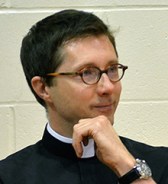
The Reverend Jeffery S. Loseke is a Priest of the Archdiocese of Omaha and is currently the pastor of St. Charl es Borromeo Parish in Gretna, Nebraska. Ordained in 2000, Fr. Loseke holds a Licentiate in Sacred Theology (S.T.L.) from the Pontifical Athenaeum of St. Anselm in Rome and is working to complete his doctoral degree (Ed.D.) in interdisciplinary leadership through Creighton University in Omaha. In addition to parish ministry, Fr. Loseke has served as a chaplain in the U.S. Air Force, taught high school theology and college-level philosophy, and has been a presenter for various missions, retreats, and diocesan formation days across the country.
Art: Allegory of the Eucharist by Artist Unknown, Ca. 1676-1725 (Wikimedia Commons)


 ourselves outside a whole lot more. We are enjoying picnics, reunions, vacations, games, gardening, and a whole host of summertime activities. Not only might we find ourselves enjoying God’s marvelous creation more, but also we add to it by expressing our own gifts and talents within it.

 in our own identity as Christians, who, like Paul, never met Jesus in the flesh. There can be no doubt that Christianity would look very differently today—if it existed at all!—without the efforts of St. Paul and his companion missionaries. For this reason, the Church has always regarded St. Paul as a model for evangelization and as one of the principal architects of the Church. Saint Paul’s missionary strategy (i.e., establishing a communal identity among new believers) is precisely what the Catholic Church has always understood as “Sacred Tradition.” Saint Paul and the other Apostles modeled their style of leadership after that of Jesus Christ and passed it on in a living Tradition. Jesus gathered His closest followers around Himself and, for a period of about three years, established a way of life that would give them their identity as His Apostles. He did not hand them a book of instructions; rather, He enjoined upon them a way of life, a communal identity, a Sacred Tradition. They in turn passed it on to the next generation.
 es Borromeo Parish in Gretna, Nebraska. Ordained in 2000, Fr. Loseke holds a Licentiate in Sacred Theology (S.T.L.) from the Pontifical Athenaeum of St. Anselm in Rome and is working to complete his doctoral degree (Ed.D.) in interdisciplinary leadership through Creighton University in Omaha. In addition to parish ministry, Fr. Loseke has served as a chaplain in the U.S. Air Force, taught high school theology and college-level philosophy, and has been a presenter for various missions, retreats, and diocesan formation days across the country.
 pelicansbreast.com