Eucharistic Adoration: The Development of a Devotion

The custom of honouring the Eucharistic presence of Christ our Lord by paying “Visits” to the Blessed Sacrament may be quoted as one of the most conspicuous examples of development in the devotional practice of the Catholic Church. 

If you are looking for thought-provoking meditations for Eucharistic Adoration this Lent, look no further! Beginning with this lovely preface today (Ash Wednesday), from hereafter each Thursday throughout Lent we will post a chapter from Coram Sanctissimo, a simple yet profound work by Mother Mary Loyola, first published in 1902. If you’ve ever wondered over the practice of Eucharistic Adoration, be sure to read on!


coram sanctissimo

In this Preface to Coram Sanctissimo by Mother Mary Loyola,
Herbert Thurston, S.J., introduces this beautiful book of meditations for Eucharistic Adoration by first discussing the development of the devotion.

Coram Sanctissimo

Preface

The custom of honouring the Eucharistic presence of Christ our Lord by paying “Visits” to the Blessed Sacrament may be quoted as one of the most conspicuous examples of development in the devotional practice of the Catholic Church.  Down to the latter part of the Middle Ages such an usage seems to have been entirely unknown.  As far as regards England, the late Father Bridgett, if I mistake not, says that in all the researches made by him while compiling his History of the Holy Eucharist in Great Britain he had not come across one clear example of a visit to the Blessed Sacrament in pre-Reformation times.  Even on the Continent the idea of any extra-liturgical cultus of the Blessed Eucharist seems to have grown up very tardily. There were many saints as late as the fifteenth century—say, for example, St. Frances of Rome, whose lives show no trace of such a conception, though nothing could be more strongly emphasised than their devotion to the Blessed Sacrament in Holy Communion.  It is remarkable to notice that even St. Ignatius Loyola, in the book of the Spiritual Exercises, when directing attention to the abiding presence of God with His creatures as a motive for awakening love, says not a word of the Blessed Sacrament.  One must not, of course, press the negative argument too far.  No prudent man would infer in this latter case that the practice of visiting churches to commune with our Lord in the Tabernacle was unknown in the sixteenth century, but it is reasonable to conclude that the uninterrupted Eucharistic presence of God with His people did not then play the same conspicuous part in the devotional life of the faithful that it does in our day.

This late and gradual development of a devotion, which seems to us now so natural and so unmistakably involved in premises that all men accepted, is certainly a remarkable fact. Even to the present day the Greek Church, though its belief in transubstantiation is no less explicit than our own, has never drawn the inference that our Lord has come in the Blessed Sacrament to be our companion and refuge as well as our food.  It seems to have been part of the Divine dispensation, in this as in some other matters, to hold men’s eyes that they should not know Him.  Throughout the long centuries our forefathers seem to have regarded the Eucharistic presence as if Christ had wished to preserve His incognito while He dwelt amongst them, or as if He were sleeping as of old in the bark of Peter and would rebuke the want of faith of those who too importunately disturbed His repose.  But surely we are right in thinking that if they so apprehended God’s purpose in remaining on our altars, their appreciation of His boon was but inchoative and imperfect.  To us now it seems so obvious that the work of Jesus Christ in the Blessed Sacrament was not meant to be intermittent, limited to the time of Mass and Holy Communion, that it is hard to believe that Christians who truly recognised this presence in their midst can ever have conceived otherwise.  Perhaps we may draw the lesson that if the fulness of understanding were long delayed in so plain a matter, it is not surprising that in other dogmas and practices which justify themselves less obviously, there may be developments in the Church’s teaching not suspected or at least not clearly apprehended by our forefathers in the faith.

As things are, no devout Catholic would wish to be deprived of the privilege of drawing near to our Saviour in the Tabernacle and making Him the daily confidant of hopes and fears, of joys and troubles.  But what distresses many pious souls is that having Him ready and willing to listen they should so often find themselves tongue-tied in His presence.  The set forms of prayer which they know by heart are worn threadbare by routine, and books too often prove stiff and artificial.  The heart has many wants and longings, but hardly knows how to put them into words.  In such a case real help, I think, is likely to be found in this very miscellaneous collection of musings, self-arraignments, out-pourings of spirit, to which the authoress has given the apt name of Coram Sanctissimo, “in the presence of the Most Holy.” They are not intended to be taken in rotation, or to be used every day, but there are times when a troubled worshipper, turning over the leaves, may light upon something here which will chime in with his mood and will make the task of prayer more easy to him.  And if for one or another the thoughts of this little book may serve to break the ice and to render the soul for the nonce more at home in that holy presence, I feel sure that the authoress will consider the labour spent in writing it to have been abundantly repaid.

It will be noticed that in the pages which follow verse finds a place as well as prose. It would not be fair to let this go forth to the world without stating that it has been written, so to speak, under protest, and that without strong encouragement Mother Mary Loyola would hardly have suffered it to see the light.  Although the verses are perhaps unequal, I do not in any way repent the share I have had in urging the writer to let them stand.  It would have been worth a greater risk of failure and a longer expenditure of time to have secured even a few such happy lines as may be read for instance in the chapter headed “In Silence and in Hope,” describing St. Mary Magdalen:—

She came with her crushing memories,
She came with her secret fears,
She brought Him her hidden misery
And her bitter, burning tears.

Or again:—

Absorbed in her loving ministries
She knelt at His feet apart,
The scandal of every eye save one
That soundeth the secret heart.  

The verses at best are only an experiment.  They were written in each case for the sake of the thought, not of the metrical form, and if the authoress could have found, as she long endeavoured to do, any suitable religious poetry which expressed kindred ideas, and which would have afforded that variety which is meant to be characteristic of this little booklet, she would have been glad, I know, to escape the seeming presumption of appearing as a writer of verse.  But I do not think that the many friends who use and appreciate Mother Loyola’s Confession and Communion and her other devotional books will be disappointed in anything which may meet their eye in this new effort of her pen.

Herbert Thurston, S.J.
11th September, 1900


image001

Thank you so much to St. Augustine Academy Press for cooperating with this endeavor! If you are interested in this or other works by Mother Mary Loyola (as well as many other great books for spiritual growth and meditation), please check out their website.You will find many wonderful treasures from which to choose!

Before the Most Holy – A Lenten Meditation Series

As you make preparations for Lent, perhaps you plan to carve out some time for Eucharistic Adoration. If so, we invite you to join us in reading a wonderful book by Mother Mary Loyola. 

As you make preparations for Lent, perhaps you plan to carve out some time for Eucharistic Adoration. If so,  we invite you to join us in reading a wonderful book by Mother Mary Loyola.

If you’ve followed my posts at all, whether here or at spiritualdirection.com, you know that Mother Mary Loyola is one of my favorite spiritual writers. Beginning with The King of the Golden City (a children’s book) many years ago, I have eagerly sought her work. Imagine how thrilled I was to learncoram sanctissimo
that St. Augustine Academy Press has beautifully reprinted all her books, that pilgrims in the 21st Century might be as blessed as those in her own generation.

Beginning on Ash Wednesday, Pelican’s Breast is so excited to share excerpts from Mother Mary Loyola’s book, Coram Sanctissimo (Before the Most Holy). With 40 chapters, intended as reflection for 40 hours of prayer before the Blessed Sacrament, this book beautifully lends itself to Lenten contemplation. As we humble ourselves before the Almighty, offering from the depths of our hearts acts of repentance, prayer and fasting, we can be inspired by the words of Mother Mary Loyola, whose sole desire is to draw us ever closer to Him.

On Ash Wednesday I will post the Preface, and then every Thursday throughout Lent,  – and perhaps thereafter – I will post one chapter from Coram Sanctissimo. I pray it will give you much fodder for thought as you approach Our Lord in the Blessed Sacrament. No doubt time spent with the insightful words of Mother Mary Loyola will help you to grow in humility and love, two great virtues necessary for true sacrifice.


image001

Thank you so much to St. Augustine Academy Press for cooperating with this endeavor! If you are interested in this or other works by Mother Mary Loyola (as well as many other great books for spiritual growth and meditation), please check out their website.You will find many wonderful treasures from which to choose!

Are We Sacrificing our Children’s Future to the Evils of the Past?

Rather than warn about the dangers of communism, the objective of these authors seems to be to show even brutal communist leader, Joseph Stalin, in a favorable light.

One of my children transferred into a public school for the first time this year, as a junior in high school. I’d heard rumors. I watch the news. I was somewhat prepared for the 120px-Hammer_and_sicklechallenges. And, of course, there were reasons that I chose homeschooling for his primary years. That said, I’ve been astonished at the overt jabs made in his textbooks – particularly history – toward all that I hold dear.

Here just two examples that demonstrate an antithetical understanding of faith in God, completely separating faith from rational thought:

Franklin never denied the existence of God. Rather, he pushed the Lord aside, making room for the free exercise of human reason. (p. 91, referring to Benjamin Franklin)

You may see this as flowery prose. But I’ve read Franklin’s autobiography. Anyone who has studied Benjamin Franklin at all knows that he never “pushed the Lord aside.” To even imply that he did is disingenuous, if not malicious. On the very first page of his autobiography, Franklin refers to the “blessings of God. And on the second page, he states,

And now I speak of thanking God, I desire with all Humility to acknowledge, that I owe the mention’d Happiness of my past Life to his kind Providence, which led me to the Means I us’d & gave them Success. My belief of this, induces me to hope, tho’ I must not presume, that the same Goodness will still be exercis’d towards me in continuing that Happiness…

Does that sound like a man who would ever push the Lord aside? Read the book – there are plenty of passages that would directly dispute the textbook quote above.

Here is another example that again sets up a “rational vs. religious” disparity. This quote was taken from a packet the kids were given to study for the same class:

Despite the inroads of rationalism, nineteenth-century Americans remained a profoundly religious people – as they have been ever since.

Here is a quote that takes on religious conservatives. I found this among many in a completely degrading and dismissive article highlighted as a sidebar on p.301:

…the more recent evangelical engagement with politics that was labeled the New Christian Right sprung up in the 1980’s — epitomized by organizations such as the Moral Majority — mostly has been a conservative force of reaction against great changes in American society. The fundamentalist Moral Majority crystallized around the politcal issues of opposition to abortion and gay rights, as well as promotion of school prayer and vouchers for private schools. [emphases mine]

Not only did they demonstrate opposition to religious values, as seen above, but further on in the sidebar, they slammed religious motives by implying that Christians are bigots:

Unlike earlier evangelical reformers, they are motivated less by millennial perfectionism than by alarm at the growing diversity and secularization of American society, and they have joined with other religious conservatives in their political campaigns.

But along with a great challenge the writers have in seeing religious people as rational individuals with laudable motives, the book also appears to show unbelievable sympathy toward anti-religious political philosophies – particularly Communism – a belief system that Our Lady sought to halt by asking that Russia be consecrated to her Immaculate Heart. Catholics have long sought to educate the public on the dangers inherent within communist ideology. Saint John Paul II , through the Hand of Divine Providence, played a key role in the ultimate demise of the Russian communist empire (USSR).

Even in secular circles, most adults who grew up during the cold war have some understanding of the dangers of Communism, which was responsible for the deaths of 100 million people in the 20th Century.

In an introduction to the Cold War, these authors seems to show communist leader, Joseph Stalin, in a favorable light, while they cast a shadow over President Truman (emphases below are mine):

“I am getting ready to go see Stalin and Churchill,” President Truman wrote to his mother in July 1945, “and it is a chore.” On board the cruiser Augusta, the new president continued to complain about the upcoming Potsdam Conference in his diary. “How I hate this trip!” he confided. “But I have to make it win, lose or draw, and we must win. I am giving nothing away except to save starving people, and even then I hope we can only help them to help themselves.”

Halfway around the world, Joseph Stalin left Moscow a day late because of a slight heart attack. The Russian leader hated to fly, so he traveled by rail. Moreover, he ordered the heavily guarded train to detour around Poland for fear of an ambush, further delaying his arrival. When he made his entrance into Potsdam, a suburb of Berlin miraculously spared the total destruction that his forces had created in the German capital, he was ready to claim the spoils of war.

These two men, one the veteran revolutionary who had been in power for two decades, the other an untested leader in office for barely three months, symbolized the enormous differences that now separated the wartime allies. Stalin was above all a realist. Brutal in securing total control at home, he was more flexible in his foreign policy, bent on exploiting Russia’s victory in World War II rather than aiming at world domination. Cunning and caution were the hallmarks of his diplomatic style. Small in stature, ungainly in build, he radiated a catlike quality as he waited behind his unassuming facade, ready to dazzle an opponent with hisbrilliant, terrifying tactical mastery.Truman, in contrast, personified traditional Wilsonian idealism. Lacking Roosevelt’s guile, the new president placed his faith in international cooperation. Like many Americans, he believed implicitly in his country’s innate goodness. Self-assured to the point of cockiness, he came to Potsdam clothed in the armor of self-righteousness. – p. 700 [emphases mine]

Please remember, Stalin is a man responsible for the deaths of over 20 million of his own people. But I didn’t find a word about his murder rate. Nothing. Zip. Nada. Granted, this is an American history book. But some back story may have been helpful as the writers describe our conflict with communists. Instead, the book explains that the Cold War was the result of land disputes in Europe after WWII, and American “distrust” of Russian motives. At the first mention of communism, here is the wording:

“After emerging victorious from World War II, the United States and the Soviet Union found themselves locked in a bitter rivalry that threatened to trigger nuclear destruction of the entire planet. At stake in this contest were not only national ambitions but also incompatible ideologies – capitalism and communism – that amplified popular suspicion and animosity. Americans feared that as agents of world communism, the leaders of the Soviet Union planned the destruction of the free market as well as individual liberty. Indeed, Americans became convinced, especially during the McCarthy “Red Scare” era of the early 1950’s, that the Soviet Union had organized an insidious conspiracy that reached into the State Department and Pentagon and compromised the interests of the United States. Playing on the fear of ordinary citizens, Senator Joseph McCarthy accused famous writers, filmmakers, and musicians of being Soviet spies and Communists intent on helping the enemy. Wars waged in far-off countries such as Vietnam aimed to halt the spread of communism, and a growing anxiety over imagined Soviet aggression served to heighten among the American people a sense of the United States having a special mission as defender of democracy and capitalism.” – 100 [emphases mine]

Communism isn’t the only philosophy looked kindly upon in this textbook. Socialism is painted not merely with sympathy, but positively. Just about everywhere I read the word socialism, it was juxtaposed with the “injustices” of capitalism. Beneath the photo of a campaign poster for “Eugene V. Debs” on the Socialist ticket, the caption reads:

Presidential campaign poster for Eugene V. Debs on the Socialist party of America ticket in 1904. The poster’s imagery appeals to industrial workers, miners, and farmers, and its slogan, “Workers of the world unite,” was a key call to action of the party to challenge the injustices of capitalism. – p. 573

When describing Debs, the book says that his party was never effectively organized to create change, but,

…he was eloquent, passionate, and visionary. An excellent speaker, he captivated audiences, attacking the injustices of capitalism and urging a workers’ republic. – p. 573

Later,

By 1911, there were socialist mayors in thirty-two cities, including Berkley, California, Butte, Montana; and Flint, Michigan….although torn by factions, the Socialist party doubled in membership between 1904 and 1908, then tripled in the four years after that. Running for president, Debs garnered 100,000 votes in 1900; 400,000 in 1904; and 900,000 in 1912, the party’s peak year. – p. 573

According to Vladimir Lenin, who led the Bolsheviks in the Communist Revolution of 1917, “The Goal of Socialism is Communism“. The tone of this book should be extremely concerning to all freedom-loving Americans. The most damning comment I found about socialism was that it didn’t gain much popularity. Otherwise, tenants seemed to be couched in rather idealistic terms.

But capitalism?

While some historians have argued that paternalism was part of a social system that was organized like a family hierarchy rather than a brutal, profit-making arrangement, there was no inconsistency between planter’s paternalism and capitalism. – p 269

Industrial capitalism — the world of factories and foremen and grimy machines — tested the immigrants and placed an enormous strain on their families. – p. 471

Many businesses used injunctions and “yellow-dog contracts” — which forbade employees to join unions – to establish open shops and deny workers the benefits of collective bargaining. Other employers wooed their workers away from unions using techniques of welfare capitalism – spending money to improve plant conditions and winning employee loyalty with pensions, paid vacations, and company cafeterias…. – p. 626

As I skimmed through this text, the distinct message was that religion and capitalism are bad. Communism and Socialism, on the other hand, seem to be held as superior alternatives to those values inherent in the fabric of our Republic.

According to Paul Kengor in his recently released book, The Politically Incorrect Guide to Communism,

We won the Cold War in the political arena, but lost it in the classroom. If and when communism is taught at all in American schools, the communists are lauded for their idealism, their devotion to equality for women and minorities. Their actual track record – the politically created famines, the wars of aggression, the body count in the tens of millions – is too frequently passed over in silence. – p. 3

That has been my experience with my son’s text. While I merely skimmed the book, I could not possibly find room in this post to share all the mud slinging I found – whether directly or by insinuation – directed toward our Catholic values.

Communism is dangerous. Socialism is a leap in that direction and gaining in popularity among the young in America, as demonstrated by the huge popularity of Bernie Sanders, self-proclaimed democratic socialist, who ran against Hilary Clinton in the 2016 presidential primary.

Recently, a poll conducted by the Victims of Communism Memorial Foundation found that 58% of Millennials would rather live in a Socialist, Communist or Fascist nation than a Capitalist one. After surveying this book, I must say that I am not surprised. Sadly, few of those who responded to the poll could properly define socialism, communism or fascism.

My aim here is merely to shed a light on my own experience and suggest that you take a closer look at your children’s texts. You may be surprised.

I did meet with my son’s principal to discuss my concerns. He was very kind, and frankly, surprised by some of what I showed him. But do you know what he said? He told me that I was the first parent to speak out since they began using this book four years ago. Do you know what that tells me?

I was right to SPEAK OUT.

And YOU should SPEAK OUT too.

We should not stand idly by and roll our eyes at the anti-Christian, anti-capitalist, anti-American propaganda being imposed upon our children. Speaking out is the only way we can take back our schools. Action is critical. For if we allow our schools to mislead and even fail to educate our children about key events in the past, aren’t we dooming them to repeat it?


Tolstoy’s Warped View of Authority Served to Destroy in Russia the Institution He Held Most Dear – The Family. Are We Doing the Same?

The authority of the Church is necessary. It is that familial authority that secures the foundations of civilization. It reinforces the sanctity of sacred institutions such as marriage and family. This is the authority that, in love, could have protected Tolstoy’s beloved Russia.

Summer Reading

Given that even writing was on the back burner for a few months in favor of a demanding summer, I was a little surprised when I picked up Tolstoy’s Anna Karenina 120px-Leo_Tolstoy,_portraitfor my summer reading. Maybe it was the relentless drumming of Russia, Russia, Russia over the airwaves every time I turned around. Or perhaps at a more subtle level it was the constant reference to socialism as a possible solution to our own country’s woes [Socialism, according to Archbishop Fulton Sheen is a “wet nurse to Communism” – Capitalism and Socialism Or Capitalism and Communism are Related?]. Or maybe I just really needed the intellectual stimulation that a classic would offer. Whatever the case, for a while I was basking in the sunlight and fragrance that only the most poetic language and intriguing ideas can offer. This man addresses issues that weigh on the soul of every human being. Family life, love, humanity and love of country. At some point I began to feel I’d found a kindred spirit in Tolstoy. Given the depth with which I was moved by his pointed defenses of the family, his patriotism and his romantic notion of traditional values and the idyllic lifestyle of the Russian farmer, I wasn’t exactly surprised by my infatuation. The more steeped I became in high society Russia, the more I began to wonder about the views of this man so driven to warn the world about the dangers he recognized in his own time – dangers that appear not so different from those I see in ours.

A Man who Cherished the Family

I began my research by turning back to the Introduction – something I am often loathe to do when it comes to classic fiction (In my experience, reading introductions takes away from the freshness of a novel). But in this case it was different. Reading the introduction made me all the more interested in Tolstoy and his writing. He witnessed tumult in his time as I do in ours, harboring great concerns about the direction of his beloved Russia. And he took to the pen to illustrate in a beautifully intimate way what he recognized as grave threats to a great country.

Anna Karenina was published only 40 years before the Russian Revolution of 1917. There are references throughout the book to communist ideology and to a distinct move toward nihilism in the way of sexual freedom and away from the traditional values associated with family life.

I was especially moved by these words in the Intro:

To publish such a book in the 1870s was an act of defiance, and Tolstoy meant it as one. By then the family novel was hopelessly out of fashion. The satirist Saltykov-Shchedrin noted at the time that the family, ‘that warm and cosy element…which once gave the novel its content, has vanished from sight…The novel of contemporary man finds its resolution in the street, on the public way, anywhere but in the home.’ The radical intelligentsia had been attacking the ‘institution’ of the family for more than a decade. Newspapers, pamphlets, ideological novel-tracts like N.G. Chernyshevsky’s “What Is to Be Done?”, advocated sexual freedom, communal living and the communal raising of children. Questions of women’s education, women’s enfranchisement, the role of women in public life, were hotly debated in the press. On all these matters, Tolstoy held conservative views. For him…family happiness was the highest human ideal. As Nabokov observed in his lecture notes on Anna Karenina, ‘Tolstoy considers that two married people with children are tied together by divine law forever.’ An intentional anachronism, his novel was meant as a challenge, both artistic and ideological, to the ideas of the Russian nihilists. — Penguin Classics Deluxe Edition, p. ix (emphasis mine)

For his heroic defense of this foundational institution, I fell in love with Tolstoy.

But then I began to dig a little deeper.

A Man Who Misunderstood the Word Authority

I decided to Google Tolstoy and Religion, just to see where he stood with respect to the Church. After all, he shared with the Catholic Church a rather sacred view of family life. I wondered whether he was strongly convicted by Church teaching.

Apparently not.

Rather than find a great conversion story in his bio, I found that Tolstoy was actually excommunicated from the Russian Orthodox Church in 1901 for his vocal rejection of traditional Christianity. He responded to his excommunication with a rather revealing entry in his diary:

“A conversion about divinity has suggested to me a great idea…the founding of a new religion…the religion of Christianity but purged of dogmatics and mysticism; a practical religion not promising future bliss, but giving bliss on earth.” 

It turns out that his rejection of organized religion influenced huge numbers of people, including other writers, philosophers, critics and public voices; this growing rejection of authority grew into a crescendo of “intelligentsia” who rejected any and all authority in Russia, which ultimately led to the Bolshevik Revolution of 1917, out of which – ironically enough – came a despotic authoritarianism the likes of which no Russian ever could have imagined. Communist rule resulted in the deaths of over 20 million Russian citizens (Soviet citizens) and over 5 million Ukrainians.

In the August 1917 issue of The Catholic World, a theologian called out Tolstoy for his great responsibility in the promotion of what was ultimately an evil that worked to destroy all that Tolstoy, himself, held dear:

He devoted the last years of his life to a ruthless war against Christianity. By terms he strove to deform the content and the teaching of the Gospels, to sneer at and repudiate the fundamental theses of Christian dogmatics; to launch the most violent invective against the clergy; to nullify or deny the supernatural and moral influence of the sacraments of Christian life. The religion of Tolstoy effaces all the characteristic features of Christian revelation. Under the pen of Tolstoy and his disciples Christianity was stripped of its supernatural brilliancy…Tolstoy and his school promoted a radical socialism with mystical anarchistic tendencies and imbued with a hatred against historical Christianity.

According to one report I read, even Dostoyevsky, his contemporary and another of my favorite authors, accused Tolstoy of “promoting, in effect, a Christianity without Christ.”

I must admit that I was shocked and devastatingly disappointed to find that Tolstoy, who considered the family to be a sacred institution, was complicit in its destruction in Russia. And we should take this opportunity to learn from his serious mistake.

Like the misguided Ayn Rand, who fled from the destructive authoritarianism of communism a generation later, Tolstoy threw all authority into the same pot, rather than distinguish between the good and the bad. He believed the authority offered by the Church was as destructive as that offered by czar. But according to Archbishop Fulton Sheen,

Authoritarianism is based on force, and therefore is physical, but authority is founded on reverence and love, and therefore is moral. – Life is Worth Living, 5th Series

The authority of the Church is necessary. It is that familial authority that secures the foundations of civilization. It reinforces the sanctity of sacred institutions such as marriage and family. This is the authority that, in love, could have protected Tolstoy’s beloved Russia.

This confusion remains in effect today, perhaps as a result of Tolstoy, Rand and other well-known writers, speakers and media representatives. Sheen addressed the confusion, which is no doubt worse, today, then when these thoughts were shared:

There is nothing more misunderstood by the modern mind than the authority of the Church. Just as soon as one mentions the authority of the Vicar of Christ there are visions of slavery, intellectual servitude, mental chains, tyrannical obedience, and blind service on the part of those who, it is said, are forbidden to think for themselves. That is positively untrue. Why has the world been so reluctant to accept the authority of the Father’s house? Why has it so often identified the Catholic Church with intellectual slaver?  The answer is, because the world has forgotten the meaning of liberty. – Communism and the Conscience of the West, 1948

In these days where Russia is so often in the news, perhaps we should acknowledge that, while we may stand in solidarity against the government that came to power in Russia in 1917, Americans may hold in common the threshold of a Russian people that sought to eradicate authority and thereby nearly suffocated beneath it.

This is where the West sits today. In a world that is increasingly hostile toward the idea of an organized Church. Of anything that resembles a moral authority, for authority has become a dirty word in the West. And yet, Christ, who is Christianity, exhorted us to submit to the Church. His Church.

We need His Church. Yes, she is made up of faulty human beings. Yes, some of her representatives have done horrible things. But that is exactly why we need her. Because horrible things are being done by people in every institution. Yet, unlike those institutions – which are also made up of sinners – from the beginning we were promised that The Holy Spirit would be with us forever, guiding the Church in all her work (John 14:16). That God, the Son, would never leave Her (Matthew 28: 18-20). Most importantly, we have been assured that the gates of Hell would never prevail against His Church (Matthew 16:18).

It is critical that we understand this. As we stand here today, Americans share a lot in common with the Russians of Tolstoy’s time. The gates of hell are fast encroaching upon the institutions and values we hold most dear. How much have we already lost in the name of individual “freedom”? Are we going to follow Russia’s path? Will we make Tolstoy’s mistake? Are we confusing the authority of the Church with the authority of a rogue government? Like Tolstoy and Rand, will we ideologically lump them both together and toss them both out? If so, where will Americans sit in 50 years? Will history repeat itself in an ultimate display of irony, the likes of which the world has never seen?

We may want to think twice about how we’re addressing our nation’s greatest problems; because in the grand scheme of things, the Church may be our only safe haven from – nay, our only defense against – a culture that seems hell-bent on pursuing “freedom” (ahem. license) at all costs. At the rate we’re going, it’s only a matter of time before our most sacred institutions are destroyed as well.

The gravest danger to American democracy…is not from the outside; it is from the inside — the hearts of citizens in whom the light of faith has gone out. Keep God as the origin of authority and you keep the ethical character of authority; reject Him and the authority becomes power subject to no law except its own. — Archbishop Fulton Sheen, Whence Come Wars, p. 64


Bibliography:
Leo Tolstoy and the Catholic Church, Fellowship of Cathoic Scholars Quarterly, Spring 2007
Anna Karenina, Introduction, Penguin Classics Deluxe Edition, 2000

Gazing Heavenward: The Great Eclipse and Eucharistic Adoration

We can use this year’s eclipse to assist us in (re-)introducing the experience of Eucharistic Exposition and Adoration to the faithful. 

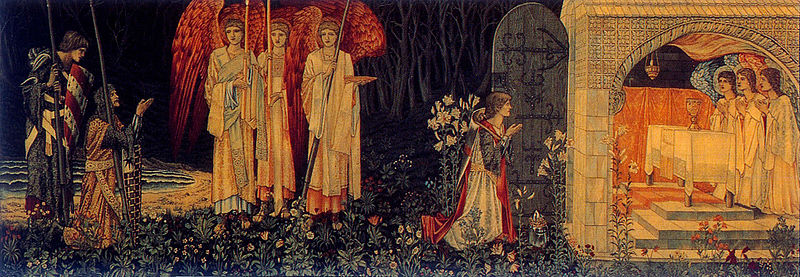
Galahad_grailby Fr. Jeff Loseke

This past Monday’s solar eclipse was a unique event that drew together people from across our country to share in the rare experience of seeing the sun obscured by the moon from one coast to the other.  Everyone in mainland USA (save northernmost Maine) was able to experience at least a partial eclipse.  The “promised land” for eclipse watchers, however, was to be in the path of totality.  More than merely darken the sky, a total eclipse promises viewers a glimpse of the sun’s corona, which cannot be seen under ordinary circumstances by the naked eye.  In fact, only when the moon completely blocks out the sun’s light is it safe to gaze heavenward toward the sun without damaging one’s eyes.

The entire experience of this year’s eclipse was fascinating to me, as it provided a deeper reflection on the longing of the human heart to witness the majesty of sights so far beyond it.  How amazing it was to see people make “pilgrimage” to the path of totality as they joined “in communion” with others to experience an event that consisted of “contemplating” the sun from our place on earth!  Though not a religious or spiritual event at all, the day’s news nevertheless overflowed with testimonies of the wonder, awe, tears, and excitement people felt as they shared and experienced this eclipse.

We can use this year’s eclipse to assist us in (re-)introducing the experience of Eucharistic Exposition and Adoration to the faithful.  Like the solar eclipse, when the Blessed Sacrament is exposed for adoration, people are given the opportunity to make pilgrimage to the church, to join in communion with God and each other, and to contemplate the Son from our place on earth.  Just as one is able to look directly at the sun’s glory when veiled by the moon, so too is one able to look upon the Son of God’s glory when veiled under sacramental form.  In order to experience the eclipse, one need only sit and gaze.  Similarly, in Eucharistic Adoration, one is invited simply to be in God’s presence and gaze at His Sacrament.  The eclipse plunged viewers into darkness in order to see the sun’s corona; likewise, only in the darkness of faith does one fully recognize the divine crown of Christ in His Sacrament.  Unlike the eclipse, however, Eucharistic Exposition allows us to contemplate the Son’s glory more than for a few minutes of totality and more frequently than once every several years or even decades.  Therefore, we should be looking for ways to increase opportunities for Exposition and Adoration in our parishes.  It is our hope that just as our bodies and skin are changed when we put ourselves in the light of the sun, our parishes themselves will be changed the more we put ourselves in the direct light of God’s only Son.

The Reverend Jeffery S. Loseke is a Priest of the Archdiocese of Omaha and is currently the pastor of  St. Charlccn_father-les Borromeo Parish in Gretna, Nebraska.  Ordained in 2000, Fr. Loseke holds a Licentiate in Sacred Theology (S.T.L.) from the Pontifical Athenaeum of St. Anselm in Rome and is working to complete his doctoral degree (Ed.D.) in interdisciplinary leadership through Creighton University in Omaha.  In addition to parish ministry, Fr. Loseke has served as a chaplain in the U.S. Air Force, taught high school theology and college-level philosophy, and has been a presenter for various missions, retreats, and diocesan formation days across the country.

Art: The Attainment: The Vision of the Holy Grail to Sir Galahad, Sir Bors, and Sir Perceval by Sir Edward Burne-Jones, 1895-96 (Wikimedia Commons)


A Faith Rooted in History

Through her living Tradition, the Church has preserved and handed down the Sacred Scriptures, the teachings of the Apostles, and the mode for celebrating the Sacraments. 

by Fr. Jeff Loseke

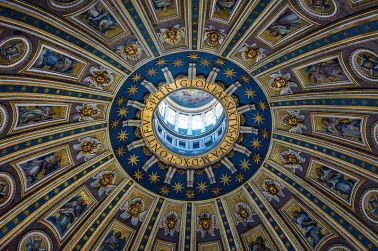
As a seminarian in Rome, I used to lead English-speaking pilgrims on a faith-filled tour of St. Peter’s Basilica on a weekly basis.  One of the highlights of the Vatican Basilica is the St_Peters_Basilica_Domemagnificent dome, which rises 448 ft above the floor.  It is set directly over the main altar, which itself is set directly over altars from the 7th to the 12th centuries on the crypt level of the basilica.  These altars themselves are situated directly above another monument from the first century that marks the gravesite of the Apostle Peter.  The ancient Roman cemetery that lies beneath St. Peter’s Basilica was unwittingly preserved by Emperor Constantine, when he buried the cemetery in order to create the foundation for the first church built over the site of Peter’s tomb.  Excavations carried out between 1939 and 1949 unearthed the ancient cemetery once again and confirmed the Church’s memory that the basilica was indeed built directly over the Apostle’s grave.

As we trace the history of the Church back through the centuries, we are reminded of the truth of St. Paul’s words in his first letter to the Corinthians that the Christian faith has been—and continues to be—passed on from one generation to the next through the lived Tradition: “For I handed on to you… what I also received” (15:3).  Through her living Tradition, the Church has preserved and handed down the Sacred Scriptures, the teachings of the Apostles, and the mode for celebrating the Sacraments.  In a word, the Church of today continues to do what the Church of the first century did: “They devoted themselves to the teaching of the Apostles and to the communal life, to the breaking of the bread and to the prayers” (Acts of the Apostles 2:42).

Because 2,000 years separate us from the days when Jesus Christ walked among us in the flesh, the Christian of today can be tempted to doubt the authenticity of what has been passed down through the centuries by the Church.  In fact, this temptation formed, in part, the impetus for the Protestant Reformation 500 years ago—that the Church had fallen off the rails and was in need of a complete overhaul.  This is why knowledge of history is so important if we hope to stand strong in the true faith!  The Word of God became flesh and dwelt among us as part of our human history (cf. John 1:14; Matthew 1:1-25).  Even more, Jesus promised that He would remain with His Church until the end of the age (Matthew 28:20), that the Holy Spirit would keep her always in the truth and free from error (John 16:13), and that the power of hell shall never prevail over the Church (Matthew 16:18).  Now it is our turn.  We must be open to receiving the deposit of faith as it has been passed down to us by the Church for centuries.  In this way, we ourselves become a part of the living history of the Church.  Then, and only then, do we participate in its authentic transmission to the next generation of believers.  Truly, “we hold this treasure in earthen vessels” (2 Corinthians 4:7) and so we must take great care with it.

The Reverend Jeffery S. Loseke is a Priest of the Archdiocese of Omaha and is currently the pastor of  St. Charlccn_father-les Borromeo Parish in Gretna, Nebraska.  Ordained in 2000, Fr. Loseke holds a Licentiate in Sacred Theology (S.T.L.) from the Pontifical Athenaeum of St. Anselm in Rome and is working to complete his doctoral degree (Ed.D.) in interdisciplinary leadership through Creighton University in Omaha.  In addition to parish ministry, Fr. Loseke has served as a chaplain in the U.S. Air Force, taught high school theology and college-level philosophy, and has been a presenter for various missions, retreats, and diocesan formation days across the country.

Photo: St. Peter’s Basilica, Dome, 2014 (Wikimedia Commons)


Making an Act of Reparation to the Sacred Heart

In this week between the Solemnities of Corpus Christi and the Most Sacred Heart, every Catholic ought to be especially aware of his or her participation in the work of salvation and, in communion with Jesus Christ and the whole Church, strive to offer oneself to the Father in reparation for sin.

by Fr. Jeff Loseke

This Friday, June 23rd, is the Solemnity of the Most Sacred Heart of Jesus.  On the one hand, it is a feast day that reminds us of God’s great love for His people; at the same time, 490px-Sacred_Heart_1770it is a feast that acknowledges humanity’s failure to love God fully in return.  Without the Savior loving both us and the Father to the end, we would not be redeemed.  Not only did Jesus willingly lay down His life for our salvation, but also He allowed His very heart to be pierced by a lance.  With that final act of man’s rejection of the Father’s love, God could have poured out judgment upon the centurion and upon the whole world for the death of His Son.  Instead, God willed that blood and water—symbols of the Eucharist and Baptism—should flow from Christ’s wounded Heart to bring healing and conversion to sinful humanity.  No matter how many times humanity has offended and rejected God, He has always been ready to meet us with mercy and forgiveness.

The Solemnity of the Most Sacred Heart, then, is a fitting day for the whole Church to offer an Act of Reparation to the Sacred Heart for the many sins committed against the love of God.  Certainly, upon the Cross, Christ the Head has offered the one Sacrifice that redeems humanity.  Nevertheless, as members of His Body, we recognize that each of us is called to make atonement for sin so that the whole Christ—Head and members—are united in the work of salvation.  With St. Paul, we ought to be able to say: “In my flesh I am filling up what is lacking in the afflictions of Christ on behalf of His Body, which is the Church” (Col 1:24).  The Blessed Virgin Mary already shows us how to do this.  She is the type and model of the Church’s participation in the work of salvation, for she stands beneath the Cross of her Son and unites her Immaculate Heart to His Sacred Heart.

In this week between the Solemnities of Corpus Christi and the Most Sacred Heart, every Catholic ought to be especially aware of his or her participation in the work of salvation and, in communion with Jesus Christ and the whole Church, strive to offer oneself to the Father in reparation for sin.  I encourage each member of the Body of Christ to offer the Act of Reparation (see below) in these days leading up to the feast of the Sacred Heart.  Hopefully, on the day itself, pastors will lead their people in a public recitation of this Act of Reparation.  Indeed, the Church grants a plenary indulgence to the Christian faithful who publicly recite the “Act of Reparation to the Sacred Heart” on the Solemnity of the Most Sacred Heart of Jesus.  (In all other cases and at all other times, the indulgence is partial.)  In order to merit a plenary indulgence—either for oneself or for one who has died—the following conditions must be met: (1) Be free of all attachment to sin, even venial sin; (2) Perform the indulgenced work; and (3) Receive sacramental Confession, Holy Communion, and pray for the Pope’s intentions (e.g., by reciting an Our Father and a Hail Mary) within several days (about 20) before or after carrying out the indulgenced work.  (Only one plenary indulgence may be merited per day.  One sacramental Confession will suffice for several plenary indulgences; however, a separate Communion and separate prayers for the Holy Father’s intentions are required for each plenary indulgence.)


Act of Reparation to the Sacred Heart (from The Handbook of Indulgences)

Most loving Jesus, how great is the love which You have poured out upon the world.  How casual and careless is our response!  Kneeling before You, we wish to atone for the indifference and the slights which pierce You to the heart.

Praise to the heart of Jesus, our Savior and our God.

We ask forgiveness for our own shameful neglect.  We wish to make amends for those who are obstinate in their unbelief, for those who turn away from the light and wander like sheep without a shepherd; and for those who have broken their baptismal promises and reject the gentle yoke of Your law.

Praise to the heart of Jesus, our Savior and our God.

We wish to make amends for the sins of our society: for lust and degradation, for the corruption of the young, for indifference and blasphemy, for attacks against Your Church, for irreverence and even sacrilege against Your love in this Blessed Sacrament, and for the public defiance of Your Law.

Praise to the heart of Jesus, our Savior and our God.

These are the sins for which You died, but now we share in Your Atonement by offering on the altar in union with You the living Sacrifice You made on the Cross, joining to it the sufferings of Your Virgin Mother, and those of all the Saints and the whole Church.

Praise to the heart of Jesus, our Savior and our God.

We promise faithfully that by Your grace we shall make reparation for our own sins and for those of others by a strong faith, by holy living, and by obedience to the law of the Gospel, whose greatest commandment is that of charity.

Praise to the heart of Jesus, our Savior and our God.

We also  promise to do our best to discourage others from insulting You and bring those we can to follow You.

Praise to the heart of Jesus, our Savior and our God.

Jesus, Lord, receive this loving act of homage together with the prayers of our Lady, who stood by the Cross, our model in reparation.  Keep us faithful, even to the point of death, give us the gift of perseverance and lead us all to our promised land in heaven, where You, with the Father and the Holy Spirit, live and reign for ever and ever.  Amen.

Praise to the heart of Jesus, our Savior and our God.


The Reverend Jeffery S. Loseke is a Priest of the Archdiocese of Omaha and is currently the pastor of  St. Charlccn_father-les Borromeo Parish in Gretna, Nebraska.  Ordained in 2000, Fr. Loseke holds a Licentiate in Sacred Theology (S.T.L.) from the Pontifical Athenaeum of St. Anselm in Rome and is working to complete his doctoral degree (Ed.D.) in interdisciplinary leadership through Creighton University in Omaha.  In addition to parish ministry, Fr. Loseke has served as a chaplain in the U.S. Air Force, taught high school theology and college-level philosophy, and has been a presenter for various missions, retreats, and diocesan formation days across the country.


Art: Sacred Heart of Jesus with Saint Ignatius of Loyola and Saint Louis Gonzaga by José de Páez, Mexico, circa 1770 (Wikimedia Commons)

Don’t Vacation From Your Vocation of Sharing the Good News!

The responsibility of giving witness and explaining the faith belongs not just to religious leaders, but it is fittingly situated in the lives of the baptized faithful.

by Fr. Jeff Loseke

A few years ago, I was on vacation with two classmates from my days in seminary.  The three of us now are Priests in different dioceses in the U.S. and get together every now 800px-Georges_Seurat_023and again for vacation to enjoy each other’s friendship while we travel.  To see us together, one would not immediately recognize us as Priests at first glance since we often do not travel in Roman collars or other such clerical garb while on vacation.  Nevertheless, our identity is sometimes uncovered… not by how we are dressed but by a faith that cannot be hidden.

While lounging at the pool and soaking up the sun, one of my friends was reading a book entitled, The Mass, whose title was clearly emblazoned on the front cover.  (Not your average, run-of-the-mill poolside reading, for sure!)  Another vacationer at the pool noticed this conspicuously Catholic book and asked my friend if he were indeed a Priest.  She, not being Catholic herself, then proceeded to ask him several questions about the Mass and the Catholic Church.  He happily answered her questions, and what could have been time wasted by the pool—albeit a well-deserved break—turned into an opportunity to share his faith.  What a great example of how one’s faith can be both recognizable and inviting without being ostentatious and standoffish.  When our faith is an integrated part of who we are, it becomes more than just a single part of us.  Instead, it permeates every other part of our very selves, and it cannot help but be seen.  For this reason, St. Peter reminds us that we must always be ready to give an explanation to anyone who asks us for a reason for our hope (see 1 Pt 3:15).

Almost 2,000 years prior to this poolside catechesis, St. Justin wrote to the pagan emperor Antoninus Pius and the Roman Senate around A.D. 155 also explaining the Mass and the Church’s beliefs.  The writings of St. Justin and other Apostolic Fathers from the first centuries of the Church’s history provide some of the best examples of Christians explaining and defending their faith to those who questioned it.  What is most interesting about St. Justin, however, is the fact that he was not a Bishop, Priest, or Deacon.  He was a layman, and he was the first as such to write extensively about the faith, especially to those who questioned it.  What an excellent example he is for the Christian faithful of today!  The responsibility of giving witness and explaining the faith belongs not just to religious leaders, but it is fittingly situated in the lives of the baptized faithful.  In all truth, the laity have more day-to-day contact with the world than do the clergy.  The Second Vatican Council rightly reminded us that it is the task of the clergy to evangelize the men and women of the Church, and that it is the task of the faithful to evangelize the world.  Truly, whether clergy or laity, there are no vacations from our vocation to announce the Good News!

The Reverend Jeffery S. Loseke is a Priest of the Archdiocese of Omaha and is currently the pastor of  St. Charlccn_father-les Borromeo Parish in Gretna, Nebraska.  Ordained in 2000, Fr. Loseke holds a Licentiate in Sacred Theology (S.T.L.) from the Pontifical Athenaeum of St. Anselm in Rome and is working to complete his doctoral degree (Ed.D.) in interdisciplinary leadership through Creighton University in Omaha.  In addition to parish ministry, Fr. Loseke has served as a chaplain in the U.S. Air Force, taught high school theology and college-level philosophy, and has been a presenter for various missions, retreats, and diocesan formation days across the country.

Art: A Sunday Afternoon on the Island of La Grande Jatte by George Seurat, 1884

The Original Novena: Ascension to Pentecost

by Fr. Jeff Loseke

Devotionally speaking, Pentecost marks the fulfillment of the original “novena” prayed by the early Church in anticipation of the promised Gift of the Holy Spirit.  After Jesus’
Jesus_ascending_to_heavenResurrection, He spoke repeatedly to His Apostles about how He would send the Holy Spirit to remain with them after He ascended into heavenly glory.  The Acts of the Apostles recounts how Mary, the Apostles, and other disciples returned to the upper room and remained there in prayer and supplication.  The total number of days between Ascension Thursday and Pentecost Sunday is nine.  This is the reason the Church’s devotional novenas follow a similar nine-day model.

The purpose of a novena prayer is to teach us patience and perseverance in prayer.  Too often we can be tempted to believe that God is not answering our prayers if we do not see “results” as expediently as we would like.  Our prayers can easily turn from being supplications, whereby we attempt to conform our wills to God’s will, to demands, whereby we attempt to conform God’s will to our own.  The discipline of the novena is more for us than it is for God: God hears and answers all our prayers, whether we pray for just one day or for 99 days.  We, however, are always in need of learning how to pray as we ought.  In a traditional novena, like the Apostles and Mary, we agree to wait for the working of the Spirit and to submit our desires to the will of God.

Unfortunately, the beautiful traditions of the Church are not free from human manipulation and error.  The Evil One wants us to forget that the purpose of the novena prayer is to wait patiently for God to work in His own time, and so he tempts us to approach novenas in superstition, believing that the prayer will be magically answered according to our will at the conclusion of the nine days.  Sadly, there are any number of unofficial prayers in print that are the result of such diabolical deception.  Perhaps you’ve seen them: “This prayer has never been known to fail,” or “Make nine copies of this prayer and leave them in church for nine consecutive days and your prayers will be answered.”  We can never forget that our repetition of prayers for any amount of time cannot force God’s hand.  Likewise, the failure to carry out a novena perfectly cannot invalidate the prayers and petitions of a humble and contrite heart.  When formulas become more important than our relationship with God and our trust in His mercy, then we find that we have turned from authentic devotion to empty superstition.  The upcoming “original novena” between Ascension Thursday and Pentecost teaches us once again that Jesus always keeps His promises and that God’s will is always done.  Come, Holy Spirit, and renew the face of the earth!

The Reverend Jeffery S. Loseke is a Priest of the Archdiocese of Omaha and is currently the pastor of  St. Charlccn_father-les Borromeo Parish in Gretna, Nebraska.  Ordained in 2000, Fr. Loseke holds a Licentiate in Sacred Theology (S.T.L.) from the Pontifical Athenaeum of St. Anselm in Rome and is working to complete his doctoral degree (Ed.D.) in interdisciplinary leadership through Creighton University in Omaha.  In addition to parish ministry, Fr. Loseke has served as a chaplain in the U.S. Air Force, taught high school theology and college-level philosophy, and has been a presenter for various missions, retreats, and diocesan formation days across the country.


Hidden Jesus and the Dancing Sun


Fatima

by Paula Zwenger

One hundred years ago today a miracle occurred
amid the hills of Portugal – I wonder, have you heard
of three young children tending sheep on hillsides near their town
who witnessed our dear Lady when from heaven she came down?
An angel came before her to prepare the children’s hearts.
She then appeared five times to them – a message to impart.

She came to see the children, sweetest Mother of Our Lord.
She came to see the children for she knew that they adored
and loved their Savior very much; but sinners as we are,
we needed her to help us see we’d wandered very far
away from Him, who loves us so with love to last all days.
She came with love and remedy to help us mend our ways.

She brought Jacinta, Francesco and Lucia a sign.
A daily rosary she asked, and sacrifices fine
to mend the sorrows of her heart, Immaculate and thorned;
without a heed to what she said, dire consequence was warned.
Our Savior’s hand of justice would be tempered if we gave
attention to her message – sent for all the world to save.

The youngest two, when all began, were too young to receive
Our Eucharistic Lord, yet still they followed and believed.
They loved the Hidden Jesus while His Mother they’d attend,
enduring even glimpse of hell where sadly, some souls end.
They sacrificed their whole day long to make amends for sins;
so none would turn from loving God and all invite Him in.

The final time she came to them upon the hilltop fair
a crowd of thousands also came to witness  Mary there.
The mud was thick upon the ground for rain had fallen too.
Then sun came out and dried their clothes, and danced in thousands’ view.
A miracle she said they’d see so all could know in truth
the message of Our Lady she had given to the youth.

These children loved Our Lady, they were persecuted long
but never lost their courage though their trials were dark and strong.
The youngest two would perish young. Lucia took the veil,
away to cloistered life she chose, submissive without fail.
She told the stories, as was asked by popes, about her friends,
but fame was never once her goal or means to reach an end.

“Oh my Jesus” so she taught and, “forgive us our sins”
“Save us from the fires of hell and lead all souls” again
“to heaven, especially those,” sweet Jesus, “most in need
of thy mercy” was the prayer she gave to intercede.
Now we say these special words at every decade done,
praying for salvation by the mercy of God’s Son.

Our rosary beads we deftly finger each and every day
to honor our dear Mother as she leads us on our way.
The sun will dance with certainty in our hearts, who believe;
for light of God is meant for truth and never to deceive.
Sweet Fatima, your message clear, we celebrate this day;
may faithfulness and sacrifice abide with us to stay.

——————————————————————————————

image1
Paula Zwenger
is a wife, mother, and grandmother who, upon finding herself an empty nester, tried on the hat of rhyme loving writer. It fit very well. Her joy manifests completely while taking the ups and downs of life and wrangling them into poetry. She also has a passion for creating rhymed treasure hunts with a Catholic flare to celebrate the faith and learn a thing or two along the way. You can find her musings at RhymeLovingWriter.com.