

by Fr. Jeff Loseke
As a seminarian in Rome, I used to lead English-speaking pilgrims on a faith-filled tour of St. Peter’s Basilica on a weekly basis. One of the highlights of the Vatican Basilica is the 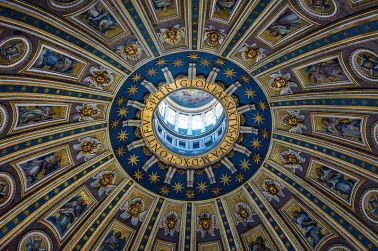 magnificent dome, which rises 448 ft above the floor. It is set directly over the main altar, which itself is set directly over altars from the 7th to the 12th centuries on the crypt level of the basilica. These altars themselves are situated directly above another monument from the first century that marks the gravesite of the Apostle Peter. The ancient Roman cemetery that lies beneath St. Peter’s Basilica was unwittingly preserved by Emperor Constantine, when he buried the cemetery in order to create the foundation for the first church built over the site of Peter’s tomb. Excavations carried out between 1939 and 1949 unearthed the ancient cemetery once again and confirmed the Church’s memory that the basilica was indeed built directly over the Apostle’s grave.
As we trace the history of the Church back through the centuries, we are reminded of the truth of St. Paul’s words in his first letter to the Corinthians that the Christian faith has been—and continues to be—passed on from one generation to the next through the lived Tradition: “For I handed on to you… what I also received” (15:3). Through her living Tradition, the Church has preserved and handed down the Sacred Scriptures, the teachings of the Apostles, and the mode for celebrating the Sacraments. In a word, the Church of today continues to do what the Church of the first century did: “They devoted themselves to the teaching of the Apostles and to the communal life, to the breaking of the bread and to the prayers” (Acts of the Apostles 2:42).
Because 2,000 years separate us from the days when Jesus Christ walked among us in the flesh, the Christian of today can be tempted to doubt the authenticity of what has been passed down through the centuries by the Church. In fact, this temptation formed, in part, the impetus for the Protestant Reformation 500 years ago—that the Church had fallen off the rails and was in need of a complete overhaul. This is why knowledge of history is so important if we hope to stand strong in the true faith! The Word of God became flesh and dwelt among us as part of our human history (cf. John 1:14; Matthew 1:1-25). Even more, Jesus promised that He would remain with His Church until the end of the age (Matthew 28:20), that the Holy Spirit would keep her always in the truth and free from error (John 16:13), and that the power of hell shall never prevail over the Church (Matthew 16:18). Now it is our turn. We must be open to receiving the deposit of faith as it has been passed down to us by the Church for centuries. In this way, we ourselves become a part of the living history of the Church. Then, and only then, do we participate in its authentic transmission to the next generation of believers. Truly, “we hold this treasure in earthen vessels” (2 Corinthians 4:7) and so we must take great care with it.
The Reverend Jeffery S. Loseke is a Priest of the Archdiocese of Omaha and is currently the pastor of St. Charl es Borromeo Parish in Gretna, Nebraska. Ordained in 2000, Fr. Loseke holds a Licentiate in Sacred Theology (S.T.L.) from the Pontifical Athenaeum of St. Anselm in Rome and is working to complete his doctoral degree (Ed.D.) in interdisciplinary leadership through Creighton University in Omaha. In addition to parish ministry, Fr. Loseke has served as a chaplain in the U.S. Air Force, taught high school theology and college-level philosophy, and has been a presenter for various missions, retreats, and diocesan formation days across the country.
Photo: St. Peter’s Basilica, Dome, 2014 (Wikimedia Commons)


 in our own identity as Christians, who, like Paul, never met Jesus in the flesh. There can be no doubt that Christianity would look very differently today—if it existed at all!—without the efforts of St. Paul and his companion missionaries. For this reason, the Church has always regarded St. Paul as a model for evangelization and as one of the principal architects of the Church. Saint Paul’s missionary strategy (i.e., establishing a communal identity among new believers) is precisely what the Catholic Church has always understood as “Sacred Tradition.” Saint Paul and the other Apostles modeled their style of leadership after that of Jesus Christ and passed it on in a living Tradition. Jesus gathered His closest followers around Himself and, for a period of about three years, established a way of life that would give them their identity as His Apostles. He did not hand them a book of instructions; rather, He enjoined upon them a way of life, a communal identity, a Sacred Tradition. They in turn passed it on to the next generation.
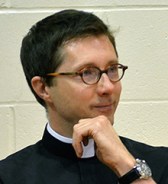 es Borromeo Parish in Gretna, Nebraska. Ordained in 2000, Fr. Loseke holds a Licentiate in Sacred Theology (S.T.L.) from the Pontifical Athenaeum of St. Anselm in Rome and is working to complete his doctoral degree (Ed.D.) in interdisciplinary leadership through Creighton University in Omaha. In addition to parish ministry, Fr. Loseke has served as a chaplain in the U.S. Air Force, taught high school theology and college-level philosophy, and has been a presenter for various missions, retreats, and diocesan formation days across the country.
 pelicansbreast.com