

 by Fr. Jeff Loseke
When most people hear the word charity, they probably associate it with donations for the poor, such as food, clothing, toys, money, and so forth. Others probably think of worthy causes, nonprofit organizations, and tax-deductible donations that help those in need. The problem with these ideas is that they reduce charity to seasonal or occasional acts of goodwill that are drawn from one’s excess resources. Charity, then, becomes a thing—and an optional one at that.
A Christian, however, must approach charity not as a something but as a Someone. Saint John’s first letter attests to the fact that “God is love” (4:8) and that “love is of God” (4:7). In the original language of this letter, the Apostle uses the Greek word agape to describe this kind of love that is divine in origin. The Greek language possesses several different words for love, making the author’s choice to describe God in terms of agape most significant for us. Agape suggests a love that is unconditional and freely given. Traditionally, this has been rendered in Latin as caritas and then into English as charity. This revelation gives our understanding of charity an entirely different dimension: God is charity, and charity is of God (cf. 1 John 4:7-8). We realize that God is selfless, unconditional charity that seeks to pour out Himself for the good of another. Theologically, this divine outpouring is referred to as kenosis, and it remains a central—if not the most central—characteristic of who God is. Indeed, Divine Revelation has shown us that God is a free and total outpouring and exchange of charity as Father, Son, and Holy Spirit. What is more is that He has destined us to share in this great and mysterious exchange of divine love!
God has invited us to share in the eternal banquet of His charity (cf. Revelation 19:7-9). The question remains: How do we respond? At the Last Supper, Jesus connected His own Sacrifice on the Cross to the ritual of the Passover and told His disciples to “do this in memory of me” (Luke 22:19). By commanding His disciples to perpetuate His Sacrifice through the Holy Eucharist, Jesus invited them into the participation of His total outpouring of charity. To further demonstrate His desire for them, He gave His disciples an example of charity as He washed their feet and said to them, “I have given you a model to follow, so that as I have done for you, you should also do” (John 13:15). Our response to God’s charity to us is a charitable return of ourselves to Him and to each other. Our gift of self must not be occasional or seasonal. It must not be limited or conditional. It must be continual and relational. We have been called to love as God loves, and that means that we must lay down our lives for others (cf. John 9:15-17). Charity is not an option for the Christian. Charity is a way of life.
The Reverend Jeffery S. Loseke is a Priest of the Archdiocese of Omaha and is currently the pastor of St. Charl es Borromeo Parish in Gretna, Nebraska. Ordained in 2000, Fr. Loseke holds a Licentiate in Sacred Theology (S.T.L.) from the Pontifical Athenaeum of St. Anselm in Rome and is working to complete his doctoral degree (Ed.D.) in interdisciplinary leadership through Creighton University in Omaha. In addition to parish ministry, Fr. Loseke has served as a chaplain in the U.S. Air Force, taught high school theology and college-level philosophy, and has been a presenter for various missions, retreats, and diocesan formation days across the country.
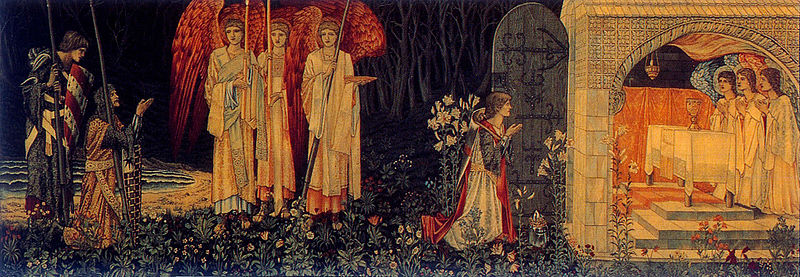
Art: The Attainment: The Vision of the Holy Grail to Sir Galahad, Sir Bors, and Sir Perceval by Sir Edward Burne-Jones, 1895-96 (Wikimedia Commons)


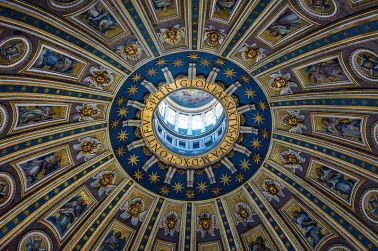 magnificent dome, which rises 448 ft above the floor. It is set directly over the main altar, which itself is set directly over altars from the 7th to the 12th centuries on the crypt level of the basilica. These altars themselves are situated directly above another monument from the first century that marks the gravesite of the Apostle Peter. The ancient Roman cemetery that lies beneath St. Peter’s Basilica was unwittingly preserved by Emperor Constantine, when he buried the cemetery in order to create the foundation for the first church built over the site of Peter’s tomb. Excavations carried out between 1939 and 1949 unearthed the ancient cemetery once again and confirmed the Church’s memory that the basilica was indeed built directly over the Apostle’s grave.

 not merely an emotion, a thought, or an ideal. Rather, the love of God is His very self. To stand before the love of God is to stand before Him who made us and who knows us better than we could ever know ourselves. Despite our complete inadequacy before God, we know that He desires that we open up ourselves in order to give ourselves to Him to the best of our abilities—even if it falls short. Love requires an openness that makes one vulnerable.

 many people across our globe who yearn to be able to live in peace and to pursue happiness in their own homelands, and there are countless others who would risk even their own lives to come to America to experience it. As we approach our nation’s Independence Day, we have much for which to be grateful. Fundamentally, our gratitude stems from the recognition that the blessings we enjoy in this country do not come from ourselves. It was someone else’s sacrifice, someone else’s struggle that won the independence we so cherish. As Christians, we can give thanks further for the ultimate gift of freedom that was purchased for us by Jesus’ one Sacrifice on the Cross. His Sacrifice fulfills all others, and, moreover, it infuses all other sacrifices with the power to defeat evil. Not only are we given the gift of freedom, but we are invested with its responsibility as well. All those who have been baptized are now sharers in the work of Christ in bringing this freedom of salvation to the whole world (cf. Col 1:24).

 crucifixion by rising from the dead. Interestingly, the cross was not one of the principal symbols the first Christians used to identify themselves as followers of Jesus, however. Why not? Probably because it was far too obvious. To publicly declare oneself a Christian, especially during the 2nd and 3rd centuries, was a crime punishable by death. While many believers publicly professed their faith when pressed to do so, they were not necessarily in the habit of volunteering such information. This was by no means an act of cowardice, but rather an act of prudence.

 it is a feast that acknowledges humanity’s failure to love God fully in return. Without the Savior loving both us and the Father to the end, we would not be redeemed. Not only did Jesus willingly lay down His life for our salvation, but also He allowed His very heart to be pierced by a lance. With that final act of man’s rejection of the Father’s love, God could have poured out judgment upon the centurion and upon the whole world for the death of His Son. Instead, God willed that blood and water—symbols of the Eucharist and Baptism—should flow from Christ’s wounded Heart to bring healing and conversion to sinful humanity. No matter how many times humanity has offended and rejected God, He has always been ready to meet us with mercy and forgiveness.

 substantial, real, and abiding presence in His Church. We acknowledge and worship this sacramental mystery whereby ordinary bread and wine become the Body and Blood of Christ. Neither is the Eucharist just a symbol of Christ’s Body and Blood nor does it reveal Christ to us only spiritually. We know that Christ is really and truly present—body, blood, soul, and divinity—in the Eucharist. This truth is so central and so important to our faith that the great Catholic American author Flannery O’Connor (d. 1964) once said in defense of the Eucharist: “Well, if it’s a symbol, to hell with it. It is the center of existence for me; all the rest of life is expendable.”

 Baptism, the outpouring of the Holy Spirit in Confirmation, and the nourishment provided in the Most Holy Eucharist. As God’s people, we reject sin and promise to live a new life of faith in Christ. Indeed, as witnesses of Jesus’ Death and Resurrection, we do what St. Paul urges: “Offer your own bodies as a living sacrifice, holy and pleasing to God… Do not conform yourselves to this age but be transformed by the renewal of your mind, that you may discern what is the will of God, what is good and pleasing and perfect” (Rom 12:1-2).
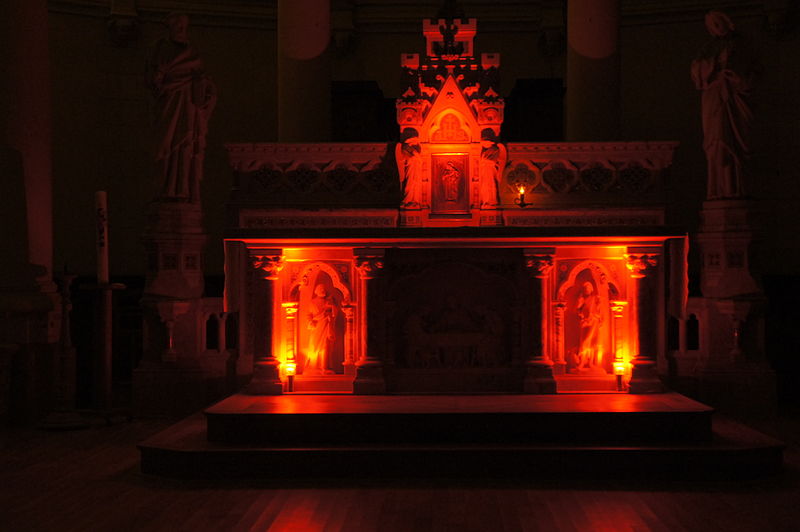
 days” and commemorates the events of the Paschal Mystery from the evening of Holy Thursday to the evening of Easter Sunday. The Triduum begins with the evening Mass of the Lord’s Supper on Holy Thursday, which recalls Jesus’ Last Supper with His Apostles. The Gospels remind us that on this night, Jesus instituted the Eucharist, washed His Apostles’ feet, and went to the Garden of Gethsemane to pray. At the Mass of the Lord’s Supper we do the same: the Eucharist is celebrated as usual, the Priest washes the feet of twelve parishioners, and the Blessed Sacrament is taken to a side altar for adoration throughout the night.

 in our own identity as Christians, who, like Paul, never met Jesus in the flesh. There can be no doubt that Christianity would look very differently today—if it existed at all!—without the efforts of St. Paul and his companion missionaries. For this reason, the Church has always regarded St. Paul as a model for evangelization and as one of the principal architects of the Church. Saint Paul’s missionary strategy (i.e., establishing a communal identity among new believers) is precisely what the Catholic Church has always understood as “Sacred Tradition.” Saint Paul and the other Apostles modeled their style of leadership after that of Jesus Christ and passed it on in a living Tradition. Jesus gathered His closest followers around Himself and, for a period of about three years, established a way of life that would give them their identity as His Apostles. He did not hand them a book of instructions; rather, He enjoined upon them a way of life, a communal identity, a Sacred Tradition. They in turn passed it on to the next generation.
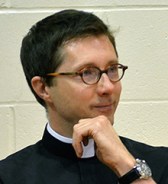 es Borromeo Parish in Gretna, Nebraska. Ordained in 2000, Fr. Loseke holds a Licentiate in Sacred Theology (S.T.L.) from the Pontifical Athenaeum of St. Anselm in Rome and is working to complete his doctoral degree (Ed.D.) in interdisciplinary leadership through Creighton University in Omaha. In addition to parish ministry, Fr. Loseke has served as a chaplain in the U.S. Air Force, taught high school theology and college-level philosophy, and has been a presenter for various missions, retreats, and diocesan formation days across the country.
 pelicansbreast.com