The Church’s Apostolic Charity

As agents of Christ in the world, our approach to the world around us ought to be different than that of an unbeliever. 

by Fr. Jeff Loseke

When Jesus established the apostolic ministry among His own Apostles, He commanded them to continue His mission of reconciliation in the world.  We see this most clearly Saint_Luke_Catholic_Church_(Danville,_Ohio)_-_tympanum_painting_-_Immaculate_Heart,_Charityexpressed by Jesus in His appearances to the Apostles after the Resurrection (e.g., Matthew 28:18-20; Luke 24:46-49; John 20:21-23).  Not only did He command them to preach “repentance, for the forgiveness of sins” (cf. Luke 24:47) but also He gave them a share in His very power so as to effect it.  The Apostles, once filled with the Holy Spirit, went out and began building up the Church, the Body of Christ on earth.

Saint Paul reminds us that, “It was he [Christ] who gave some to be apostles… to prepare God’s people for works of service, so that the body of Christ may be built up until we all reach unity in the faith and in the knowledge of the Son of God…” (Ephesians 4:11-13).  As Jesus’ disciples today, we have benefited from the witness of the Apostles and have been gathered together in virtue of our common baptism.  Our mandate is clear: we must be active in “works of service.”  Anyone who has heard the Gospel and has been taught how to live as a disciple cannot ignore the prompting of the Spirit to put his or her faith into action.  Through our works of charity, we participate with the Apostles in transforming the world and communicating Christ’s presence wherever we go.  As agents of Christ in the world, our approach to the world around us ought to be different than that of an unbeliever.  The way we conduct our business, participate in our communities, and raise our families ought to show others how Christ Himself would do such things.  Living more like Christ will draw us more and more together and overcome the divisions our sins have caused.

As Catholics, we recognize that the apostolic ministry itself has been shared with the Apostles and their successors, the Bishops today, through the laying on of hands and the invocation of the Holy Spirit (cf. 2 Timothy 1:1-2,6).  We are confident that the Apostolic line has remained unbroken for 2,000 years and that Christ’s ministry remains present and active in His Church today.  All of us who have benefited from the Apostolic ministry—especially through the preaching of the Word and the reception of the Sacraments—must take up our own part in the Church’s apostolate.  Through our works of charity, we reveal to the world that Jesus Christ is indeed risen from the dead and that He desires to draw the whole world to Himself for salvation.

The Reverend Jeffery S. Loseke is a Priest of the Archdiocese of Omaha and is currently the pastor of  St. Charlccn_father-les Borromeo Parish in Gretna, Nebraska.  Ordained in 2000, Fr. Loseke holds a Licentiate in Sacred Theology (S.T.L.) from the Pontifical Athenaeum of St. Anselm in Rome and is working to complete his doctoral degree (Ed.D.) in interdisciplinary leadership through Creighton University in Omaha.  In addition to parish ministry, Fr. Loseke has served as a chaplain in the U.S. Air Force, taught high school theology and college-level philosophy, and has been a presenter for various missions, retreats, and diocesan formation days across the country.

Art: Saint Luke Catholic Church (Danville, Ohio) – tympanum painting – Immaculate Heart, Charity, 2016 (Wikimedia Commons)


The Terrible Beauty of God’s Love

Despite our complete inadequacy before God, we know that He desires that we open up ourselves in order to give ourselves to Him to the best of our abilities—even if it falls short.  Love requires an openness that makes one vulnerable.

by Fr. Jeff Loseke

There is nothing more beautiful—and more terrifying—than to reflect upon the love of God.  God’s love is so beautiful and so terrifying because God’s love is utterly real.  It is Believer Heartnot merely an emotion, a thought, or an ideal.  Rather, the love of God is His very self.  To stand before the love of God is to stand before Him who made us and who knows us better than we could ever know ourselves.  Despite our complete inadequacy before God, we know that He desires that we open up ourselves in order to give ourselves to Him to the best of our abilities—even if it falls short.  Love requires an openness that makes one vulnerable.

As human beings, we do such a good job covering up our weaknesses and donning various armors and defense mechanisms all for the sake of protecting our weak and vulnerable selves.  On the one hand, we desire love and intimacy.  On the other hand, we want to remain in control.  We struggle with weakness—both in ourselves and in others.  We are often perturbed by our own lack of strength and fortitude, and we are not always gentle and understanding with the weaknesses and shortcomings of others.  And so, as an antidote, we must look to the Cross.

The Cross of Jesus Christ is God’s most perfect communication of His love for us.  On the Cross, Jesus chose to become weak, broken, despised, and even forgotten.  What an act of faith to look at Jesus’ Cross and see God there!  To the nonbeliever, one would see only a criminal, beaten beyond recognition, guilty of treason, and left to die on an instrument of profound humiliation and torture.  He is a loser, defeated… and yet, in that total emptying of self, He gives all, and He gains all.  This is the truth about love, which makes little sense to our secular society that is driven primarily by feelings, emotions, and personal desires.

To understand and relish the truth about love requires one to spend time studying, digesting, and even entering into a relationship with the truth.  I use the word relationship to highlight this reality because if God is truth, then to know and relish the truth is to know and relish one’s relationship with God.  That relationship, however, ought not to collapse in on itself, however.  Therefore, to translate the truth into the way one lives his or her life is necessary for love to be complete.  Love must bear fruit, give life, and bring people together.  It must be relational, fruitful, and affect the way we live our lives—for God and for others.  This is the mystery of love, the mystery of God, and the mystery of the human person.  To be open and vulnerable before another in total self-gift is to be real.  This is what makes God’s love both beautiful and terrifying at the same time.


The Reverend Jeffery S. Loseke is a Priest of the Archdiocese of Omaha and is currently the pastor of  St. Charlccn_father-les Borromeo Parish in Gretna, Nebraska.  Ordained in 2000, Fr. Loseke holds a Licentiate in Sacred Theology (S.T.L.) from the Pontifical Athenaeum of St. Anselm in Rome and is working to complete his doctoral degree (Ed.D.) in interdisciplinary leadership through Creighton University in Omaha.  In addition to parish ministry, Fr. Loseke has served as a chaplain in the U.S. Air Force, taught high school theology and college-level philosophy, and has been a presenter for various missions, retreats, and diocesan formation days across the country.

Art: Christ, helped by angels, decorates the believer’s heart wit, 2014 (Wikimedia Commons)


Making an Act of Reparation to the Sacred Heart

In this week between the Solemnities of Corpus Christi and the Most Sacred Heart, every Catholic ought to be especially aware of his or her participation in the work of salvation and, in communion with Jesus Christ and the whole Church, strive to offer oneself to the Father in reparation for sin.

by Fr. Jeff Loseke

This Friday, June 23rd, is the Solemnity of the Most Sacred Heart of Jesus.  On the one hand, it is a feast day that reminds us of God’s great love for His people; at the same time, 490px-Sacred_Heart_1770it is a feast that acknowledges humanity’s failure to love God fully in return.  Without the Savior loving both us and the Father to the end, we would not be redeemed.  Not only did Jesus willingly lay down His life for our salvation, but also He allowed His very heart to be pierced by a lance.  With that final act of man’s rejection of the Father’s love, God could have poured out judgment upon the centurion and upon the whole world for the death of His Son.  Instead, God willed that blood and water—symbols of the Eucharist and Baptism—should flow from Christ’s wounded Heart to bring healing and conversion to sinful humanity.  No matter how many times humanity has offended and rejected God, He has always been ready to meet us with mercy and forgiveness.

The Solemnity of the Most Sacred Heart, then, is a fitting day for the whole Church to offer an Act of Reparation to the Sacred Heart for the many sins committed against the love of God.  Certainly, upon the Cross, Christ the Head has offered the one Sacrifice that redeems humanity.  Nevertheless, as members of His Body, we recognize that each of us is called to make atonement for sin so that the whole Christ—Head and members—are united in the work of salvation.  With St. Paul, we ought to be able to say: “In my flesh I am filling up what is lacking in the afflictions of Christ on behalf of His Body, which is the Church” (Col 1:24).  The Blessed Virgin Mary already shows us how to do this.  She is the type and model of the Church’s participation in the work of salvation, for she stands beneath the Cross of her Son and unites her Immaculate Heart to His Sacred Heart.

In this week between the Solemnities of Corpus Christi and the Most Sacred Heart, every Catholic ought to be especially aware of his or her participation in the work of salvation and, in communion with Jesus Christ and the whole Church, strive to offer oneself to the Father in reparation for sin.  I encourage each member of the Body of Christ to offer the Act of Reparation (see below) in these days leading up to the feast of the Sacred Heart.  Hopefully, on the day itself, pastors will lead their people in a public recitation of this Act of Reparation.  Indeed, the Church grants a plenary indulgence to the Christian faithful who publicly recite the “Act of Reparation to the Sacred Heart” on the Solemnity of the Most Sacred Heart of Jesus.  (In all other cases and at all other times, the indulgence is partial.)  In order to merit a plenary indulgence—either for oneself or for one who has died—the following conditions must be met: (1) Be free of all attachment to sin, even venial sin; (2) Perform the indulgenced work; and (3) Receive sacramental Confession, Holy Communion, and pray for the Pope’s intentions (e.g., by reciting an Our Father and a Hail Mary) within several days (about 20) before or after carrying out the indulgenced work.  (Only one plenary indulgence may be merited per day.  One sacramental Confession will suffice for several plenary indulgences; however, a separate Communion and separate prayers for the Holy Father’s intentions are required for each plenary indulgence.)


Act of Reparation to the Sacred Heart (from The Handbook of Indulgences)

Most loving Jesus, how great is the love which You have poured out upon the world.  How casual and careless is our response!  Kneeling before You, we wish to atone for the indifference and the slights which pierce You to the heart.

Praise to the heart of Jesus, our Savior and our God.

We ask forgiveness for our own shameful neglect.  We wish to make amends for those who are obstinate in their unbelief, for those who turn away from the light and wander like sheep without a shepherd; and for those who have broken their baptismal promises and reject the gentle yoke of Your law.

Praise to the heart of Jesus, our Savior and our God.

We wish to make amends for the sins of our society: for lust and degradation, for the corruption of the young, for indifference and blasphemy, for attacks against Your Church, for irreverence and even sacrilege against Your love in this Blessed Sacrament, and for the public defiance of Your Law.

Praise to the heart of Jesus, our Savior and our God.

These are the sins for which You died, but now we share in Your Atonement by offering on the altar in union with You the living Sacrifice You made on the Cross, joining to it the sufferings of Your Virgin Mother, and those of all the Saints and the whole Church.

Praise to the heart of Jesus, our Savior and our God.

We promise faithfully that by Your grace we shall make reparation for our own sins and for those of others by a strong faith, by holy living, and by obedience to the law of the Gospel, whose greatest commandment is that of charity.

Praise to the heart of Jesus, our Savior and our God.

We also  promise to do our best to discourage others from insulting You and bring those we can to follow You.

Praise to the heart of Jesus, our Savior and our God.

Jesus, Lord, receive this loving act of homage together with the prayers of our Lady, who stood by the Cross, our model in reparation.  Keep us faithful, even to the point of death, give us the gift of perseverance and lead us all to our promised land in heaven, where You, with the Father and the Holy Spirit, live and reign for ever and ever.  Amen.

Praise to the heart of Jesus, our Savior and our God.


The Reverend Jeffery S. Loseke is a Priest of the Archdiocese of Omaha and is currently the pastor of  St. Charlccn_father-les Borromeo Parish in Gretna, Nebraska.  Ordained in 2000, Fr. Loseke holds a Licentiate in Sacred Theology (S.T.L.) from the Pontifical Athenaeum of St. Anselm in Rome and is working to complete his doctoral degree (Ed.D.) in interdisciplinary leadership through Creighton University in Omaha.  In addition to parish ministry, Fr. Loseke has served as a chaplain in the U.S. Air Force, taught high school theology and college-level philosophy, and has been a presenter for various missions, retreats, and diocesan formation days across the country.


Art: Sacred Heart of Jesus with Saint Ignatius of Loyola and Saint Louis Gonzaga by José de Páez, Mexico, circa 1770 (Wikimedia Commons)

Mother Mary, Mother Church and the Vocation of Motherhood

Just as it is the ordained Priest’s vocation to give a physical face to Jesus Christ in the world today, so also it belongs in a special way to mothers to give a physical face to the Church.

by Fr. Jeff Loseke

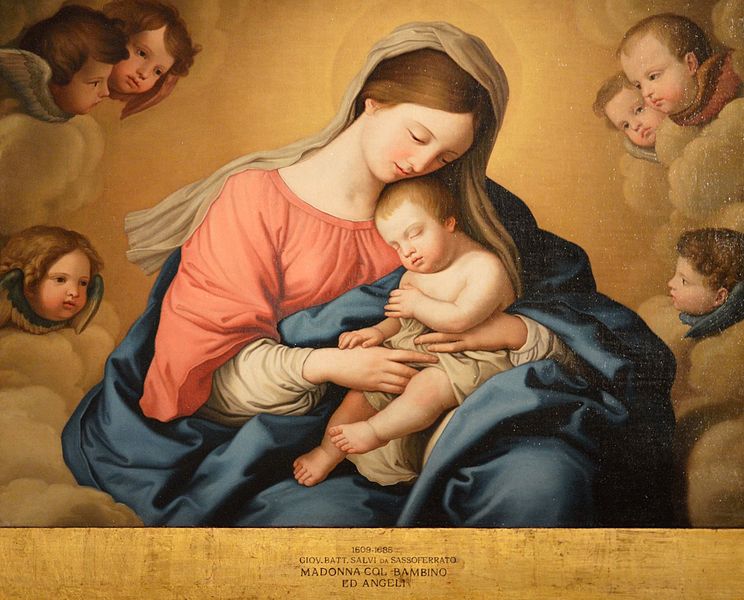
This month of May is dedicated in a special way to Mary, the Mother of God.  We recall how, on the Cross, Jesus entrusted Mary and the Beloved Disciple into each other’s care.  Madonna_with_child_and_angelsIn so doing, He gave all of His disciples into His Mother’s care and gave us Mary to be our Mother as well.  As the one chosen by the Father to give birth to His Only-Begotten Son, Mary serves as a resplendent example of motherhood to all who are her children as well as to all who share the noble vocation of motherhood.  Mary’s motherhood extends to us primarily because Jesus joined His disciples to Himself and made us members of His Body in the Church.  Mary, as the Mother of Jesus, is the mother also of His very Body, the Church.
Mary’s vocation as mother is also iconic of the motherhood of the Church.  As the most perfect disciple of Jesus, Mary reveals in her very person what the whole Church, comprised of many members, looks like.  The Church, being the Bride of Christ, gives birth to His offspring from the watery womb of the Baptismal Font.  Like Mary, the Church’s vocation in the world is maternal: Mary gave birth to Jesus in history; the Church gives birth to the Body of Christ in the present.  This is why the Church is referred to with a feminine pronoun (e.g., “she”, “her”, etc.) and oftentimes is called “Mother Church”.  Like all mothers, the Church gives birth to her children and nourishes them at her breast.  She teaches them and shares her wisdom with them.  She nurtures them and heals them with a gentle laying on of hands when they are hurt.  Sometimes she even needs to discipline them for their own good.  In every way, the Church is our spiritual mother.

Each and every mother for her part also shares in this iconic vocation.  Just as it is the ordained Priest’s vocation to give a physical face to Jesus Christ in the world today, so also it belongs in a special way to mothers to give a physical face to the Church.  Their motherhood stems from and points to the God who created them and who established His Church to communicate the new life of grace to all believers.  No longer is Eve the model of motherhood—the life she gave ended in death.  The Church, represented in the person of Mary, is the New Eve who gives a life that never dies.  May God bless all our mothers and grandmothers who reveal to us what it means to be alive in Christ Jesus our Lord!


The Reverend Jeffery S. Loseke is a Priest of the Archdiocese of Omaha and is currently the pastor of  St. Charlccn_father-les Borromeo Parish in Gretna, Nebraska.  Ordained in 2000, Fr. Loseke holds a Licentiate in Sacred Theology (S.T.L.) from the Pontifical Athenaeum of St. Anselm in Rome and is working to complete his doctoral degree (Ed.D.) in interdisciplinary leadership through Creighton University in Omaha.  In addition to parish ministry, Fr. Loseke has served as a chaplain in the U.S. Air Force, taught high school theology and college-level philosophy, and has been a presenter for various missions, retreats, and diocesan formation days across the country.

]

Pain: A Path Leading to Virtue

Learning such a love does not necessarily come easily. Indeed, the acquisition of virtue is often—if not always—a painful process.
by Rev. Jeff Loseke

When a child is brought to be baptized, the  parents and godparents are reminded over and over again by the Church’s minister of their responsibility to teach their son or daughter Ste-therese-on-deathbedhow to love God, how to love their neighbor, and how to constantly practice their faith.  These exhortations always remind me that, because of our fallen human nature and the inclination to sin (i.e., concupiscence), the love to which God calls us must be learned and practiced over time.  Learning such a love does not necessarily come easily.  Indeed, the acquisition of virtue is often—if not always—a painful process.

For those engaged in the practice of Christian love and virtue, it is not uncommon to experience painful emotions such as shame, shock, anger, discomfort, confusion, and so forth.  As an example, think of the person who goes on a mission trip for the first time.  His or her encounter with poverty, injustice, suffering, and other evils can be difficult to process at first.  The experience of negative reactions and emotions, however, should not be interpreted as a bad thing or as a moral evil.  Rather, this painful path is more in accord with Aristotle’s theory that those being schooled in the virtues do not actually enjoy practicing them.  Nevertheless, the path of pain leads a person to see things more clearly and to recognize what it true within oneself regarding his or her complicity in the injustices and sins of the world.  In reflecting upon the path of virtue through pain, I am reminded of something C. S. Lewis wrote in The Problem of Pain: “Pain insists upon being attended to.  God whispers to us in our pleasures, speaks in our conscience, but shouts in our pain: it is His megaphone to rouse a deaf world”.

While the process of growing in virtue—especially in the virtue of justice—may be painful or uncomfortable, I firmly believe that it should not be avoided.  The challenge to parents, educators, and all who guide others, however, will be to provide the tools and the resources to help learners process their painful experiences in order to grow from them.  As a spiritual director and confessor, I often have to challenge my directees and penitents to delve more deeply into the shadows, the brokenness, and the pain in their lives in order to arrive at the deepest level of truth about themselves.  Walking with them in order to help them face those difficult emotions, feelings, and spiritual realities is part of my ministry as a Priest.  Even more, it must be part of our lives as Christians.  Jesus reminds us in the Beatitudes that we are blessed when we mourn or suffer pain.  He also reminds us that we are blessed when we work to alleviate such pain by working for a more just world.


The Reverend Jeffery S. Loseke is a Priest of the Archdiocese of Omaha and is currently the pastor of  St. Charlccn_father-les Borromeo Parish in Gretna, Nebraska.  Ordained in 2000, Fr. Loseke holds a Licentiate in Sacred Theology (S.T.L.) from the Pontifical Athenaeum of St. Anselm in Rome and is working to complete his doctoral degree (Ed.D.) in interdisciplinary leadership through Creighton University in Omaha.  In addition to parish ministry, Fr. Loseke has served as a chaplain in the U.S. Air Force, taught high school theology and college-level philosophy, and has been a presenter for various missions, retreats, and diocesan formation days across the country.


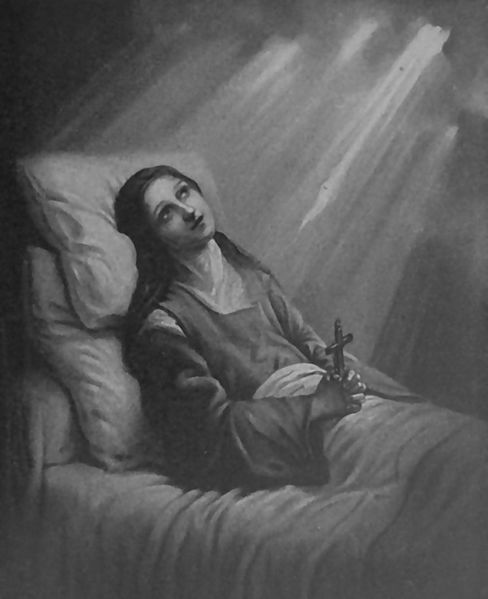
Art: St. Therese de Lisieux on her Death Bed by Anonymous, 1925 (Wikimedia Commons)

Our Mission – like Saint Paul’s – is the Salvation of the World

More than daily monotony, each moment is laced with the potential to change the world by changing those whom we encounter.

by Rev. Jeff Loseke

More often than not, the Second Reading at Mass each Sunday comes from one of the letters of St. Paul.  In many ways, he is a model for us to embrace and to follow, especially 470px-DUJARDIN_Karel_St_Paul_Healing_the_Cripple_at_Lystrain our own identity as Christians, who, like Paul, never met Jesus in the flesh.  There can be no doubt that Christianity would look very differently today—if it existed at all!—without the efforts of St. Paul and his companion missionaries.  For this reason, the  Church has always regarded St. Paul as a model for evangelization and as one of the principal architects of the Church.  Saint Paul’s missionary strategy (i.e., establishing a communal identity among new believers) is precisely what the Catholic Church has always understood as “Sacred Tradition.”  Saint Paul and the other Apostles modeled their style of leadership after that of Jesus Christ and passed it on in a living Tradition.  Jesus gathered His closest followers around Himself and, for a period of about three years, established a way of life that would give them their identity as His Apostles.  He did not hand them a book of instructions; rather, He enjoined upon them a way of life, a communal identity, a Sacred Tradition.  They in turn passed it on to the next generation.

We ourselves should be very aware of this communal aspect of the Sacred Tradition, especially in the weekly ritual of Sunday Mass.  In the Church, there is an old adage: lex orandi, lex credendi, lex vivendi.  In essence, it declares that what we pray is what we believe, and what we believe is how we live.  Ritual, belief, and way of life are intimately tied together.  I know that part of my role as a Priest is to help men and women discover who they are in Jesus Christ.  In so doing, I realize that I am helping them to be defined by their faith in God, which ought to have a concrete effect on their lives when they leave the church building.

At the end of Mass, we are instructed by the minister to go forth and to spread the Good News by the way we live our own lives.  In essence, we are sent out on mission, just like St. Paul for the salvation of the whole world.  This is certainly something we must reflect upon in our daily lives, especially in moments of difficulty or tedium.  We ought to be reminded just how important each and every opportunity is.  More than daily monotony, each moment is laced with the potential to change the world by changing those whom we encounter.  I imagine St. Paul and his companions recognized this when they chose to do very ordinary things in quite extraordinary ways, thus breathing new life into Christianity.  Why should one think that today we are any less able to have as profound an effect on the world as St. Paul did if it is the same Jesus Christ at work in all of us?  With St. Paul, we too can say, “I live, no longer I, but Christ lives in me” (Galatians 2:20a).


The Reverend Jeffery S. Loseke is a Priest of the Archdiocese of Omaha and is currently the pastor of  St. Charlccn_father-les Borromeo Parish in Gretna, Nebraska.  Ordained in 2000, Fr. Loseke holds a Licentiate in Sacred Theology (S.T.L.) from the Pontifical Athenaeum of St. Anselm in Rome and is working to complete his doctoral degree (Ed.D.) in interdisciplinary leadership through Creighton University in Omaha.  In addition to parish ministry, Fr. Loseke has served as a chaplain in the U.S. Air Force, taught high school theology and college-level philosophy, and has been a presenter for various missions, retreats, and diocesan formation days across the country.


Art: St Paul Healing the Cripple at Lystra by Karel Dujardin, 1663 (Wikimedia Commons)

This Year – Give Dandelions to God

Whatever you offer to God this Lent, may you present it with all the awkward generosity, sincere devotion and loving desire of a child.

There is something precious about a three-year-old presenting his mother with a bouquet of dandelions. No matter that the flowers handed over are a crushed and virtually the_fountain_-_with_jets_of_new_meanings_1870_14595484249unrecognizable sweaty clump of weeds. There is a sacred element to the gift as a result, not of its quality, but of the depth of the child’s desire to please. That desire is evident in the exuberant bounce of the step, the excited thrust of the gift into her open palms, the devoted gaze and the joyful anticipation of mother’s reaction as she receives such a loving gesture.

When we think about Lent, doesn’t it seem likely that this is what God desires for us as we approach this sacred season? For our own sakes, He doesn’t want  us to approach Lent with a show of indifference, where we give up something like caster oil or spinach and call it good.  On the other hand, He isn’t looking for heavy sighs and feigned martyrdom when we consider what we’d like to offer God this year. He doesn’t want us to spend the next 40 days trudging from here to there with gritted teeth, downtrodden expressions, sunken eyes and never-ending groans of agony until Easter morning. That said, He also isn’t looking for us to beat ourselves up because we commit to a mountain of resolutions and then fall short.

He wants the simple but joyful sacrifice of a child. More than anything, He is looking for the genuine desire to give what we have to Our Lord for his pleasure.

Lent is a call for penance, fasting and abstinence. Not for His sake, but for our sake. Just as a grateful and generous child grows in virtue in the very act of giving, Christians develop virtue and grow in holiness when they generously offer penance, fasting and abstinence as loving gestures in order to please God; not merely to fulfill an obligation.

It is no coincidence that Lent falls shortly after we celebrate the greatest gift of all time – the gift of the Incarnation, wherein God condescended to become Man in order to lead us to Himself. What is Christmas but the beautiful celebration wherein Christ offers himself as a gift for all mankind. According to Jean Danielou, S.J. in The Angels and Their Mission,

The true mystery of the Nativity is the self-abasement of the divine Person of the Word, a “little lower than angels” (Hebrews 2:7), p. 41.

Webster’s Dictionary defines self-abasement as “voluntary self-punishment in order to atone for some wrong-doing. Synonyms are “self-mortification, penance.”

From the moment of the incarnation, Christ offered Himself as a sacrifice. Lent, in a very special way, calls us to a new springtime of union with Him. A union wherein we cooperate in His sacrifice by giving of ourselves.  Where in all weakness and humility, we try to offer back to the God who has given so much to us. By His example and through His grace, we are able to offer our own self-mortification and penance. During Lent, we are given an opportunity to sacrifice.

What does it mean to sacrifice? Saint Teresa of Calcutta said it best:

“A sacrifice to be real must cost, must hurt, and must empty ourselves.”

These are words we should keep in mind as we approach Lent.

But there is a difference between emptying ourselves, and letting everyone know the cost of the emptying. Lent is about offering gifts to God. As is evident when we gaze upon a crucifix, the greatest gifts often come at the greatest cost. But when we offer ourselves and our gifts in love, we don’t count the cost.

When one loves, one does not calculate – St. Therese of Lisieux

Have you ever received a gift from a reluctant giver? Or from a giver who goes on and on about the cost or challenge in obtaining or sharing the gift? More often than not, most of us would rather that person had kept his gift than that he bemoan the difficulties sustained in its presentation.

Lenten resolutions bemoaned and endured turn us into victims. Resolutions offered in love, no matter the cost, are called sacrifices. Through a willingness to carry our crosses, we unite ourselves to Christ on His Cross. By eagerly giving of ourselves, our offering becomes united to His Offering. Our love is united to His Love. Our sacrifice is united to His Sacrifice.

Imagine the reaction when we run to God with our gifts, no matter how small they may be? Imagine His joy when we thrust them into His wounded palms, His pride at our humble willingness to look like fools for God – that our desire to give far outweighs our desire for perfection. Our desire to look good. Our desire to win.

Whatever you offer to God this Lent, may you present it with all the awkward generosity, sincere devotion and loving desire of a child.


Artwork: from The Fountain: with Jets of New Meaning, 1870


A Lenten Retreat that will Last a Lifetime!

This world is a battleground, and we, the Church Militant, are called to fight evil – whether on a societal level or in the deepest recesses of our own souls – that we might grow in union with God and join Him for all eternity in heaven.

What do you say? The reading of these good books does not concern you? But I find this duty more incumbent on you than on those living in the security of the cloister. For you who sail on the open sea, whether you will it or not, are beset by a thousand occasions of sin. Thus the aid of spiritual books is for you a necessity. A religious cannot be wounded, because she is far from the combat. But you who are in the midst of battle, must protect yourself with the buckler of holy thoughts drawn from good books. – St. John Chrysostom, Discourse 3

This world is a battleground, and we, the Church Militant, are called to fight evil – whether on a societal level or in the deepest recesses of our own souls – that we might grow in union with God and join Him for all eternity in heaven. But the battle is difficult. And weak as we are, it is easy to get get wounded, to grow soft in discipline or get distracted from our mission. Sometimes we succumb to the world and all its demands and then look up to find that we are not where we hoped we’d be. Somehow we need to ground ourselves before we head out into battle each day. To retreat from battle that we might arm ourselves with the Sword of the Spirit (Ephesians 6:17), cling to the Pillar of Truth (1 Timothy 3:15), and fill ourselves with the buckler of holy thoughts, in order to face the enemy each day.

Prepare for Battle

What would you say if I offered you the opportunity to go on retreat for 15-30 minutes five days per week, directed by some of the greatest minds in the Church? This retreat will offer rewards like you’ve never dreamed. After 15-30 minutes of quiet, prayerful meditation, you will be ready to face your day like never before. If you embark on this retreat, I guarantee you will be equipped with everything you need to make progress in your spiritual life – progress that will be witnessed by your family, friends, colleagues and fellow pilgrims you meet each day.

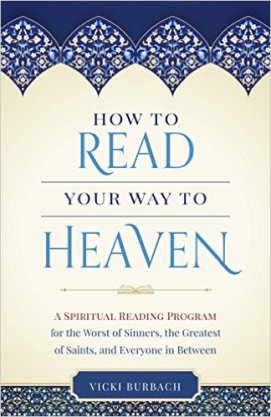
You’ll find this retreat in How to Read Your Way to Heaven: A Spiritual Reading Program for the Worst of Sinners, the Greatest of Saints and Everyone in Between.

book-cover

Sound like a far-fetched sales pitch?

Absolutely not! In just 15-30 minutes per day, you will

  • Meditate on Sacred Scripture
  • Read 1-2 paragraphs from the Catechism of the Catholic Church
  • Read a few pages from some of the greatest minds in the history of the Church

Spiritual reading is organized around the Four Pillars of the Catechism:

  1. The Profession of Faith – What we Believe as Catholics
  2. The Celebration of the Christian Mystery – Liturgy and the Sacraments
  3. Life in Christ – Man’s Vocation as a Christian
  4. Christian Prayer 

For the person who hasn’t done much spiritual reading…

this program offers a no-fail plan, sans dates or pressure, so you can get started right away, and pace yourself – while reaping great rewards found through Sacred Scripture, the direction of the Saints and  wisdom of the Early Church Fathers.

For the avid reader…

this program provides rhyme and reason to your spiritual reading. It puts order into what is often a random process, allowing for accelerated progress in the spiritual life. Spending concentrated time in each pillar allows you to learn from various perspectives and to practice what you’ve learned in your daily life for an extended time, before moving on to the next topic.

The Time is Now

Lent is upon us – do not delay. Make spiritual reading your Lenten resolution. How to Read Your Way to Heaven is a tool that will help you with all facets of the process. Make this your best Lent ever by uniting yourself to Our Lord like never before!

What’s Inside:

  • Why Spiritual Reading is critical to our lives as Christians
  • Important considerations when embarking on a Spiritual Reading Program
  • What is Syntopical Reading and how it can help you make great strides in your spiritual life
  • What kinds of works to read
  • How to read sacred scripture
  • How to structure your reading time
  • Specific assignments for a 1-Year, 3-Year or 5-Year Reading Program
  • Blank spaces each day so you can add or substitute books of your choice
  • Two Fabulous Book Lists: 99 of the favorite reads of notable Catholics; Fr. C. John McCloskey’s Lifetime Catholic Reading List
  • A lay-flat binding to ensure years of use


There isn’t enough space to extoll the benefits of spiritual reading – Rather than belabor the point, I’ll leave you with a final quote from Venerable Louis of Granada, favorite spiritual writer of St. Teresa of Avila, St. John of the Cross, St. Francis de Sales, St. Charles Borromeo, St. Vincent de Paul and St. Rose of Lima:

So great is the light and fruit of spiritual reading that we know from experience many person who have changed their entire lives by this means. When asked the root and cause of such a change, they responded that after reading such and such a book they resolved to amend their lives…

So sublime are the mysteries that the Christian religion proposes to man and so powerful for moving hearts that I would not be surprised if they effected a great change in anyone who attentively considers them. – Summa of the Christian Life, p. 7-8


What People are Saying about How to Read Your Way to Heaven:

Recently, Catholic radio host Allison Gingras of breadboxmedia.com, sent me a link to a recent program, where she and guest Cristina Trinidad had been discussing my book. What a fun show! All discussions about Lent and spiritual reading should be so joyful!! I hope you’ll check it out – let these ladies give you their perspective on the book:

A Seeking Heart – 2/17/17

Personal Message:

Just finished reading Rome Sweet Home and loved it. I’m also enjoying the Book of Matthew. I think it’s a great book to start with. I’m looking forward to my reading time early every morning. I thank God for giving me you…to show me the way to reading His Word. I love to read and this has been something I’ve wanted to do for a very long time.

Check out Amazon for Reader Reviews!

Editorial Reviews
McCloskey III profile photo

“If you want to develop a deep knowledge of our Faith, here is a reliable book that shows you how.” Fr. C. John McCloskey III


Aquilina profile photo

“We can read all day and read forever, and still feel as if we’re not making progress. Vicki Burbach gets us out of the rut and onto a track toward real spiritual — and cultural and intellectual — progress. This is the kind of book that can make life so much richer — by leading to many more books, and all in good order.” Mike Aquilina


Hendey profile photo

“Whether you’re a lifelong Catholic or a skeptical inquirer, you’ll find How to Read Your Way to Heaven by Vicki Burbach to be an indispensable gift for your intellectual and spiritual life. With this timeless treasure, Vicki has helped solve my so many books and so little time problem by providing a masterplan that’s both exciting and accomplishable.”
Lisa M. Hendey Founder of CatholicMom.com and author of The Grace of Yes


Burke profile photo

“Getting to heaven often requires that we rely on the wisdom of those who have gone before us. Vicki Burbach has done us a great service by providing an insightful reading plan and approach that, if absorbed and followed, will no doubt produce saints!”
Dan Burke, President of the Avila Institute


Is Your Marriage Lacking a Certain Chemical Element?

Do you watch all the ads with the lovey dovey smiles and the flirtatious eyes, and try to remember what that felt like? Do you recall the giddiness of being young fresh and so in love that even folding socks together was fun?

Valentine’s Day is upon us again.

Do you watch all the ads with the lovey dovey smiles and the flirtatious eyes, and try to remember what that felt like? Do you recall the giddiness of being young and marriage paintingfresh and so in love that even folding socks together was fun? Where even an accidental touch was electrifying and you called your love 100 times a day just to hear his voice?

If we’re not careful, love can become like a favorite shirt thoughtlessly tossed into the bottom of a drawer. Over time we tend to pile other things on top of it, passing it over from day to day without even thinking until some random thought, word or action sparks a reminder, and we realize that something very special is missing.

When I was in my early twenties, I began a cross-stitch project that I was sure would be a permanent focal point on my wall. It was a huge, colorful piece of country folk art, and it would have been beautiful. Today, six kids and fifty million ideas later, that piece of art has long been abandoned to the wasteland of forgotten projects.

Recently, my daughters and I were digging through my sewing box to find notions for their latest crafts. Sure enough, they found that old piece of material with the beautiful, but unfinished cross-section of a town, all neatly stitched in bright, bold colors. The finished portion would probably fill a 9×13 frame. They were awestruck. “Mom! This was sooo beautiful! Why would you leave it in a box?! Why don’t you finish it? How could you just put this down and walk away?”

How to explain that things came up? That I was too busy holding babies, doing laundry and feeding kids? And as time passed, my obligations only became greater, running kids from here to there. Other goals. Other plans. I never intended to set it aside for good. In the beginning, I only put it away during a busy time in my life. But then along came something else. And pretty soon, it was relegated to an old sewing box as I focused on making new curtains, pillows and bedspreads for our first house. And then along came the children and there were the sports and the play dates and school. There was always something that kept me from picking up that project.

And now?

I’m no longer interested.

Sadly, many marriages end up in the predicament. Sometimes we cast them aside, with every intention of getting back to them “later,” when life calms down. But then things don’t calm down, and our marriage becomes faded and dingy, lacking the bright color and excitement it once had.

Has our love dwindled?

No.

It’s there; but it might be a little lethargic, perhaps suffering from a lack of oxygen.

It might do us good to breathe a little life back into our marriages – both body and soul.

While challenges in marriage can be complicated, the action of loving is not. Love is a verb. And we must take steps to love our spouses, no matter the condition of our relationship. A simple love offering can go a long way toward reviving that spark. Take some time this week to spend some special time together, sans distractions. And make that a habit. Talk. Listen. Pray together. Attend adoration together. And more than anything else, recognize the privilege you’ve been given by virtue of your sacred union.

There is no magic pill that will liven a marriage relationship. Love takes time. It takes sacrifice. And it takes commitment. Here are just six thoughts to keep in mind regarding this amazing sacrament that is marriage on this very special day. Perhaps contemplating the profound nature of your relationship will help to ignite the flame of desire and spark the passion of commitment:

  1. You have been chosen and called, therefore, as husbands and wives to be for one another the living experiential sign and expression of God’s love by sharing with each other the gifts of uncompromising love, unconditional acceptance, ceaseless dedication, total fidelity, and untiring service. These are the signs of God’s love, and this is what makes God present in the Sacrament of Matrimony. — Dietrich von Hildebrand, Marriage: the Mystery of Faithful Love

  2. How can I ever express the happiness of the marriage that is joined together by the church, strengthened by an offering, sealed by a blessing, announced by angels and ratified by the Father?!!! How wonderful the bond between two believers, with a single hope, a single desire, a single observance, a single service! They are both brethren and both fellow servants; there is no separation between them in spirit or flesh. In fact, they are truly two in one flesh, and where the flesh is one, one is the spirit. Tertullian, quoted in Familiaris Consortio, by Pope John Paul II

  3. The basic error of mankind has been to assume that only two are needed for love; you and me, or society and me, or humanity and me. Really it takes three: self, other selves, and God; you, and me, and God. Love of self without love of God is selfishness; love of neighbor without love of God embraces only those who are pleasing to us, not those who are hateful…Duality in love is extinction through the exhaustion of self-giving. Love is triune or it dies. —Archbishop Fulton Sheen, Three to Get Married, p. 43

  4. In spousal love, the body of the beloved assumes a unique charm as the vessel of this person’s soul, and also as embodying in a unique way the general charm and attraction which femininity has for man, or virility has for woman. Spousal love aspires to the bodily union as a specific fulfillment of the total union, as a unique, deep, mutual self-donation. — Dietrich von Hildebrand, Man and Woman: Love and the Meaning of Intimacy, p. 47

  5. Romance is almost sure to die; love, however, does not have to die with it. Love is meant to mature, and it can do so if that readiness for sacrifice implied in the original self-giving of marital consent is alive or can be activiated. The idea that true love is prepared for sacrifice strikes a chord that perhaps our preaching needs to touch on more. As Pope John Paul II says, “It’s natural for the human heart to accept demands, even difficult ones, in the name of love for an ideal, and above all in the name of love for a person.— Cormac Burke, Covenanted Happiness, pg. 24

  6. Matrimony crushes selfishness, first of all, because it merges individuals into a corporate life in which neither lives for self but for the other; it crushes selfishness also because the very permanence of marriage is destructive of those fleeting infatuations, which are born with the moment and die with it; it destroys selfishness, furthermore, because the mutual love of husband and wife takes them out of themselves into the incarnation of their mutual love, their other selves, their children; and finally it narrows selfishness because the rearing of children demands sacrifice, without which, like unwatered flowers, they wilt and die.— Archbishop Fulton Sheen, The Cross and the Beatitudes, p. 41-42

  7. Do not forget that true love sets no conditions. It does not calculate or complain, but simply loves. – Saint John Paul II, Jubilee of Youth

Guest-Post: Introducing Paula Zwenger

In marriage, those small blessings we can offer our spouse tend to go a long way. Paula Zwenger captures their beauty in her poem, “This Man of Mine”


Recently I camthe_marriage_of_mary_and_joseph-_engraving_by_s-a-_bolswert_wellcome_v0034533e across a poem by Paula Zwenger that really speaks to the subject of sacrifice in a beautiful and inviting way – particularly as it pertains to the vocation of marriage. I wasted no time in asking if she would allow me to post it here. Thankfully she said yes – please enjoy her contribution below:


Easing Into the Ordinary

Who doesn’t love a good party – times when you gather with family and friends, partake of really delicious food, and wile away hours in fun and games? Perhaps you commemorate festivities by exchanging gifts, traditional mementos or souvenirs?

Life is full of reasons to rejoice. We make merry at birthday parties, graduations, or if good health and grace allow, high-number anniversaries in our vocations. We may travel different paths to arrive at our milestones, and express our thanksgiving in unique and creative ways based on our cultural traditions, but the logistics of our celebrations hold a few things in common.

Each one starts with preparation, building anticipation proportionate to the length and importance of the feast. Do you need to choose and send invitations? Are out-of-town guests expected? Where will they stay? Who plans and executes the menus for meals (don’t forget that Aunt Susan is allergic to nuts and Cousin Joe is diabetic)? Is special clothing required? Will there be a photographer? What about decorations? ‘To-do’ lists span columns or pages and require many hands to accomplish.

Finally . . . the ‘big day’ arrives! Everything goes off without a hitch (or not).  You spend yourself in joy, creating memories to last a lifetime. You may even arrive at this day exhausted by your preparations, but still luxuriate in what goes right, and bask in the joy on faces of those around you. This is what life is about – the very feasts that help make life worth living. Gratitude is simple to attain and acclaim in the midst of such blessing!

Then . . . a new day dawns. The party is over. It’s now time for post-celebration clean-up and return to day to day living. No more dancing in the streets, or aisles, or banquet hall – now you roll up your sleeves and return to work.

As Catholics, our faith tradition provides us with a liturgical calendar of seasons which help to focus our prayers, thoughts and actions.  We cherish the beauty of an extended Christmas season, which lasts far beyond the influences of secular society. Yet even with all the opportunity for special feasts and solemnities, we can wax nostalgic for the beauty of the crèche and stockings and beautifully lighted tree as it comes to a close.

In fact, in our house we’ve been known to ‘extend’ this season, as evidenced by holiday decorations, by as long as two weeks into Ordinary Time. If your family is anything like mine, everyone is excited to put up Christmas decorations, but no one is excited to take them down. The house looks a bit empty for awhile when the colors, lights, and precious heirlooms have been stowed away again for another year, out of sight.

This year, once again, I was dreading the chore of ringing out Christmas and ringing in ordinary time. My husband, Patrick, and I had talked on January 6th, the traditional calendar date of Epiphany, about needing to take things down on the following Saturday (the day this poem arrived to be written).

That morning he, an early riser by nature, held to his usual schedule while I slept in.  I was upstairs longer than usual, puttering around and reading online articles while listening to the local radio station, not looking forward to the chore ahead.

As it turns out, a plan beyond my own was already in motion. You might say I had a little ‘epiphany’ of my own about easing into the ordinary – which prompted the poem below.

This Man of Mine

I’ve never fully understood, not even ‘til today
how bonds we formed so long ago have blessed us both to stay
It’s got to be a gracing, giving strength beyond our own
that holds this love together all through choices we have grown
You take two different people and conjoin them up for life,
a model tried through centuries, this husband with his wife

He’s not given to praising and perfection’s not his game
but oh, he works in many ways at loving, just the same
Today, for instance, when I rose, ‘to-do’ list on my mind
I came downstairs with heavy sigh and what gift did I find?
The tree and lights, near put away (Epiphany now passed)
he did a chore I didn’t like without it being asked

Some frown at my believing and they wonder at my hope
yet every day, some way I’m blessed with gifts that help me cope
My answer is in trusting full that come good days or bad
this sacramental bonding tarries not as passing fad
It’s choice each morn on rising new to honor and to bless
in ways the other may not know, or ever even guess

I don’t pretend all answers in this riddle that we live
but time and time again it seems we get more when we give
I share with you if you are blue that times can turn around
not Pollyanna pandering but truth that I have found
I’ll write the blues when they appear but sunshine rays this day
right now it’s time to ‘walk my talk’ with no more word delay

I’ll find the chore that blesses him and makes for brighter day
I’ll love it into being and amend my past delays
When gratitude is lacking I will turn my heart to prayer
And offer even that to God who meets me in His care
There’s nothing that I cannot do when guided by His call
In loving you, in loving Him, whose mercy saves us all


——————————————————————————————

image1
Paula Zwenger
is a wife, mother, and grandmother who, upon finding herself an empty nester, tried on the hat of rhyme loving writer. It fitted very well. Her joy manifests completely while taking the ups and downs of life and wrangling them into poetry. She also has a passion for creating rhymed treasure hunts with a Catholic flare to celebrate the faith and learn a thing or two along the way. You can find her musings at RhymeLovingWriter.com.