Mother Mary, Mother Church and the Vocation of Motherhood

Just as it is the ordained Priest’s vocation to give a physical face to Jesus Christ in the world today, so also it belongs in a special way to mothers to give a physical face to the Church.

by Fr. Jeff Loseke

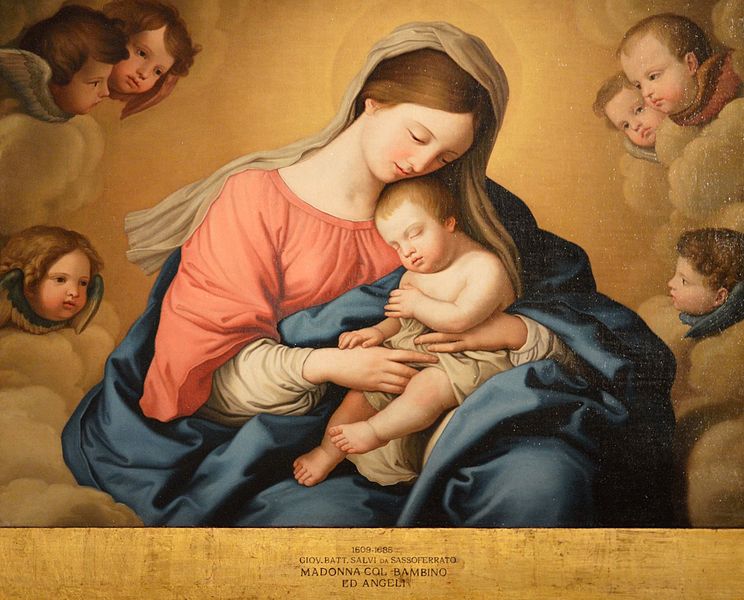
This month of May is dedicated in a special way to Mary, the Mother of God.  We recall how, on the Cross, Jesus entrusted Mary and the Beloved Disciple into each other’s care.  Madonna_with_child_and_angelsIn so doing, He gave all of His disciples into His Mother’s care and gave us Mary to be our Mother as well.  As the one chosen by the Father to give birth to His Only-Begotten Son, Mary serves as a resplendent example of motherhood to all who are her children as well as to all who share the noble vocation of motherhood.  Mary’s motherhood extends to us primarily because Jesus joined His disciples to Himself and made us members of His Body in the Church.  Mary, as the Mother of Jesus, is the mother also of His very Body, the Church.

Mary’s vocation as mother is also iconic of the motherhood of the Church.  As the most perfect disciple of Jesus, Mary reveals in her very person what the whole Church, comprised of many members, looks like.  The Church, being the Bride of Christ, gives birth to His offspring from the watery womb of the Baptismal Font.  Like Mary, the Church’s vocation in the world is maternal: Mary gave birth to Jesus in history; the Church gives birth to the Body of Christ in the present.  This is why the Church is referred to with a feminine pronoun (e.g., “she”, “her”, etc.) and oftentimes is called “Mother Church”.  Like all mothers, the Church gives birth to her children and nourishes them at her breast.  She teaches them and shares her wisdom with them.  She nurtures them and heals them with a gentle laying on of hands when they are hurt.  Sometimes she even needs to discipline them for their own good.  In every way, the Church is our spiritual mother.

Each and every mother for her part also shares in this iconic vocation.  Just as it is the ordained Priest’s vocation to give a physical face to Jesus Christ in the world today, so also it belongs in a special way to mothers to give a physical face to the Church.  Their motherhood stems from and points to the God who created them and who established His Church to communicate the new life of grace to all believers.  No longer is Eve the model of motherhood—the life she gave ended in death.  The Church, represented in the person of Mary, is the New Eve who gives a life that never dies.  May God bless all our mothers and grandmothers who reveal to us what it means to be alive in Christ Jesus our Lord!


The Reverend Jeffery S. Loseke is a Priest of the Archdiocese of Omaha and is currently the pastor of  St. Charlccn_father-les Borromeo Parish in Gretna, Nebraska.  Ordained in 2000, Fr. Loseke holds a Licentiate in Sacred Theology (S.T.L.) from the Pontifical Athenaeum of St. Anselm in Rome and is working to complete his doctoral degree (Ed.D.) in interdisciplinary leadership through Creighton University in Omaha.  In addition to parish ministry, Fr. Loseke has served as a chaplain in the U.S. Air Force, taught high school theology and college-level philosophy, and has been a presenter for various missions, retreats, and diocesan formation days across the country.

]

The Resurrection: Blessed Are Those Who Have Not Seen and Have Believed

Jesus’ Resurrection is not an event to be recorded in a history book. It is not something to be studied through the scientific method. The Resurrection of Jesus is a relational encounter that we have in faith.

by Rev. Jeff Loseke

The mystery of the Resurrection is like nothing else in human history.  While Jesus’ life, death, and Resurrection are all historical events that happened in time, there is resurrectionsomething about them that transcends time.  There were many disciples of Jesus who followed Him throughout the course of His earthly ministry and became witnesses of the many miracles.  They saw Him.  We can only imagine how many people actually heard Jesus’ teachings, saw His wonders, or stood by as He walked the Way of the Cross.  Countless numbers had some experience, some story to tell of Jesus’ life and death.

Jesus’ Resurrection, however, is different.  No one was there to witness Him rise from the dead.  No one was there to see Him break open the gates of hell for the just.  No one was there to see Him roll the stone away and walk out of the tomb.  No one at all.  And yet, our entire faith hinges on the fact that Jesus did all these things.  To paraphrase St. Paul:  if Jesus had not risen from the dead, then our Christian life is lived in vain.

If you think about it, the only proof we have of Jesus’ Resurrection is an empty tomb, the absence of a body… that is to say, we have no proof at all.  There is no hard evidence to look to to say that Jesus positively has risen from the dead.  And that’s okay.  Jesus’ Resurrection is not an event to be recorded in a history book.  It is not something to be studied through the scientific method.  The Resurrection of Jesus is a relational encounter that we have in faith.  Even those who knew Him best, Mary Magdalene and His disciples (e.g., the two on the road to Emmaus) for instance, did not recognize Him right away.  It was only when their eyes of faith were opened that they finally saw the Risen Jesus.  The same was true for St. Paul.  Never did he meet Jesus while He was alive.  His conversion happened on the road to Damascus when He encountered the Risen Jesus spiritually.  This gives us great hope today.  We are no different from St. Paul and Jesus’ other disciples:  through our faith, we too can come to know the Risen One.  If you want to see Him, if you want to know that He is risen from the dead, then you begin by believing.  Like the Resurrection itself, this faith of ours transcends time and carries us beyond this world into the kingdom yet to come!


The Reverend Jeffery S. Loseke is a Priest of the Archdiocese of Omaha and is currently the pastor of  St. Charlccn_father-les Borromeo Parish in Gretna, Nebraska.  Ordained in 2000, Fr. Loseke holds a Licentiate in Sacred Theology (S.T.L.) from the Pontifical Athenaeum of St. Anselm in Rome and is working to complete his doctoral degree (Ed.D.) in interdisciplinary leadership through Creighton University in Omaha.  In addition to parish ministry, Fr. Loseke has served as a chaplain in the U.S. Air Force, taught high school theology and college-level philosophy, and has been a presenter for various missions, retreats, and diocesan formation days across the country.


Art: The Resserection by Carl Heinrich Bloch, 2009 (Wikimedia Commons)

Where Did All the Crosses Go?

As Holy Week and the Sacred Triduum fast approach, we cannot relax our efforts to rend our hearts. Ultimately, it is God who will work the grace of His Death and Resurrection in us, breaking our hearts of stone in order to give us hearts that live (cf. Ezekiel 36:26).

by Rev. Jeff Loseke

In many places this weekend, the Fifth Sunday of Lent, the faithful will walk into churches and find that the crosses and sacred images have all been covered or removed Attachment-1from sight.  During Lent, the Church recommends—and even obliges in some matters—that the liturgy be stripped of those elements that communicate the fullness of Easter joy so that the reality of this penitential time might be more apparent.  For example, no flowers are permitted and musical instruments are silenced (except for last week’s Lætare Sunday celebration), the Gloria is omitted, fewer Saints’ days are commemorated, and so forth.  And now, as we enter into the final two weeks of Lent, many parishes will observe the longstanding tradition of stripping away even the crosses and sacred images from the church—a poignant reminder of how Christ Himself shed His heavenly glory to become a man for our sake… even to the point of death.

The church building itself is consecrated to stand in the midst of the local community as a visible image of Christ.  For this reason, its architecture and artistry should stand out from all the ordinary, profane, and secular buildings that surround it.  Indeed, a church’s walls are anointed with Sacred Chrism by the Bishop, signifying that it stands in and of itself as an “anointed one,” (i.e., a “Christ”) for all to see.  During these last weeks of Lent, as the beauty of the physical environment of the church building fades away, we recall the words of Scripture regarding God’s Suffering Servant: “He had no majestic bearing to catch our eye, no beauty to draw us to him” (Isaiah 53:2).

Rather than winding down at its end, Lent intensifies.  The reason is simple: How can there be a Resurrection without first experiencing a death?  As we ritually and sacramentally experience Jesus’ Passion and Death, each of us is called to enter into these very Mysteries and to let them permeate his or her own life.  Just as Jesus was stripped—and now the church stands stripped—we must ask ourselves: What needs to be stripped away in my own life?  How yet do I need to die to my own selfishness?  There is nothing serene or passive about that!  As Holy Week and the Sacred Triduum fast approach, we cannot relax our efforts to rend our hearts.  Ultimately, it is God who will work the grace of His Death and Resurrection in us, breaking our hearts of stone in order to give us hearts that live (cf. Ezekiel 36:26).

The Reverend Jeffery S. Loseke is a Priest of the Archdiocese of Omaha and is currently the pastor of  St. Charlccn_father-les Borromeo Parish in Gretna, Nebraska.  Ordained in 2000, Fr. Loseke holds a Licentiate in Sacred Theology (S.T.L.) from the Pontifical Athenaeum of St. Anselm in Rome and is working to complete his doctoral degree (Ed.D.) in interdisciplinary leadership through Creighton University in Omaha.  In addition to parish ministry, Fr. Loseke has served as a chaplain in the U.S. Air Force, taught high school theology and college-level philosophy, and has been a presenter for various missions, retreats, and diocesan formation days across the country.

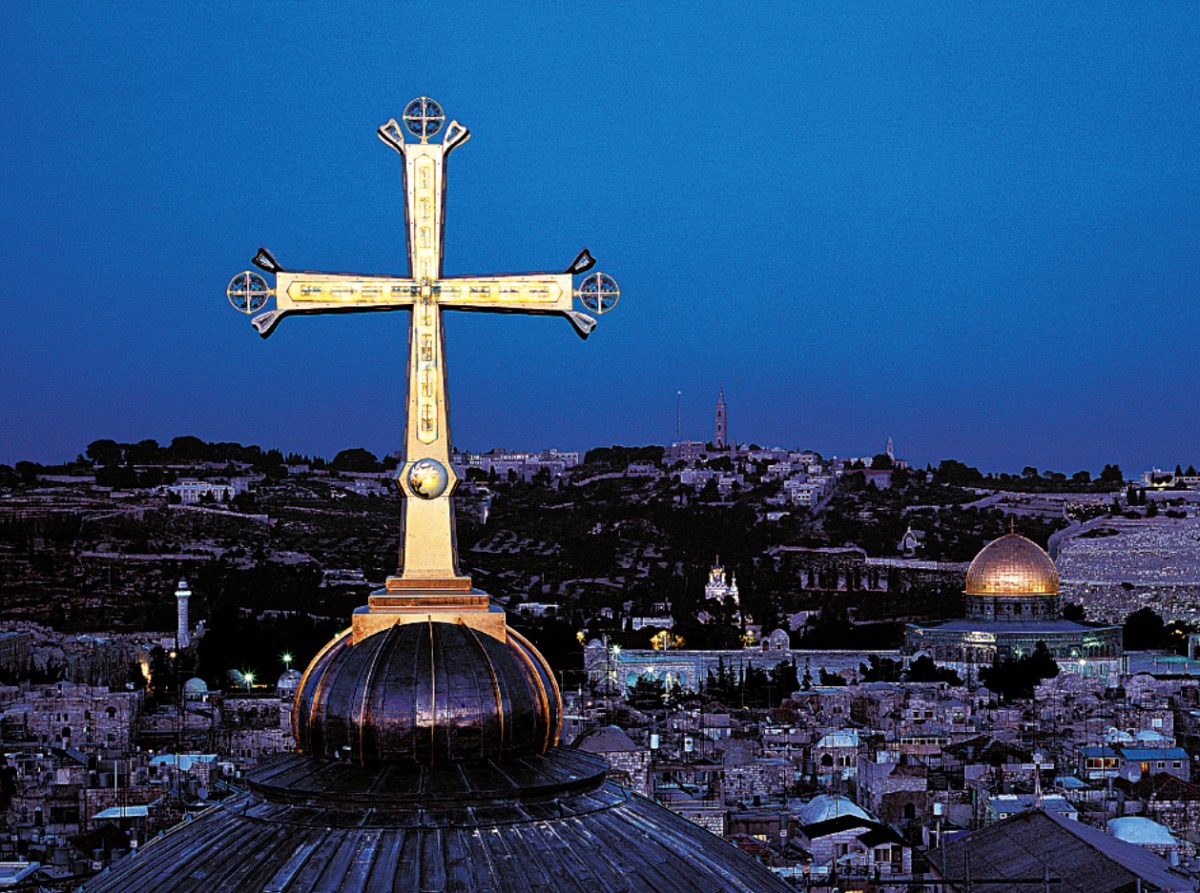
Art: Photography – Golgotha Crucifix, Church of the Holy Sepulcher in Jerusalem (Wikimedia Commons)

Reconciliation: Don’t Wait to Rejoice!

Do not wait to take advantage of the opportunity to know God’s mercy as soon as possible, to live in His light, and to experience His joy right now!

by Rev. Jeff Loseke

This Sunday, Lætare Sunday—whose name comes from the first words of the Entrance Antiphon at Mass, Lætare Ierusalem (Rejoice, Jerusalem)—marks the halfway point in Artgate_Fondazione_Cariplo_-_Molteni_Giuseppe,_La_confessioneLent and invites us to begin experiencing the joy of the Resurrection even as we continue our journey to the Cross.  Hopefully, our Lenten practices and penances have been chipping away at our hardened hearts so that they are already being freed from temptation and slavery to sin through God’s grace.  Our works alone are incapable of effecting this interior change, however.  Only in cooperation with God’s work do we experience the movement from darkness to light.

Were an athlete or a musician to wait until the last minute to begin practicing for a contest or performance, he or she would not likely perform to the best of his or her ability.  All the weeks and months of potential growth would have been squandered through procrastination.  I would suggest that we ought to consider our spiritual life with a similar mindset, especially during Lent.  Too many Catholics, perhaps, like to wait to the last minute to go to Confession before Easter so that they will be “squeaky clean” for Easter Sunday.  Unfortunately, by putting off the Sacrament of Reconciliation to the last minute, one is left to struggle through Lent without the particular help of that sacramental grace.  While on the one hand, Confession in the eleventh hour will bring us full forgiveness of sins prior to the Easter Mysteries, on the other hand, it leaves us potentially in a state of sin now, stymieing the effects of sanctifying grace, which could have been growing in us over time.  The fullness of our Easter joy is potentially stunted because of our tardiness in choosing to be freed from sin as soon as possible.  The earlier we are freed, the longer we walk in grace and grow in joy.

Almost everywhere you go, a number of extra opportunities are being made available during Lent for the faithful to receive the Sacrament of Reconciliation.  Do not wait to take advantage of the opportunity to know God’s mercy as soon as possible, to live in His light, and to experience His joy right now!  Had the Prodigal Son not waited so long to return to his father’s house, he would not have had to face starvation and destitution.  Why, then, should we wait to be forgiven?  Rather, we should be running to our Savior, who cannot wait to give us the fullness of His joy.  Therefore, with the whole Church we cry out: “Rejoice, Jerusalem, and all who love her.  Be joyful, all who were in mourning; exult and be satisfied at her consoling breast.


The Reverend Jeffery S. Loseke is a Priest of the Archdiocese of Omaha and is currently the pastor of  St. Charlccn_father-les Borromeo Parish in Gretna, Nebraska.  Ordained in 2000, Fr. Loseke holds a Licentiate in Sacred Theology (S.T.L.) from the Pontifical Athenaeum of St. Anselm in Rome and is working to complete his doctoral degree (Ed.D.) in interdisciplinary leadership through Creighton University in Omaha.  In addition to parish ministry, Fr. Loseke has served as a chaplain in the U.S. Air Force, taught high school theology and college-level philosophy, and has been a presenter for various missions, retreats, and diocesan formation days across the country.


Art: The Confession by Giuseppe Molteni, 1838

Our Mission – like Saint Paul’s – is the Salvation of the World

More than daily monotony, each moment is laced with the potential to change the world by changing those whom we encounter.

by Rev. Jeff Loseke

More often than not, the Second Reading at Mass each Sunday comes from one of the letters of St. Paul.  In many ways, he is a model for us to embrace and to follow, especially 470px-DUJARDIN_Karel_St_Paul_Healing_the_Cripple_at_Lystrain our own identity as Christians, who, like Paul, never met Jesus in the flesh.  There can be no doubt that Christianity would look very differently today—if it existed at all!—without the efforts of St. Paul and his companion missionaries.  For this reason, the  Church has always regarded St. Paul as a model for evangelization and as one of the principal architects of the Church.  Saint Paul’s missionary strategy (i.e., establishing a communal identity among new believers) is precisely what the Catholic Church has always understood as “Sacred Tradition.”  Saint Paul and the other Apostles modeled their style of leadership after that of Jesus Christ and passed it on in a living Tradition.  Jesus gathered His closest followers around Himself and, for a period of about three years, established a way of life that would give them their identity as His Apostles.  He did not hand them a book of instructions; rather, He enjoined upon them a way of life, a communal identity, a Sacred Tradition.  They in turn passed it on to the next generation.

We ourselves should be very aware of this communal aspect of the Sacred Tradition, especially in the weekly ritual of Sunday Mass.  In the Church, there is an old adage: lex orandi, lex credendi, lex vivendi.  In essence, it declares that what we pray is what we believe, and what we believe is how we live.  Ritual, belief, and way of life are intimately tied together.  I know that part of my role as a Priest is to help men and women discover who they are in Jesus Christ.  In so doing, I realize that I am helping them to be defined by their faith in God, which ought to have a concrete effect on their lives when they leave the church building.

At the end of Mass, we are instructed by the minister to go forth and to spread the Good News by the way we live our own lives.  In essence, we are sent out on mission, just like St. Paul for the salvation of the whole world.  This is certainly something we must reflect upon in our daily lives, especially in moments of difficulty or tedium.  We ought to be reminded just how important each and every opportunity is.  More than daily monotony, each moment is laced with the potential to change the world by changing those whom we encounter.  I imagine St. Paul and his companions recognized this when they chose to do very ordinary things in quite extraordinary ways, thus breathing new life into Christianity.  Why should one think that today we are any less able to have as profound an effect on the world as St. Paul did if it is the same Jesus Christ at work in all of us?  With St. Paul, we too can say, “I live, no longer I, but Christ lives in me” (Galatians 2:20a).


The Reverend Jeffery S. Loseke is a Priest of the Archdiocese of Omaha and is currently the pastor of  St. Charlccn_father-les Borromeo Parish in Gretna, Nebraska.  Ordained in 2000, Fr. Loseke holds a Licentiate in Sacred Theology (S.T.L.) from the Pontifical Athenaeum of St. Anselm in Rome and is working to complete his doctoral degree (Ed.D.) in interdisciplinary leadership through Creighton University in Omaha.  In addition to parish ministry, Fr. Loseke has served as a chaplain in the U.S. Air Force, taught high school theology and college-level philosophy, and has been a presenter for various missions, retreats, and diocesan formation days across the country.


Art: St Paul Healing the Cripple at Lystra by Karel Dujardin, 1663 (Wikimedia Commons)

Why Stations of the Cross Should be Part of Your Lenten Journey

The Stations of the Cross are an excellent way of not only retelling the story of Jesus’ Passion but also entering into dialogue with the One who gave Himself up for our sake.

Introducing Rev. Jeff Loseke

I first heard Fr. Jeff when he was the pastor of Holy Trinity in Hartington, Nebraska. He is full of wisdom and has graciously agreed to post some of his insight for your benefit. In fact, this column marks the beginning of a weekly contribution by Father Jeff to Pelican’s Breast. Please spread the word! 

Why Stations of the Cross Should be Part of Your Lenten Journey

When one examines the four Gospels in the New Testament, one cannot help but notice that within each account the Passion narrative is the most detailed part of the entire simon_pomaga_kristusu_nositi_kriz_19-_stGospel.  In fact, the amount of space in each Gospel that is given to the three days of Jesus’ Passion (20%-30%) is inordinately disproportionate to the space given to all the preceding events that make up the other three years of His life.  This tells us just how significant Jesus’ Paschal Mystery was to the faith of the Evangelists and the early Christian communities.  More than all of His miracles, teachings, and parables, Jesus’ Passion stands out as the single most important thing He did on this earth.

The first Christians shared the account of Jesus’ Passion and death through the oral and written traditions in order to give subsequent generations the experience of being with Jesus as this great drama unfolded.  This encounter with Jesus helped to personalize the love the Savior shared with us throughout His suffering and death.  How much more important it is for us today, living some 2,000 years later, to make that personal connection with Jesus through meditation on the events that saved us.

The Stations of the Cross are an excellent way of not only retelling the story of Jesus’ Passion but also entering into dialogue with the One who gave Himself up for our sake.  The Stations allow a person to make a spiritual pilgrimage along the path of Christ’s suffering without having to travel to the Holy Land itself.  Each station hanging on the church wall marks a particular “place” on the road to Calvary where we are to move ourselves interiorly.  This interior movement is the ultimate goal of the Stations: to bring us closer to Christ and to grow in our love for Him.  Of Christ’s Twelve Apostles, only John the Beloved possessed the kind of passionate love that gave him the courage to walk the journey with the Virgin Mary alongside Jesus all the way to Calvary; the others either betrayed Him or fled in fear.  I have good memories of attending the Stations of the Cross on Friday nights with my own mother when I was young, and so I extend a special invitation to each of you, especially to you who are parents with children: Try to take part in your local parish’s commemoration of the Stations of the Cross to walk with Jesus along the journey of His Passion and, in so doing, to experience the profound love He has for us.


The Reverend Jeffery S. Loseke is a Priest of the Archdiocese of Omaha and is currently the pastor of  St. Charlccn_father-les Borromeo Parish in Gretna, Nebraska.  Ordained in 2000, Fr. Loseke holds a Licentiate in Sacred Theology (S.T.L.) from the Pontifical Athenaeum of St. Anselm in Rome and is working to complete his doctoral degree (Ed.D.) in interdisciplinary leadership through Creighton University in Omaha.  In addition to parish ministry, Fr. Loseke has served as a chaplain in the U.S. Air Force, taught high school theology and college-level philosophy, and has been a presenter for various missions, retreats, and diocesan formation days across the country.


Art: Simon pomaga Kristusu nositi križ; 19th Century (Wikimedia Commons)

Guest Post: Finding Your Little Way -Rhymes & Riddles and Role Models for Lent

Put some lift in your Lent by solving some riddles that point to some excellent examples of “saintly” devotion.

Paula Zwenger has a lovely way of using rhyme to bring joy and inspiration to any subject – Hopefully her guest post of rhymes and riddles will liven up your Lenten journey. Find more of Paula’s wordplay at RhymeLovingWriter.com.

Lost and Found

Have you ever arrived at what you thought would be your intended destination only to find it had moved? Perhaps a favorite store expanded into a larger space, or an office found more favorable rental terms and relocated? Surely a practical minded person would double check on a detail like this before striking out to travel any appreciable distance, wouldn’t they?

Well, maybe – or maybe not. My husband and I recently scheduled an appointment across town, approximately a forty minute drive from home. Having been to this particular location several times in the past, we confidently left plenty of time to account for possible traffic jams.

Except when we arrived, with minutes to spare, the business we sought was empty. The main sign still displayed on the outer street marquee, but the office space stood unoccupied.

Thankfully we had a simple cell phone and contact number, so quickly called the business. We learned that they relocated three weeks prior (yes, they’d mailed a notice but we’d both missed it somehow). We then used that most ancient of all devices, a paper street map, to chart our course to the new location.

Although potentially embarrassing, the experience provides fodder for reflection. In today’s age of advancing technology, there seems little need to do advance planning. You research your intended destination from home to get a drive-time estimate. As for particular turns or detours, those take care of themselves with smart phone updates as you travel.

Unless you don’t have a smart phone or app that provides that service – then what happens? How will you travel in a good direction and arrive at your desired destination? Is the newest technology necessary to make for smoothest transition between point A and point B?

Sometimes old ‘tried and true’ methods hold merit worthy of examination.

Tis’ the Season

We’ve begun again – the wonderful, penitential season of Lent, gifted to us through the wisdom of Holy Mother Church. These forty days before Easter afford time for renewal and repentance, manifested through disciplines of prayer, fast, and almsgiving.

We travel, as did our forefathers in faith – as did Jesus – through the desert. We prepare our hearts and minds to celebrate the Paschal mystery and renewal of Easter promises. One step after another, we surrender to grace.

We won’t fall into developing good habits by accident. Instead of ‘business as usual’, resembling a slip into minimal awareness of our dignity as God’s chosen people, we focus with intent on all we can become, by His grace. One thing that helps focus our efforts is a plan, a road map of sorts, to provide direction.

Where there’s a Will – There’s a Way

Beyond general guidance and minimal requirements proscribed by the Church, she encourages us to choose activities which help us center ever more closely on taking up our cross and following Christ. These choices entail a certain amount of sacrifice.

Sacrifice is a personal thing. What works for one person may be inappropriate for another. What sufficed for a child no longer challenges as an adult. How do we decide each year which particular disciplines honor God at this point in our spiritual journey? Certainly, the counsel of a spiritual director or wise Christian friend helps us discern possibilities. Whether found via a search on a smart phone or within the volumes of pages published on the subject, numerous Lenten guides are available as well.

One other possibility holds promise – learning about choices made by our older brothers and sisters in faith – the Saints. Though unique to each, as is our particular call and path, we find inspiration and perhaps discipline for adaptation in their ‘tried and true’ life stories.

Five Little Ways in Rhyme

The following rhymed riddle verses hint about particular Saints and how each followed a distinct path to take up his/her cross and follow Christ. Try to puzzle out who each verse marigold_garden_pictures_and_rhymes_1910_14566514398describes. (If you get stuck, answers are listed at the very bottom of this post.)

Perhaps you’ve already determined and implemented your plan for the 2017 Lenten season. If not, maybe the footsteps of those who successfully lived lives of heroic virtue point to a new ‘little way’ of inspiration.


She faced an illness, then was cured; devoted to His holy Word
Her mother died at tender age, yet never against God did rage
Instead she focused all on Him, with disregard for selfish whims
She died on Holy Saturday in passion’s ecstasy displayed
From Lucca was her hailing place; accomplished all through God’s own grace
“Daughter of Passion” once was known – surrendered life to build His throne
A victim soul, for all repents – now known as patron of students
Christ’s Passion did become her all – she answered Him with Love’s own call

~~~~

This man became a priest though weak, His served the Lord in all ways meek
Though Satan often battered him, His faith in God would never dim
He’s known for gift of ‘reading souls’, confessing hours on end untold
He’d bi-locate and counsel give, to souls in need so they could live
Though Rome showed care in early days, to sanctity his cause was raised
The stigmata his sign to bear; with other crosses hidden there
A hospital was built nearby to help the poor to heal or die
His motto – it is said to be : was ”Pray, Hope, and Don’t Worry”

~~~~

A powerhouse of Godly strength, this woman’s life of shortened length
Mere years of thirty-three she spent, yet nearly all showed heaven’s bent
From tender age she vowed so pure to live for God alone, so sure
was she about this calling true; it focused all she chose to do
Though born a twin, her sister died in infancy, but she survived
Her writings now, prolific then; give stir to hearts of many men
She counseled popes; she served the ill; She’s known for her persuasive skill
Dominican and mystic both, to Jesus Christ she was betrothed

~~~~

Next comes a man, from France he hailed; a holy man thought sometimes frail
His Latin teacher had a chore to help him reach some passing scores
Yet holiness and love for God were central to the way he trod
Though drafted for the army range he never served for reasons strange
Then after war and amnesty he finished up seminary
Then sent to a small town to preach; his heart for all set him to teach
So many came – forgiveness sought; in confession God’s graces wrought
We celebrate his August feast; and hold him patron for our priests

~~~~

This final riddle of a saint tells of a person some found quaint
Yet as a child so sensitive, her youngest years were tough to live
Her mother died, some siblings too, though older sister helped her through
Her Mom made lace, the best around, her father’s work with watch renowned
She often struggled as a child, to find a way so meek and mild
She even asked the Pope to give permission so as nun she’d live
He said to wait, and so she did; but soon enough she would be bid
to join Franciscans, as was planned; though short, her time with them was grand

~~~~

So think on these, some ‘little ways’, which could become your own one day. 
A life inspires if lived full well – and every life a tale can tell.
Will ours unfold as holy too? Let’s pray for Love to see it through.
We’ll pray and live as Saints have done – the cross of God’s redeeming Son.


Answers:

St. Gemma Galgani
St. Pio of Pietrelcina
St. Catherine of Siena
St. John Marie Vianney
St. Therese of Lisieux


Art: Marigold garden; pictures and rhymes  Greenaway, Kate

This Year – Give Dandelions to God

Whatever you offer to God this Lent, may you present it with all the awkward generosity, sincere devotion and loving desire of a child.

There is something precious about a three-year-old presenting his mother with a bouquet of dandelions. No matter that the flowers handed over are a crushed and virtually the_fountain_-_with_jets_of_new_meanings_1870_14595484249unrecognizable sweaty clump of weeds. There is a sacred element to the gift as a result, not of its quality, but of the depth of the child’s desire to please. That desire is evident in the exuberant bounce of the step, the excited thrust of the gift into her open palms, the devoted gaze and the joyful anticipation of mother’s reaction as she receives such a loving gesture.

When we think about Lent, doesn’t it seem likely that this is what God desires for us as we approach this sacred season? For our own sakes, He doesn’t want  us to approach Lent with a show of indifference, where we give up something like caster oil or spinach and call it good.  On the other hand, He isn’t looking for heavy sighs and feigned martyrdom when we consider what we’d like to offer God this year. He doesn’t want us to spend the next 40 days trudging from here to there with gritted teeth, downtrodden expressions, sunken eyes and never-ending groans of agony until Easter morning. That said, He also isn’t looking for us to beat ourselves up because we commit to a mountain of resolutions and then fall short.

He wants the simple but joyful sacrifice of a child. More than anything, He is looking for the genuine desire to give what we have to Our Lord for his pleasure.

Lent is a call for penance, fasting and abstinence. Not for His sake, but for our sake. Just as a grateful and generous child grows in virtue in the very act of giving, Christians develop virtue and grow in holiness when they generously offer penance, fasting and abstinence as loving gestures in order to please God; not merely to fulfill an obligation.

It is no coincidence that Lent falls shortly after we celebrate the greatest gift of all time – the gift of the Incarnation, wherein God condescended to become Man in order to lead us to Himself. What is Christmas but the beautiful celebration wherein Christ offers himself as a gift for all mankind. According to Jean Danielou, S.J. in The Angels and Their Mission,

The true mystery of the Nativity is the self-abasement of the divine Person of the Word, a “little lower than angels” (Hebrews 2:7), p. 41.

Webster’s Dictionary defines self-abasement as “voluntary self-punishment in order to atone for some wrong-doing. Synonyms are “self-mortification, penance.”

From the moment of the incarnation, Christ offered Himself as a sacrifice. Lent, in a very special way, calls us to a new springtime of union with Him. A union wherein we cooperate in His sacrifice by giving of ourselves.  Where in all weakness and humility, we try to offer back to the God who has given so much to us. By His example and through His grace, we are able to offer our own self-mortification and penance. During Lent, we are given an opportunity to sacrifice.

What does it mean to sacrifice? Saint Teresa of Calcutta said it best:

“A sacrifice to be real must cost, must hurt, and must empty ourselves.”

These are words we should keep in mind as we approach Lent.

But there is a difference between emptying ourselves, and letting everyone know the cost of the emptying. Lent is about offering gifts to God. As is evident when we gaze upon a crucifix, the greatest gifts often come at the greatest cost. But when we offer ourselves and our gifts in love, we don’t count the cost.

When one loves, one does not calculate – St. Therese of Lisieux

Have you ever received a gift from a reluctant giver? Or from a giver who goes on and on about the cost or challenge in obtaining or sharing the gift? More often than not, most of us would rather that person had kept his gift than that he bemoan the difficulties sustained in its presentation.

Lenten resolutions bemoaned and endured turn us into victims. Resolutions offered in love, no matter the cost, are called sacrifices. Through a willingness to carry our crosses, we unite ourselves to Christ on His Cross. By eagerly giving of ourselves, our offering becomes united to His Offering. Our love is united to His Love. Our sacrifice is united to His Sacrifice.

Imagine the reaction when we run to God with our gifts, no matter how small they may be? Imagine His joy when we thrust them into His wounded palms, His pride at our humble willingness to look like fools for God – that our desire to give far outweighs our desire for perfection. Our desire to look good. Our desire to win.

Whatever you offer to God this Lent, may you present it with all the awkward generosity, sincere devotion and loving desire of a child.


Artwork: from The Fountain: with Jets of New Meaning, 1870


A Lenten Retreat that will Last a Lifetime!

This world is a battleground, and we, the Church Militant, are called to fight evil – whether on a societal level or in the deepest recesses of our own souls – that we might grow in union with God and join Him for all eternity in heaven.

What do you say? The reading of these good books does not concern you? But I find this duty more incumbent on you than on those living in the security of the cloister. For you who sail on the open sea, whether you will it or not, are beset by a thousand occasions of sin. Thus the aid of spiritual books is for you a necessity. A religious cannot be wounded, because she is far from the combat. But you who are in the midst of battle, must protect yourself with the buckler of holy thoughts drawn from good books. – St. John Chrysostom, Discourse 3

This world is a battleground, and we, the Church Militant, are called to fight evil – whether on a societal level or in the deepest recesses of our own souls – that we might grow in union with God and join Him for all eternity in heaven. But the battle is difficult. And weak as we are, it is easy to get get wounded, to grow soft in discipline or get distracted from our mission. Sometimes we succumb to the world and all its demands and then look up to find that we are not where we hoped we’d be. Somehow we need to ground ourselves before we head out into battle each day. To retreat from battle that we might arm ourselves with the Sword of the Spirit (Ephesians 6:17), cling to the Pillar of Truth (1 Timothy 3:15), and fill ourselves with the buckler of holy thoughts, in order to face the enemy each day.

Prepare for Battle

What would you say if I offered you the opportunity to go on retreat for 15-30 minutes five days per week, directed by some of the greatest minds in the Church? This retreat will offer rewards like you’ve never dreamed. After 15-30 minutes of quiet, prayerful meditation, you will be ready to face your day like never before. If you embark on this retreat, I guarantee you will be equipped with everything you need to make progress in your spiritual life – progress that will be witnessed by your family, friends, colleagues and fellow pilgrims you meet each day.

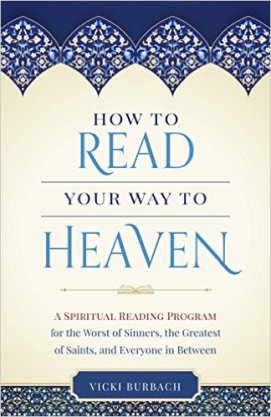
You’ll find this retreat in How to Read Your Way to Heaven: A Spiritual Reading Program for the Worst of Sinners, the Greatest of Saints and Everyone in Between.

book-cover

Sound like a far-fetched sales pitch?

Absolutely not! In just 15-30 minutes per day, you will

  • Meditate on Sacred Scripture
  • Read 1-2 paragraphs from the Catechism of the Catholic Church
  • Read a few pages from some of the greatest minds in the history of the Church

Spiritual reading is organized around the Four Pillars of the Catechism:

  1. The Profession of Faith – What we Believe as Catholics
  2. The Celebration of the Christian Mystery – Liturgy and the Sacraments
  3. Life in Christ – Man’s Vocation as a Christian
  4. Christian Prayer 

For the person who hasn’t done much spiritual reading…

this program offers a no-fail plan, sans dates or pressure, so you can get started right away, and pace yourself – while reaping great rewards found through Sacred Scripture, the direction of the Saints and  wisdom of the Early Church Fathers.

For the avid reader…

this program provides rhyme and reason to your spiritual reading. It puts order into what is often a random process, allowing for accelerated progress in the spiritual life. Spending concentrated time in each pillar allows you to learn from various perspectives and to practice what you’ve learned in your daily life for an extended time, before moving on to the next topic.

The Time is Now

Lent is upon us – do not delay. Make spiritual reading your Lenten resolution. How to Read Your Way to Heaven is a tool that will help you with all facets of the process. Make this your best Lent ever by uniting yourself to Our Lord like never before!

What’s Inside:

  • Why Spiritual Reading is critical to our lives as Christians
  • Important considerations when embarking on a Spiritual Reading Program
  • What is Syntopical Reading and how it can help you make great strides in your spiritual life
  • What kinds of works to read
  • How to read sacred scripture
  • How to structure your reading time
  • Specific assignments for a 1-Year, 3-Year or 5-Year Reading Program
  • Blank spaces each day so you can add or substitute books of your choice
  • Two Fabulous Book Lists: 99 of the favorite reads of notable Catholics; Fr. C. John McCloskey’s Lifetime Catholic Reading List
  • A lay-flat binding to ensure years of use


There isn’t enough space to extoll the benefits of spiritual reading – Rather than belabor the point, I’ll leave you with a final quote from Venerable Louis of Granada, favorite spiritual writer of St. Teresa of Avila, St. John of the Cross, St. Francis de Sales, St. Charles Borromeo, St. Vincent de Paul and St. Rose of Lima:

So great is the light and fruit of spiritual reading that we know from experience many person who have changed their entire lives by this means. When asked the root and cause of such a change, they responded that after reading such and such a book they resolved to amend their lives…

So sublime are the mysteries that the Christian religion proposes to man and so powerful for moving hearts that I would not be surprised if they effected a great change in anyone who attentively considers them. – Summa of the Christian Life, p. 7-8


What People are Saying about How to Read Your Way to Heaven:

Recently, Catholic radio host Allison Gingras of breadboxmedia.com, sent me a link to a recent program, where she and guest Cristina Trinidad had been discussing my book. What a fun show! All discussions about Lent and spiritual reading should be so joyful!! I hope you’ll check it out – let these ladies give you their perspective on the book:

A Seeking Heart – 2/17/17

Personal Message:

Just finished reading Rome Sweet Home and loved it. I’m also enjoying the Book of Matthew. I think it’s a great book to start with. I’m looking forward to my reading time early every morning. I thank God for giving me you…to show me the way to reading His Word. I love to read and this has been something I’ve wanted to do for a very long time.

Check out Amazon for Reader Reviews!

Editorial Reviews
McCloskey III profile photo

“If you want to develop a deep knowledge of our Faith, here is a reliable book that shows you how.” Fr. C. John McCloskey III


Aquilina profile photo

“We can read all day and read forever, and still feel as if we’re not making progress. Vicki Burbach gets us out of the rut and onto a track toward real spiritual — and cultural and intellectual — progress. This is the kind of book that can make life so much richer — by leading to many more books, and all in good order.” Mike Aquilina


Hendey profile photo

“Whether you’re a lifelong Catholic or a skeptical inquirer, you’ll find How to Read Your Way to Heaven by Vicki Burbach to be an indispensable gift for your intellectual and spiritual life. With this timeless treasure, Vicki has helped solve my so many books and so little time problem by providing a masterplan that’s both exciting and accomplishable.”
Lisa M. Hendey Founder of CatholicMom.com and author of The Grace of Yes


Burke profile photo

“Getting to heaven often requires that we rely on the wisdom of those who have gone before us. Vicki Burbach has done us a great service by providing an insightful reading plan and approach that, if absorbed and followed, will no doubt produce saints!”
Dan Burke, President of the Avila Institute


The Real Value of Work

We learn through work that patience matters. That, eventually, given great effort day after day, year after year, we’ll see results. Through our experience in work, we can deduce that that progress in the spiritual life is slow, but that it will pay off. We learn that we don’t necessarily have to see the big picture in order to know it’s there.

Recently I heard some horrific statistics regarding young men and their participation in the work force. The host of a national radio program cited an article from The Washington Post 800px-gustave_courbet_-_the_stonebreakers_-_wga05457that referred to recent research demonstrating a growing tend in America. Apparently, not only are about 20% of young men between 21-30 years of age out of work, but they aren’t too upset about it. Instead, they are finding satisfaction in video games, computers and television, while living in their parents’ basements. Most in this group have not held a job of any kind in at least a year.  Staggering. As such, this is the first generation to feel no guilt about a virtual no-show in the work force, or about being dependent upon parents or the government dole.

While this news is shocking, the astute have been warning about this problem for the past several years. In Bill Bennet’s, The Book of Man, published in 2011, he quotes another author,

There is trouble with men today. For example, after studying today’s workforce data, author and commentator David Brooks observed that “in 1954, about 96 percent of American men between the ages of 25-54 worked. Today that number is around 80 percent. One-fifth of all men in their prime working ages are not getting up  and going to work.”

There are many reasons for this change in society. Bennet, himself, cites video games, single parenthood, corrosive entertainment and a lack of religion, among other things.

Whatever the cause, I want to discuss one particular concern among the many overwhelming consequences this lack of discipline and drive among our young men will reap on their souls. One young man profiled in the Washington Post article – who holds an Associates Degree, by the way – had some words that should give us great pause:

 “When I play a game, I know if I have a few hours I will be rewarded” he said. “With a job, it’s always been up in the air with the amount of work I put in and the reward.”

That quote got me thinking about the true value of work.

Of course, there are the obvious things. Work is necessary in a civil society, allowing us the ability to support ourselves and our families – as such it is often the conduit through which God provides our daily bread. Work is good for us both physically and intellectually. God called man to work, telling Adam, “in the sweat of your face you shall eat bread” (Genesis 3:19).

But what concerns me most is how much work provides for us spiritually, how perfectly our experience with work can reflect our spiritual journey, and how this disconnect with work is will result in an even greater disconnect with the spiritual in our young men.

Labor is a physical manifestation of the spiritual effort we must continue faithfully throughout our lives in order to obtain union with God.

Just as the carpenter must continue to hew the wood, patiently carving, hour upon hour, day by day, seeing the end product only in his mind’s eye, so too, we must continue to pursue heaven, trusting that, indeed, “no eye has seen, nor ear heard, nor the heart of man conceived, what God has prepared for the who love him” (1 Corinthians 2:9).

Just as the bricklayer lays brick after brick, taking care to place each and every one exactly to plan, not seeing the end of his work, but only trusting in the plan of the architect, so we, too, must continue to pursue excellence with every step, trusting the architect of our lives to create something magnificent from the application of our best efforts to some of the most mundane tasks, day after day after day.

If the carpenter quits before seeing the final product, it will be forever hidden within the confines of the wood. In that case no one will ever see the beauty hidden within. And the wood will never realize its intended end.

If the brick layer allows himself to get tired on the job, his work will be sloppy, and his building will not be up to par. The plan may have been correct, but the brick-layer’s carelessness will cause problems for him, for anyone who works beside him, or anyone who plans to use that building that he so carelessly built. We, too, must apply the utmost care every step of the way, for our work affects those around us in ways we may never witness.

In our vocations as fathers, mothers, husbands, wives, priests, consecrated singles and others, we must not simply plod along, but rather work with passion and purpose – and great care – from hour to hour, day to day. Never mind the monotony; never mind the challenges; never mind the tiresome little crosses we must bear.

We learn these things through a consistent experience with work. Not necessarily paid work. As a stay-at-home mom, I certainly see the connection between my work life and my spiritual life. I toil day after day, trusting in God’s plan for my children. I see glimpses here and there, but so often as a mother, I am tempted to throw my hands up at what appears to be the futility of the work. I’ll never be able to do this job right. This is too much. It is too thankless. It will never be finished. Too often I fail to see the fruits of my labor.

No matter. I am only called to lay the bricks according to God’s plan. I must trust that He will work everything out for the best. Day after day, I must rejoice even in the mundane. I must bring my all to the job that, frankly, doesn’t always offer positive feedback. But there is one way that my experience differs from that of the bricklayer. The architect may not be standing alongside the bricklayer, assuring him and encouraging his progress. In our case, Christ is with us. He helps us to lay that brick. He applies the mortar so all our efforts build toward the finished product, which is the eternal happiness of heaven for ourselves and our families.

If we ignore the architect, if we lose faith in the finished product, if we try to follow our own plans, we will look back and wish we would have paid closer attention, that we would not have trudged along with such half-baked effort. For our lives will be scarred reflections of our own sloppiness, our lack of patience, diligence and discipline.

We learn through work that patience matters. That, eventually, given great effort day after day, year after year, we’ll see results. Through our experience in work, we can deduce that that progress in the spiritual life is slow, but that it will pay off. We learn that we don’t necessarily have to see the big picture in order to know it’s there.

Ultimately, work gives us evidence in the physical realm of what religion can do for us in the spiritual realm. According to Saint John Paul II,

(9) Work is a good thing for man-a good thing for his humanity-because through work man not only transforms nature, adapting it to his own needs, but he also achieves fulfilment as a human being and indeed, in a sense, becomes “more a human being”. – Laborem Exercens

To the extent that our young men are not “achieving fulfillment” as human beings, we cannot possibly achieve fulfillment as a society.

Even more importantly, if we do not teach our young men to have patience to perform a good job in pursuit of long-term satisfaction on earth, how will they ever be able to pursue the long-term satisfaction of heaven? If the immediate feedback from a video game trumps the long-term satisfaction of a job well-done, how will they ever be willing to do the work necessary on earth now, that one day they might hear these glorious words from heaven:

Well done, my good and faithful servant…enter into the joy of your master.”