Joy – That Elusive but Necessary Virtue

Clearly those who knew Chiara witnessed something very special. People are starving to experience the joy of Christ. Imagine what the world would be like if all Christians were brimming with it.

For Easter, I received the long-awaited biography, Chiara Corbella Petrillo: Witness to Joy. I say long-awaited, and yet Chiara died just less than four years ago. But her story has spread like wildfire. In fact, I first heard about her two years ago at a retreat withchiara corbella the Apostles of the Interior Life in Kansas City. The talk was an unbelievably inspirational meditation on Joy. 

Only two years after her death, her story had traveled over 5,000 miles. Amazing. Since then it has no doubt traveled the world.

At first glance, Chiara’s story is quite tragic. By the young age of 28, she had given birth twice to two beautiful children, only to lose each of them within 24 hours. Shortly thereafter, she and her husband were blessed with another baby, only to learn early in her pregnancy that she had cancer. Immediately after they gave birth to a healthy baby boy, Chiara had to undergo major surgery to remove the tumor. But their story didn’t stop there. Shortly after her surgery, Chiara and her husband, Enrico learned that her condition was terminal, and at the time of this photograph, her body was completely ravaged with cancer, even taking the sight from her right eye. She passed from this world shortly thereafter.

Now do you see what’s so compelling about this woman? With all that she had lost, and with all that she stood to lose, her joy was – is –  captivating.

Chiara was a living image of the Word of God:

In this you rejoice, though now for a little while you may have to suffer various trials, so that the genuineness of your faith, more precious than gold which though perishable is tested by fire, may redound to praise and glory and honor at the revelation of Jesus Christ. Without having seen him you love him; though you do not now see him you believe in him and rejoice with unutterable and exalted joy (1 Peter 1:6-8).

This is the kind of joy we are called to live as Christians!

So if we are supposed to have this kind of joy, why is Chiara so inspirational?

Could it be because many of us can’t seem to bring ourselves to be joyful in the face of the menial inconveniences of daily life – late alarm, cold coffee, cold weather, hot weather, busy children, too little sleep – let alone summon a smile when tragedy strikes?

What is it about those for whom it seems second nature to look at the glass half full? How do they do it? How do they live out their Faith with such grace?! Do they just FEEL so full of joy that they can’t seem to contain the smiles, the laughter, the overall good nature?

For some of us, this is hard to imagine.

Were they born that way?!

Most of us think there may be a bit of truth to that one. Case in point – My 15-year-old son. Rarely is he seen without a smile on his face (He’s also rarely seen sitting still, but that’s another subject altogether.). There is nothing he enjoys more than making someone smile – he actually told me once that it makes his day. Last Saturday, he laughed when he shared that another employee where he works walked over to where he was busy running the cash register and told him, “I’m just going to stand here and see if some of your positivity will rub off on me.”

I have to admit, I’m a little jealous. I spend a decent amount of time examining traits I admire in others, and thinking, “It is not fair that ‘So and So’ is naturally  ________, while I have to work so hard at it!” Forget about the unfair distribution of wealth – what about the unfair distribution of virtue?!

While such natural traits seem ridiculously unfair, don’t think the rest of us are off the hook. It may be a common excuse on earth, but I don’t think “I was born that way” is going to play well when we stand before Justice Himself, trying to explain our brooding natures.

So what about us? What about the great majority of people who were not born with joy shooting through our veins? Maybe we tend to be caught up in our problems and can’t seem to get out of ourselves long enough to make any real attempts at sustained joy. Is there no hope for us?

Well, I’m sure those of us who have to work a little harder can learn from those who seem to have an easy time of things.

My son, for example, has been blessed with a few characteristics that I am willing to bet are common to all joyful people. First, he is grateful. He doesn’t seem to take things for granted, but rather makes a point to enjoy every conversation, every song, every joke, every job – every moment. Second, he tends to let things run off his back and is quick to forgive. Third, he cares about others. Fourth, he gives his all. He spends very little if any time wondering whether he “fits in.” Rather, he dives in head first and goes for broke. He’s not about getting noticed – whether in school, sports, church, or anything else. Sure – he appreciates accolades. But really, he’s about living. And when he is busy living, he gets noticed because people are naturally drawn to his personality.

These are things we can all work on – gratitude, forgiveness, caring, perseverance. By growing in these areas, perhaps we will find some of that joy that seems so elusive to many of us.

And that’s something else to think about. When we notice those people who are brimming with joy, how do we know that they were born with it? It’s easy for me to think they were – makes for a good excuse on my part. But could it be that they wake up every day with a desire and determination to exhibit the virtue of joy, whether they feel it or not?

Maybe joy is like love – not so much an emotion that we exhibit only when we feel like it, but a verb – something we do because we will it, even when we don’t feel it on the inside.

Take the example given by Servant of God, Elisabeth Leseur in her Secret Diary. In memoriam, her husband says of her,

She was thoroughly gay and took care to be so always; she even considered gaiety a virtue. In her final years, she remembered gladly that St. Teresa of Avila…recommended her sisters to be always gay. Her lovely laughter rang out at every opportunity, with its fresh, frank sound.

More than anything, we must remember that God is the source of all virtue, joy included, whether it is imbued upon birth, or developed over time. For Elisabeth, joy was clearly a discipline that she sought to develop through God’s grace in her daily life. Perhaps we should borrow both her resolution and prayer to emulate in our own lives:

One resolution that I have taken and begun to put into practice, notwithstanding physical and moral weakness, is to be “joyful” in the Christian sense of the word, as joyful as I can be toward life, toward others, and even toward myself. My God, help me, and “Thy Kingdom Come!”

But why all this talk about joy? Is it really necessary that we are a joy-filled people? Well, just look again at Chiara. Isn’t it our goal as Christians to spread the light of Christ? Through Chiara’s life and beautiful death have come such amazing grace. In her biography, the priest who spoke at her funeral writes,

The desire to know Chiara was immediately very strong, and at her funeral, when I said at the end of my homily, “If you wish to know more about Chiara, come ask us,” people responded by the thousands.

Clearly those who knew Chiara witnessed something very special. People are starving to experience the joy of Christ. Imagine what the world would be like if all Christians were brimming with it. If only we could harness that elusive virtue, we could truly serve as His witnesses, for we would

…show triumphantly that all the human lights collectively cannot obscure the pure light of God, but gain, on the contrary, additional radiance from it. – Elisabeth Leseur, “Work to Bring Christ to Others”

The Gift of Sacrifice

This is God’s gift to us. The opportunity to unite our sufferings, our frustrations, our inconveniences, to His in Love. Throughout our lives as Children of God, we are offered an infinite number of “rungs” which to climb upon the ladder of the Cross. When taken in love, the result is beautiful, both in Heaven and on earth.

“Greater love hath no man than to lay down his life for his friends” (John 15:13).

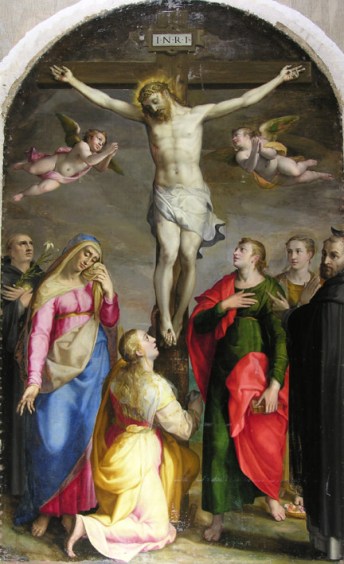
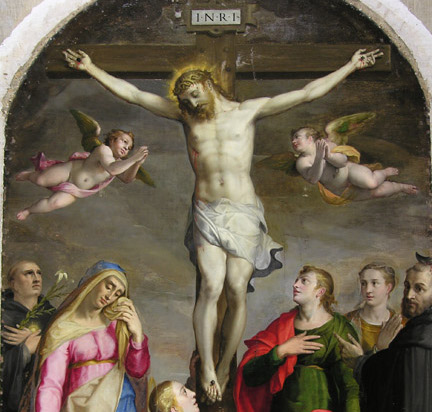
We speak often of the gift of redemption that Christ offers us via His death on the cross. But through His Passion and death, He gives us another gift as well. One that we often overlook. He offersSabatini_santi crucifixion us an opportunity to experience first-hand that “greater love” of which He speaks. Not through His sacrifice. But through our own.

Of all the imaginable plans for redemption that one could have conceived, it seems the one God chose is most peculiar. After all, His only Son didn’t come into the public realm until His 30th year, he surrounded Himself with devoted friends, walked with them, talked with them, and confided in them over the course of three years, only to allow leaders of the day to mock Him, scourge Him, strip Him of His dignity, nail Him to a cross in a most humiliating way and leave Him to hang for three hours until he breathed his last.

What about that makes sense? As a Protestant, I must admit I didn’t ask very many questions. I just accepted that He died, so I didn’t have to.

But after spending some time contemplating the cross, I began to think I wasn’t seeing the whole picture. I began asking. Thankfully, our Faith offers answers. And they are more profound and beautiful than I could have ever imagined.

My greatest question had to do with His manner of death. We understand that Christ redeemed us from the absolute misery and degradation of sin. But why in this way – through a humiliatingly public and  torturous death which reached its climax atop a mountain, upon a crude and rugged cross?

Why did Christ have to make redemption such a profound and gruesome process?

Most likely His goal was to give us an example to follow:

A new commandment I give to you, that you love one another; even as I have loved you, that you also love one another. By this all men will know you are my disciples, if you have love for one another (John 13:34-35).

With those six little words, “even as I have loved you,” Christ gives us everything.

By virtue of His cross, Christ re-opened the gates of heaven. Gates that had been closed for thousands of years as a consequence of the first sin. He demonstrated for us the power of that cross. And He calls us to follow his example:

“If any man would come after me, let him deny himself and take up his cross and follow me. For whoever would save his life will lose it, and whoever loses his life for my sake will find it” (Matthew 16:24-25),

This is that narrow gate about which we hear so often (Matthew 7:13).

Love is not a a pile of sentimental poems or a confetti of rose petals streaming from the heavens.

In reality, love looks a lot like suffering. It can be painful. It can be heart wrenching.

Indeed, love is a sacrifice.

A sacrifice first wrought by Christ, who came to show us The Way.

According to Pope Benedict XVI in Jesus of Nazareth: Holy Week,

He has truly gone right to the end, to the very limit and even beyond that limit. He has accomplished the utter fullness of love – he has given himself.

First Christ defined love.

And then He asked us to practice it.

You shall love the Lord your God with all your heart, and with all your soul, and with all your mind. This is the great and first commandment. And a second is like it, You shall love your neighbor as yourself” (Matthew 22: 36-39).

For God, love = sacrifice.

And what is a sacrifice, but suffering, wrapped in a beautiful package and offered as pure gift?

Through our participation in the Body of Christ, we have the opportunity to unite our suffering with His, as we truly are One Body – this is not mere concept and symbolism. Rather, the very gift of Self that Christ has given us is the grace that helps us to love as He has loved. As Paul explains, through our participation in The Body, we have the privilege of participating in redemption:

Now I rejoice in my sufferings for your sake, and in my flesh I complete what is lacking in Christ’s afflictions for the sake of his body, that is, the church….(Colossians 1:24)

Paul  bids us to offer ourselves as well, to worship God through our own participation in this new concept of sacrifice that Jesus has introduced by the cross:

I appeal to you therefore, brethren, by the mercies of God, to present you bodies as a living sacrifice, holy and acceptable to God, which is your spiritual worship.(Romans 12:1).

Benedict XVI expounds on this concept of sacrifice:

…it means the offering of one’s whole existence that must be penetrated by the word and must become a gift to God. Paul, who places so much emphasis on the impossibility of justification on the basis of one’s own morality, is doubtless presupposing that this new form of Christian worship, in which Christians themselves are the “living and holy sacrifice”, is possible only through sharing in the incarnate love of Jesus Christ, a love that conquers all our insufficiency through the power of his holiness…

…the greatness of Christ’s love is revealed precisely in the fact that he takes us up into himself in all our wretchedness, into his living and holy sacrifice, so that we truly become “his body.”

Later, he concludes,

In living out the Gospel and in suffering for it, the Church, under the guidance of the apostolic preaching has learned to understand the mystery of the Cross more and more, even though ultimately it is a mystery that defies analysis in terms of our rational formulae. The darkness and irrationality of sin and the holiness of God, too dazzling for our eyes, come together in the Cross, transcending our power of understanding. And yet in the message of the New Testament, and in the proof of that message in the lives of the saints, the great mystery has become radiant light.

This is God’s gift to us. The opportunity to unite our sufferings, our frustrations, our inconveniences, to His in Love. For the good of ourselves; for the good of the body of Christ, that is, the Church.

Throughout our lives as Children of God, we are offered an infinite number of “rungs” upon which to climb as we progress up the ladder of the Cross. When we ascend in love, the result is beautiful, both in Heaven and on earth.

When you look at a crucifix today, thank God for the gift of sacrifice.

And ask for the grace to answer His call.

Seven Words for Seven Days: Meditations and Sacrifices for Holy Week

Why not make this Holy Week the greatest one yet? Don’t worry. You needn’t drop everything and spend the week in a monastery (lovely thought, but not practical for most of us). Instead, spend some time meditating on the seven last words of Christ. Easter is seven days from now – just enough time to contemplate each. But if you read this later in the week, begin wherever you find yourself. In the interest of space, my words are few, meant only to inspire further contemplation on The Word.

We have come to the last stretch of Lent. Now we begin our journey through Holy Week, the most sacred week of the year, culminating in the magnificent celebration of the Resurrection on Easter Sunday.

it is finishedSo how fruitful has your Lent been thus far? Have you taken this time to repent of your sins and wring your soul of all its wretched ugliness? Have you purified your intentions, discarded your attachment to the material and focused your eyes on the goal of heaven? Have you taken additional time for prayer, fasting and almsgiving?  For some additional spiritual reading? Or do you sit on the cusp of Holy Week wishing you’d given just a bit more of yourself over the past several weeks?


Often we begin our Lenten journey with great intentions, full of courage regarding the road ahead. We are determined to tackle that narrow path. We seek God’s grace and we truly believe that we can do all things through Christ who strengthens us (Philippians 4:13). We set our sights far before us, planning to thrust off the world and claim our inheritance as children of God. But as the journey takes its toll, temptations stand tall and our view of heaven is obstructed once again. Earthly commitments tend to get in the way, and our resolve fades as the days grow long and the light at the end looms dim.

But Holy Week is a new beginning. Regardless of how we’ve faired in the desert, Christ asks us to walk with Him as He makes his way through Jerusalem and enters into His paschal mystery. What a privilege to solemnly unite ourselves to His Way for the final trek of his journey.

Why not make this Holy Week the greatest one yet? Don’t worry. You needn’t drop everything and spend the week in a monastery (lovely thought, but not practical for most of us). Instead, spend some time meditating on the seven last words of Christ. Easter is seven days from now – just enough time to contemplate each. But if you read this later in the week, begin wherever you find yourself. In the interest of space, my words are few, meant only to inspire further contemplation on The Word.

Sunday: “Father, Forgive them, for they know not what they do.” — Luke 23:24

Like Christ, who forgave the most evil of actions and actually prayed for His persecutors, take some time today to pray for someone who has persecuted you. Perhaps you don’t hold a grudge on the surface; but somewhere deep in your heart have you hardened yourself toward someone who just keeps on pushing – your spouse? Your teenager? Your best friend? Today is the day to release those who continue to sin toward you.

Action: Consider all the sins you’ve committed. Acknowledge that you would be lost without Christ’s grace. Go to Confession if at all possible; and regardless, pray an Act of Contrition. Then offer a penance today by denying yourself one of your favorite daily habits.

Monday: “Truly, I say to you, today you will be with me in Paradise.” —Luke 23:43

Remember that Christ showed mercy to even the most lost of souls. Extend yourself to someone who does not deserve it. And remember that before God, we are not more deserving than the lowest of the low who stands before us. We must love like Christ loves, that (like the good thief on the cross), we, too, might join Him in Paradise.

Action: Contemplate heaven. Think of your absolute favorite thing on this earth; and then consider it as nothing compared to the eternal joy of our Heavenly Father’s house. For others – pray for the poor souls in Purgatory. Consider adding the Saint Gertrude Prayer to your daily routine. For yourself or for a loved one – take the steps necessary today to obtain a plenary indulgence.

Tuesday: Jesus said to his mother: “Woman, behold your son.” Then he said to the disciple, “This is your mother.” — John 19:26-27

Mary is your mother. Just stop and inhale that thought for a moment. The Mother of God is your mother too! And just as your earthly mother desires only what’s best for you, your heavenly mother desires only to unite you to her Son, and will do whatever it takes to lead you to Him.

Action: Pray the rosary today. Contemplate the Sorrowful mysteries and spend time thinking both of Christ’s suffering for us, and also of the Sorrows of Mary that are part and parcel of her perfect motherhood.

Wednesday: “My God, my God, why have you forsaken me?” — Matthew 27:46 and Mark 15:34

Sometimes we feel completely abandoned by God. But even in your darkest hour, you can rest assured that “the Lord your God goes with you; he will never leave you nor forsake you” (Deuteronomy 31:6). There is no greater obedience than that which stems from trust. And we have God’s word that we can trust Him, “For I know the plans I have for you,” declares the Lord, “plans to prosper you and not to harm you, plans to give you hope and a future” (Jeremiah 29:11).

Action: Pray the Divine Mercy Chaplet today. If you haven’t already done so, consider making it part of your daily routine, . For a great discussion on God’s gift of Divine Mercy and how it is playing itself out in our world today, read The Second Greatest Story Ever Told by Father Michael Gaitley.

Thursday: I thirst. — John 19:28

As Blessed Mother Teresa often said, Christ’s greatest thirst is for souls. He doesn’t long for just any soul. He longs for your soul. He desires nothing more than to be united with you forever in His heavenly kingdom. And the most beautiful part? At your innermost core, you long to quench His thirst, for “As the heart longs for flowing streams, so longs my soul for thee, O God” (Psalms 42:1). Christ longs for us. We long for Him. A perfect match, disparaged only by the brokenness and obscurity of sin.

Action: When Mother Teresa was young, the very poor would knock on her family’s door asking for food. Her mother used to say, “Teresa, go and make a sandwich for Jesus.” Quench His thirst as did Blessed Mother Teresa. Today, offer your time, talent and or treasure to serve the poorest of the poor in your community. Also, deny yourself a meal today and offer your sacrifice for the poor among us. Do not simply give. Give with absolute joy and thanksgiving, recognizing those whom you serve for who they are – Christ, in your midst.

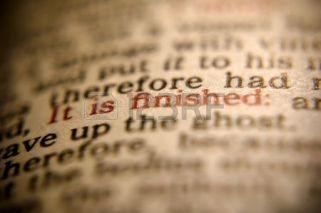
Friday: They put a sponge soaked in wine on a sprig of hyssop and put it up to his mouth. When Jesus had received the wine, he said, “It is finished;” and he bowed his head and handed over the spirit. Gospel of John 19:29-30

Oh, the thousands of pages that have been written to analyze these three words. Yes. It is finished. At the most simple level, His job is complete. We have been redeemed. Now, the question – as we force ourselves to contemplate his blood-soaked body, hanging helplessly upon the cross –  How are we going to respond to His gift?

Action: Attend The Stations of the Cross today, on this, the saddest and yet most beautiful day of the year. The Bible tells us that “greater love hath no man than this, that a man lay down his life for his friends” (John 15:13). Is there someone you would like to bring back to Christ? In addition to your Lenten fast, offer a particularly difficult sacrifice today for that person’s soul. Whether it be giving up coffee, complaining, or something else that reminds you of your sacrifice several times today, you will never regret offering such a loving gift. God hears your prayers and will not leave you alone. Elisabeth Leseur spent years offering prayers and sacrifices for the conversion of her atheist husband, even offering her life in the end. Her sacrifices were rewarded when her husband became a practicing Catholic, and then a Dominican priest.

Saturday: Jesus cried out in a loud voice,  “Father, into your hands I commend my spirit.” Gospel of Luke 23:46

At the end of your earthly life, we, too, will commend our spirits into God’s hands. It should be our greatest desire to do this with peace and joy, rather than fear and trepidation. Choosing daily to unite our wills to God’s, will bring great comfort, for we will never be unsure about what to expect when our time comes.

In handing your life over to God, you can be confident that upon your death, you will hear the words, “Well done, good and faithful servant; you have been faithful over a little, I will set you over much; enter into the joy of your Master” (Matthew 25:23). For you, Easter Sunday will be a reminder of the Hope that gives us the power to trust without fear.

Action: Spend an hour in adoration today. Contemplate His will. Know that in your sacrifice, you are uniting yourself to Him. Prepare yourself for the Resurrection that is to come, and think of the joy that will surpass all words when, upon leaving this earthly life, you find yourself in the arms of your Heavenly Father.

The root of all good works is the hope of the resurrection; for the expectation of the reward  [moves] the soul to good works. – Saint Cyril of Jerusalem


Note: If you like what you just read, please click the “follow” button to receive thought-provoking and action-oriented bi-weekly posts promoting the virtue of sacrifice. 

Lent – Where the Body Meets the Soul

Have you given anything up this Lent?

It seems everywhere I turn this year, I have found recommendations about “doing” things for Lent. I’ve seen flyers taped to church doors, I’ve received videos from Catholic chocolateapostolates, and I’ve heard discussions via Catholic radio. They don’t suggest that we not attempt a physical discipline; but while they encourage us to engage in spiritual reading, help the poor, perform the corporal and spiritual works for mercy or spend more time in prayer, they say virtually nothing about restraining our appetites in any way.
This “do something positive” trend seems to have increased in recent years. But while  the above suggestions are all laudable activities, we should remind ourselves that the saints would not have separated living out their faith in a positive way from disciplining themselves via abstinence, fasting and mortification. In fact, they considered the spiritual life to be deeply connected with the physical. They recognized that when we lack discipline in our physical lives, our spiritual lives suffer.

Here are just a few comments from the saints on physical discipline (or a lack thereof) and its relationship with the soul:

Do you not know that fasting can master concupiscence, lift up the soul, confirm it in the paths of virtue, and prepare a fine reward for the Christian? -Saint Hedwig of Silesia

Irrational feeding darkens the soul and makes it unfit for spiritual experiences. – St. Thomas Aquinas

As long as a single passion reigns in our hearts, though all the others should have been overcome, the soul will never enjoy peace. – St. Joseph Calasanctius

It is almost certain that excess in eating is the cause of almost all the diseases of the body, but its effects on the soul are even more disastrous. – St. Alphonsus Liguori

The more we indulge ourselves in soft living and pampered bodies, the more rebellious they will become against the spirit. – St. Rita of Cascia

Yes, of course we should engage in activities that help others or increase our spiritual knowledge and time with Christ. But we shouldn’t allow those things to excuse us from taming our passions and appetites.

Unfortunately, many times we allow our sacrifices to become ends in themselves. Perhaps this explains the “upswing” in recommendations for other Lenten activities. After all, things like prayer, spiritual reading, or even practicing works of mercy  directly impact our relationship with The Lord, whereas giving up cake could seem like a random and inconsequential activity. But the fact is that our faith is not either…or; it should be both…and.

We will not have a fruitful Lent just because we declare that we are “giving up _____.” Rather we should remember that those physical sacrifices are not ends in themselves. The end of all discipline must be love. We give up chocolate, – or whatever else – to remind ourselves that this world is fleeting. It is an expression of love that we lavish on Our Lord, passionately declaring that this television set, this candy bar, this ice cream, this cake, these cookies – any and all things which we enjoy in this life – are but nothing compared to Him.

This is the time of year when, as individuals united with the entire Church, we encourage ourselves to walk through the fires of discipline and denial for Our Beloved! This is our time in the desert. This is when, by God’s grace, we face the temptation of X, and we declare,

Man should not live by bread alone, but by every word that comes from the Father’s mouth. – Matthew 4:4.

It is when we look over all creation and remind ourselves,

You shall worship the Lord your God and him only shall you serve. – Matthew 4:10

There is great power in knowing that by Gods’ grace we can be in control. That our appetites do not rule us. Provided we always keep in mind the ultimate end of self-control:

The purpose of asceticism, self-denial and mortification is the growth in charity or love of God. Christian self-denial is not based on the idea that the world, or the flesh are intrinsically wicked, but on the conviction that God is intrinsically good. – Archbishop Fulton Sheen

We release the chains of this world so we can bind ourselves more closely to Christ. Doing so will help us to live our faith more fully. God’s grace helps us to feed the hungry, clothe the naked or visit the imprisoned. And that grace flows abundantly when one of His children demonstrates a commitment to God, the Father, in heaven over the material gods of the earth.

So – What have you given up this Lent? There’s still time…


Note: If you like what you just read, please click the “follow” button to receive thought-provoking and action-oriented bi-weekly posts promoting the virtue of sacrifice. 

Lord, Teach Me to Love

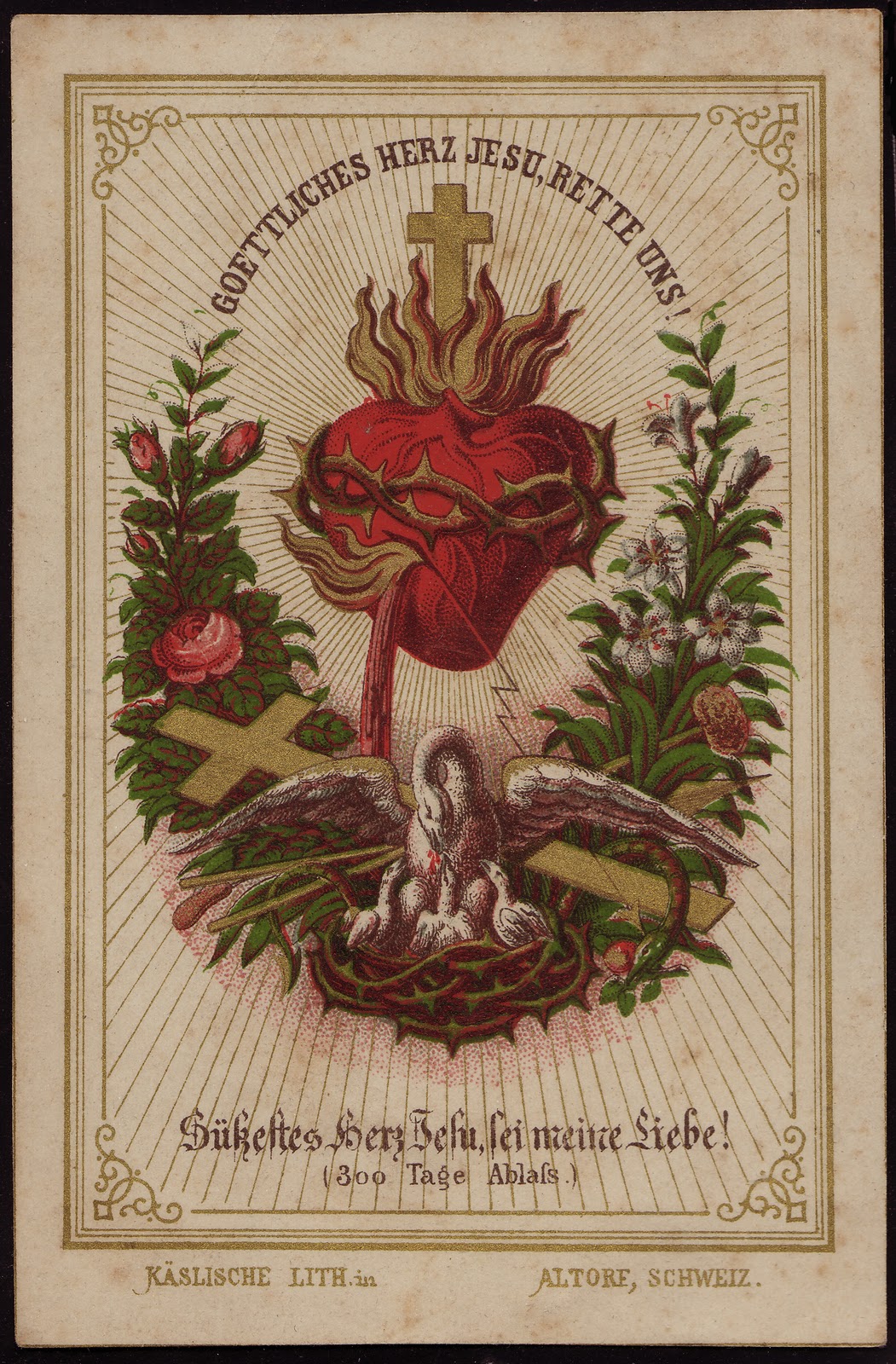
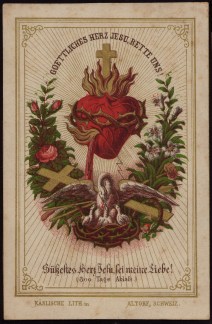
DDivine Heart of Jesus save us. Sacred Heart of Jesus, be my loveear Lord,

This morning in prayer I was contemplating your Sacred Heart.  I thought about Saint Margaret Mary and how you told her of your great love for us and your desire to be loved.  How you ask that we make reparation for all those who don’t love you.  Those who take you for granted even as they call themselves Christians.

I thought of your great desire for love and sacrifices.  In a passion of prayer, my heart was full to overflowing. I threw myself at your feet and promised that I would love you. That I would do anything to make up for those who have failed you.

But immediately I was struck by a paralyzing realization.

I am the one who has failed you. I am the one who has turned my back on you. I am the one who has taken you for granted.  I am the one for whom you seek reparation.

I am not the cure; I am the disease!

It occurred to me that I, who long to love you above all things, don’t even know how to love.

Through divine inspiration, you defined love for us in 1 Corinthians 13:

Love is patient

...but I am not patient.

Love is kind

…but I can be unkind.

Love is not jealous

…but as I look around, I find it difficult not to compare myself to others and succumb to jealousy when I come up short.

Love is not pompous; Love is not inflated

…but too often I find myself full of pride.

Love is not rude

…but I can be rude.

Love does not seek its own interests

…but my interests are all too often on my mind.

Love is not quick-tempered

...how often do I lose my temper?

Love does not brood over injury

…but I brood. And brood. And brood.

Love bears all things

…but I am so weak.

Love believes all things

…but too often I live in fear and doubt.

Love hopes all things

…how many times have I felt helpless and hopeless?

Loves endures all things

…but I have been known to argue and complain.


Who am I to offer my devotion to you?

Love is sacrifice. And sacrifice calls me to give of myself. In this, I hesitate. I want to let go; to give. But I continue to hold on. Hold on to what? To my desires. My goals. My preferences. My plans. My time. Each time I reach out, I am quick to pull back. I know that, like you, I must crucify myself in order to truly love. But even in small things, I often find the cross too painful to bear.

Saint Paul instructed us,

…Present your bodies as a living sacrifice, holy and acceptable to God… —Romans 12:1

But crawling up on that altar is soooo hard.

Thankfully, he also told us what we must do to take this difficult step:

Do not be conformed to this world but be transformed by the renewal of your  mind, that you may prove what is the will of God, what is good and acceptable and perfect. — Romans 12:2

I have a long way to go before I break the shackles of this world. But in this I am not hopeless.  I know that if I ask, You will give me the grace to know You, to love You and to serve You.  To sacrifice for you.

Please help me to climb up on that altar.

Teach me to be patient and kind.  To avoid jealousy, pompousness, pride, selfishness, a quick-temper and please replace my brooding nature with one of great joy!  Help me to bear all things, hope all things and to endure all things.

Lord, teach me to love.

*Image borrowed from Holy Card Heaven


Note: If you like what you just read, please click the “follow” button to receive thought-provoking and action-oriented bi-weekly posts promoting the virtue of sacrifice. 

Divine Mercy for Godly Leaders

Tomorrow is Super Tuesday. Voters from thirteen states and one territory will head to the polls to voice their choice of Republican and Democratic candidates for president of the american flagUnited States of America. As a resident of Nebraska, I will not be voting tomorrow, but will be riveted to my television set to learn where all the votes land. With 600 delegates up for grabs, tomorrow will either serve to further solidify the current path or prove to be a significant game changer.

Thus far there has been record-setting participation throughout this process. Americans realize there is a lot at stake in this election. I don’t think I’m overstating things when I say that many Americans believe our country stands on the brink of disaster. With regard to social, economic and national security issues, our nation’s very identity may be on the line.

What can we do? Of course, each of us has an obligation to vote with a well-formed conscience. But additionally, we must pray. I’ve learned that prayer for our country is a sacrifice that is both immediate and fruitful.

At spiritualdirection.com we are reading Father Michael Gaitley’s The Second Greatest Story Ever Told. I strongly recommend the book; thus far it has illustrated for me in a profound way the very personal interest Our Lord has in our lives and the power of Divine Mercy to change them. Not only our lives as individuals, but to change our nations.

Until now I have felt relatively helpless about the direction of this campaign cycle. Certainly I have prayed – but in a posture of isolation. No longer. The truth is that I am certainly not alone; doubtless there are thousands who desire God’s mercy on our country and who might be willing to unite together in a sacrifice of prayer for Divine Mercy with the intention of God’s hand in the selection of our nation’s leaders. With this, I have gained a new hope.

For with God, nothing will be impossible (Luke 1:37).

Just imagine how Our Lord will look down upon his children, pleading together for His purpose in this, the Year of Mercy. Perhaps together we can be to Our Lord as the widow who incessantly pleaded with the judge for vindication against her adversary (Luke 18:1-8). In the end, He took pity on her and acted on her behalf. This parable serves as an example to us, for Christ concluded by saying,

And will not God vindicate his elect, who cry to him day and night? Will he delay long over them? I tell you, he will vindicate them speedily. – Luke 18:7-8)

Would you be willing to sacrifice a few minutes every month until the November election to join us in a perpetual prayer of Divine Mercy for the united intention of Godly leaders for our country – particularly for the office of president and for the selection of a Supreme Court nominee that may or may not be appointed before the November election? If so, please click on the link below to commit to one day of the month when you will pray a Divine Mercy Chaplet for our united intentions. Then over the next eight months – until the election – please pray the chaplet each month on your chosen day. This type of sign-up does not allow for email reminders, so please put your date on the calendar with a monthly reminder.

Divine Mercy for a Divided Country

Please find a link to the Divine Mercy Chaplet here.

Eight months and eight days stand between us and the presidential election. The number eight has great biblical significance. There are eight beatitudes – our given path to Joy and Peace. Also, our Lord rose from the dead on the eighth day after his providential ride into Jerusalem. The number eight represents joy, peace and resurrection – three things of which our country is in great need.

None of us knows what November will bring. But no matter how the election bears out, we have confidence that our prayers will be fruitful. For we know

that in everything God works for good with those who love him, who are called according to His purpose. — Romans 8:28.

With that in mind, always…

Rejoice in your hope, be patient in tribulation, be constant in prayer. – Romans 12:12

I hope that you will consider this small sacrifice for our country.

Mother Mary, Immaculate, Patron of The United States of America, Pray for Us.


Note: If you like what you just read, please click the “follow” button to receive thought-provoking and action-oriented bi-weekly posts promoting the virtue of sacrifice. 

Pelican’s Breast – A Symbol of Sacrifice

There is a great need for sacrifice in our world. Rather than look to God merely for His glory, we must seek Him in His suffering and degradation.

Perhaps you’re wondering why anyone would choose Pelican’s Breast for a blog name? It’s certainly not top on the list of popular domain names, that’s for sure. But when I contemplated a discussion on sacrifice, it became clear that Pelican’s Breast was the way to go.

Throughout history, the pelican has been a great symbol of sacrifice. According to ancient legend, a mother pelican would pierce her own breast in times of famine, that her children might seek sustenance from her very flesh and blood. When necessary, the mother pelican was said to have readily offered this sacrifice at the cost of her own life. Pelican's Breast Image

Over time, for obvious reasons, the pelican came to symbolize Christ, who gives us his very flesh and blood, that we might have eternal life. You may have even noticed carvings or stained glass windows of the mother pelican and her young in your local church, as a symbol of Christ in the Eucharist, but also as a symbol of sacrifice for us to model.

Unfortunately, just as the story of Christ’s actual sacrifice is heralded less and less, in most places today we hear little of the legend of the pelican. Sacrifice is something not often promoted today. At least, not in close quarters. We’d rather have the resurrection without the cross. But sadly, without the cross, there can be no resurrection. For Christ Himself said,

If any man would come after me, let him deny himself and take up his cross and follow me. For whoever would save his life will lose it, but whoever loses his life for my sake will find it.  -Matthew 16:24-25.

Christ calls us to sacrifice. He isn’t just calling for us to “suffer” with him because misery loves company. Rather, in His infinite wisdom, He knows that in this world so lovingly created for us, our joy will directly correspond to our ability to keep our eyes on the ball, so to speak. He knows that our willingness to sacrifice in this life will not only prepare us for heaven, but will make for a much more fulfilling time on earth. In our day, we are experiencing the antithesis of this. We are seeing the results of a refusal to sacrifice. We are witnessing daily the results of the culture of ME. And most of us would agree that they are not pretty.

There is a great need for sacrifice in our world. Rather than look to God merely for His glory, we must seek Him in His suffering and degradation. We must follow Saint Paul and

…rejoice in our sufferings, knowing that suffering produces endurance, and endurance produces character, and character produces hope, and hope does not disappoint us, because God’s love has been poured into our hearts through the Holy Spirit who has been given to us. – Romans 5:3-5

When we turn suffering, annoyances or obligations into gifts of love, they become sacrifices. When we give – whether our time, treasure, desires or our very selves – we are offering sacrifices. And we are in great need of sacrifice today.

Back to the symbol of the pelican. Our own children are starving. Worse than starving from physical depravation, they are suffering from great emotional and spiritual deprivation. Many are missing the very foundation of childhood that stems from the security of family. They are raised in a culture that values the material over the spiritual, relativism over truth, personal choice over life and pleasure and self-determination over commitment.

Starvation from love and truth are exponentially more destructive than starvation from food:

And do not fear those who kill the body but cannot kill the soul; rather fear him who can destroy both soul and body in hell. – Matthew 10:28

For the sake of our souls and for those of our children, we must begin to embrace the notion of sacrifice. Take some time this week to contemplate the cross. And if you are so inclined, tune in to the pelicansbreast.com and join our discussion.

In my next post, we’ll begin to discuss sacrifice in practical terms.


Note: If you like what you just read, please click the “follow” button to receive thought-provoking and action-oriented bi-weekly posts promoting the virtue of sacrifice. 


A New Blog about Sacrifice

Let’s start a conversation about sacrifice. If each of us takes even a step in the right direction, imagine what a change we could effect on the world.

mother teresaSacrifice, to be real, must cost, must hurt, must empty us of ourselves.” – Blessed Mother Teresa of Calcutta

Over the past four years, along with thousands of fellow Christians, I have combed through the pages of some of the most profound books ever written on Catholic spirituality (check out our book club at spiritualdirection.com). During that time, my soul has been awash with gallons of words, some more palatable than others. Much to my chagrin, the most common word in all those great works has by far been the most difficult to ingest – its sticking power gnawing at my insides in the most inopportune moments – whenever I want to splurge on a new book, or when I’m dying to eat that last piece of cake, or when my son asks me to iron his forgotten school shirt at 11:30pm, or when I just sit down to read and the dog starts barking at the door.

That word is…Sacrifice.

An all-American, consumption-loving girl at heart, I’ve been doing my best to ignore this little word as it nibbles ceaselessly at my core; but try as I might, it’s not working.

It’s one of those words that inspires from afar; but most of us don’t want to get too close.  There is a love-hate relationship with the notion of sacrifice that is unlike that of any other subject.  We admire those who make great sacrifices, but most of us have become virtually unwilling to get into the mire and muck of pain and self-denial necessary to get the job done.

You see, in our culture, SACRIFICE is a dirty word.

The thing is, throughout my reading I have discovered that sacrifice is a theme that gets to the heart of all blossoming relationships.  It is a theme that would have been obvious to any of the saints to whom we look for inspiration.  It is a theme that was perhaps taken for granted even a hundred years ago.  But it has long since been left in the dust, smited by the philosophy of individualism that has taken us from a freedom to do good, to a belief in license to do whatever we want, despite foreseeable consequences to those around us.  We have become a society grounded in “ME.”  And any society grounded in ME is bound to have members who recklessly trample each other to destruction.  Even our definition of LOVE has come to represent ME.  It is all about my FEELINGS.  And when my FEELINGS no longer exist, then LOVE is gone and I am obligated to find MY fulfillment elsewhere.

Interestingly enough, in the history of the Church, love has never been bound up with feelings.  And it has never been about ME.  Rather, since Our Lord came into this world over 2,000 years ago as Love incarnate, ultimately laying down His life for each and every one of us, love has always been a verb – a verb inextricably intertwined with SACRIFICE.

Hence this blog. Let’s start a conversation about sacrifice. Not a complaining, frustrated conversation. A positive, life-changing conversation. About sacrifice in our country; sacrifice in our homes; but mostly, about sacrifice in our thoughts and in our words, in what we do (not what we fail to do). Let’s have a conversation about offering all to a God who has given all to us. If each of us takes even a step in the right direction, imagine what a change we could effect on the world.

Will you join me?


Note: If you like what you just read, please click the “follow” button to receive thought-provoking and action-oriented bi-weekly posts promoting the virtue of sacrifice.