

by Fr. Jeff Loseke
As a seminarian in Rome, I used to lead English-speaking pilgrims on a faith-filled tour of St. Peter’s Basilica on a weekly basis. One of the highlights of the Vatican Basilica is the 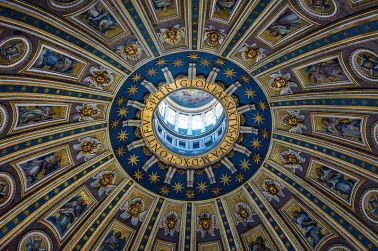 magnificent dome, which rises 448 ft above the floor. It is set directly over the main altar, which itself is set directly over altars from the 7th to the 12th centuries on the crypt level of the basilica. These altars themselves are situated directly above another monument from the first century that marks the gravesite of the Apostle Peter. The ancient Roman cemetery that lies beneath St. Peter’s Basilica was unwittingly preserved by Emperor Constantine, when he buried the cemetery in order to create the foundation for the first church built over the site of Peter’s tomb. Excavations carried out between 1939 and 1949 unearthed the ancient cemetery once again and confirmed the Church’s memory that the basilica was indeed built directly over the Apostle’s grave.
As we trace the history of the Church back through the centuries, we are reminded of the truth of St. Paul’s words in his first letter to the Corinthians that the Christian faith has been—and continues to be—passed on from one generation to the next through the lived Tradition: “For I handed on to you… what I also received” (15:3). Through her living Tradition, the Church has preserved and handed down the Sacred Scriptures, the teachings of the Apostles, and the mode for celebrating the Sacraments. In a word, the Church of today continues to do what the Church of the first century did: “They devoted themselves to the teaching of the Apostles and to the communal life, to the breaking of the bread and to the prayers” (Acts of the Apostles 2:42).
Because 2,000 years separate us from the days when Jesus Christ walked among us in the flesh, the Christian of today can be tempted to doubt the authenticity of what has been passed down through the centuries by the Church. In fact, this temptation formed, in part, the impetus for the Protestant Reformation 500 years ago—that the Church had fallen off the rails and was in need of a complete overhaul. This is why knowledge of history is so important if we hope to stand strong in the true faith! The Word of God became flesh and dwelt among us as part of our human history (cf. John 1:14; Matthew 1:1-25). Even more, Jesus promised that He would remain with His Church until the end of the age (Matthew 28:20), that the Holy Spirit would keep her always in the truth and free from error (John 16:13), and that the power of hell shall never prevail over the Church (Matthew 16:18). Now it is our turn. We must be open to receiving the deposit of faith as it has been passed down to us by the Church for centuries. In this way, we ourselves become a part of the living history of the Church. Then, and only then, do we participate in its authentic transmission to the next generation of believers. Truly, “we hold this treasure in earthen vessels” (2 Corinthians 4:7) and so we must take great care with it.
The Reverend Jeffery S. Loseke is a Priest of the Archdiocese of Omaha and is currently the pastor of St. Charl es Borromeo Parish in Gretna, Nebraska. Ordained in 2000, Fr. Loseke holds a Licentiate in Sacred Theology (S.T.L.) from the Pontifical Athenaeum of St. Anselm in Rome and is working to complete his doctoral degree (Ed.D.) in interdisciplinary leadership through Creighton University in Omaha. In addition to parish ministry, Fr. Loseke has served as a chaplain in the U.S. Air Force, taught high school theology and college-level philosophy, and has been a presenter for various missions, retreats, and diocesan formation days across the country.
Photo: St. Peter’s Basilica, Dome, 2014 (Wikimedia Commons)


 expressed by Jesus in His appearances to the Apostles after the Resurrection (e.g., Matthew 28:18-20; Luke 24:46-49; John 20:21-23). Not only did He command them to preach “repentance, for the forgiveness of sins” (cf. Luke 24:47) but also He gave them a share in His very power so as to effect it. The Apostles, once filled with the Holy Spirit, went out and began building up the Church, the Body of Christ on earth.

 situation further, I discovered that some of the very shelves that once held the tomes of Christianity and Judaism had given way to an increasing repertoire of books organized in categories such as “Magical Studies,” “Inspiration,” and “Spirituality”. This shift in the popular demand for these kind of books does not indicate necessarily that people are becoming less spiritual. Rather, it seems that our society today is becoming far less Christian or, at least, less religious than it used to be.

 not merely an emotion, a thought, or an ideal. Rather, the love of God is His very self. To stand before the love of God is to stand before Him who made us and who knows us better than we could ever know ourselves. Despite our complete inadequacy before God, we know that He desires that we open up ourselves in order to give ourselves to Him to the best of our abilities—even if it falls short. Love requires an openness that makes one vulnerable.

 many people across our globe who yearn to be able to live in peace and to pursue happiness in their own homelands, and there are countless others who would risk even their own lives to come to America to experience it. As we approach our nation’s Independence Day, we have much for which to be grateful. Fundamentally, our gratitude stems from the recognition that the blessings we enjoy in this country do not come from ourselves. It was someone else’s sacrifice, someone else’s struggle that won the independence we so cherish. As Christians, we can give thanks further for the ultimate gift of freedom that was purchased for us by Jesus’ one Sacrifice on the Cross. His Sacrifice fulfills all others, and, moreover, it infuses all other sacrifices with the power to defeat evil. Not only are we given the gift of freedom, but we are invested with its responsibility as well. All those who have been baptized are now sharers in the work of Christ in bringing this freedom of salvation to the whole world (cf. Col 1:24).

 crucifixion by rising from the dead. Interestingly, the cross was not one of the principal symbols the first Christians used to identify themselves as followers of Jesus, however. Why not? Probably because it was far too obvious. To publicly declare oneself a Christian, especially during the 2nd and 3rd centuries, was a crime punishable by death. While many believers publicly professed their faith when pressed to do so, they were not necessarily in the habit of volunteering such information. This was by no means an act of cowardice, but rather an act of prudence.

 it is a feast that acknowledges humanity’s failure to love God fully in return. Without the Savior loving both us and the Father to the end, we would not be redeemed. Not only did Jesus willingly lay down His life for our salvation, but also He allowed His very heart to be pierced by a lance. With that final act of man’s rejection of the Father’s love, God could have poured out judgment upon the centurion and upon the whole world for the death of His Son. Instead, God willed that blood and water—symbols of the Eucharist and Baptism—should flow from Christ’s wounded Heart to bring healing and conversion to sinful humanity. No matter how many times humanity has offended and rejected God, He has always been ready to meet us with mercy and forgiveness.

 substantial, real, and abiding presence in His Church. We acknowledge and worship this sacramental mystery whereby ordinary bread and wine become the Body and Blood of Christ. Neither is the Eucharist just a symbol of Christ’s Body and Blood nor does it reveal Christ to us only spiritually. We know that Christ is really and truly present—body, blood, soul, and divinity—in the Eucharist. This truth is so central and so important to our faith that the great Catholic American author Flannery O’Connor (d. 1964) once said in defense of the Eucharist: “Well, if it’s a symbol, to hell with it. It is the center of existence for me; all the rest of life is expendable.”

 and again for vacation to enjoy each other’s friendship while we travel. To see us together, one would not immediately recognize us as Priests at first glance since we often do not travel in Roman collars or other such clerical garb while on vacation. Nevertheless, our identity is sometimes uncovered… not by how we are dressed but by a faith that cannot be hidden.

 ourselves outside a whole lot more. We are enjoying picnics, reunions, vacations, games, gardening, and a whole host of summertime activities. Not only might we find ourselves enjoying God’s marvelous creation more, but also we add to it by expressing our own gifts and talents within it.
 pelicansbreast.com