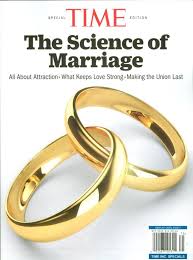
Time Magazine, Marriage is a Sacrament – Not a Science

Watch what you read. When it comes to sacred topics – particularly marriage – you may want to seek answers from among the great annals of wisdom available within the Church. For only in union with Christ can marriage achieve its true fulfillment.

time

I just picked up Time Magazine’s special edition issue on The Science of Marriage.

Interesting take. That is, if you detest the institution of marriage and choose to see it through the eyes of an  impassioned skeptic. Here’s the very first paragraph in the issue:


There’s a reason fairy tales always end in marriage. It’s because nobody wants to see what comes after. It’s too grim. Meeting the right person, working through comic misunderstandings and overcoming family disapproval to get to the altar — those are stories worth telling. Plodding on year after year with that same old soul? Yawnsville.
– p. 6

A few paragraphs later the attitude doesn’t improve:

Matrimony used to be an institution people entered out of custom, duty or a need to procreate. Now that it’s become a technology-assisted endeavor that has been delayed until conditions are at their most optimal, it needs to deliver better-quality benefits. More of us think this one relationship should – and could – provide the full buffet of satisfaction: intimacy, support, stability happiness and sexual exhilaration. And if it’s not up to the task, it’s quicker and cheaper than ever to unsubscribe. It’s not clear any relationship can overcome that challenge. – p. 6

This is what the world is hearing when it comes to the most beautiful and sacred union available to man this side of heaven.

The article goes on to assert that

“It’s not even clear anymore exactly what couples are signing up for. Marriage is the most basic and intimate of our social institutions but also the one most subject to shifts in cultural, technological and economic forces, many of which have made single life a completely viable and attractive proposition.”

Really? I submit that environmental factors have not lessened the success of marriage. Perhaps one of the problems is a mistaken understanding that marriage can be analyzed in the same way that you analyze a science experiment. That it can broken down into individual ingredients recipe-style; measured and stirred to create a concoction of some sort – whether a happy and fulfilling life enhancer or an abhorrently hideous Frankenstein’s monster, depending on the mix.

To be fair, this issue of Time is not all negative. It is primarily devoted to things like How to Make Your Marriage Last, or The (Real) Key to a Joyful Union – The problem is that these topics are discussed on a backdrop of negative commentary. The entire magazine is full of skepticism. Beauty is nowhere to be found. Yes, they talk about happy marriages; but the talk is pretty cheap. These writers may mean well; but it’s as though they are dissecting a dead body to look for its soul.  You will never find the key to marriage by sifting through all the parts. Nor can you relay an image of a true marital union by starting with a contractual understanding of the relationship. It’s no wonder these writers seem flummoxed.

When marriage is described as a crap shoot where you throw yourself in and who knows what you’ll get, it’s bound to draw disdain. But for that matter, if it’s described as a science, wherein you’ll get the outcome you want, provided you do a, b and c, there is something hollow in the advice. Either perspective is a sure sign that marriage has been horribly misrepresented and people are being duped  by the unpredictable “science” of love.

No doubt this secular perspective is the reason fewer Americans are tying the knot (20% of adults age 25 or older have never been married, compared to 9% in 1960). No longer is marriage seen as a Sacred Union, but rather as an individual choice, not unlike one’s choice of career. Gone are the days when marriage is universally presumed to be “’till death do us part.” In fact, this Time Special Edition, while sharing much data that demonstrates the benefits of marriage – greater happiness, health, wealth and stability, child development  (in all areas) – also includes a section called The Good Divorce. Including the words “good” and “divorce” in the same header misses the point of marriage entirely.

If you want to learn more about marriage, focus less on the science and more on the Sacramental. Even the Source and Summit of our Faith – the Holy Eucharist – has been referred to as “a nuptial sacrament,” in effort to illustrate the amazing union it confers between ourselves and Our Lord. A oneness akin to the sacred union that takes place between a man and his wife.

A sacramental marriage is a “fountain of grace,” according to Alice von Hildebrand in her introduction to (her husband) Dietrich von Hildebrand’s, Marriage: The Mystery of Faithful Love:

As a Sacrament, marriage gives people the supernatural strength necessary to “fight the good fight.” Every victory achieved together over habit, routine, and boredom cements the bonds existing between the spouses and makes their love produce new blossoms.

Also, because it explicitly and sacramentally unites the spouses with the infinite love that Christ has for each one of them, sacramental marriage overcomes the tragic limits of natural marriage and achieves the infinite and eternal character to which every love aspires. – p. xiv

Dietrich von Hildebrand asserts,

No natural human good has been exalted so high in the New Testament. No other good has been chosen to become one of the seven Sacraments. No other has been endowed with the honor of participating directly in the establishment of the Kingdom of God. – p. 3

And because of this amazing gift, we who are privileged to take part are called to a higher level of sacrifice:

In the supernatural sphere, God gives mankind grace in different measures and demands more from them according to the measure of grace received…So, too, marriage demands more from the husband and wife in the measure that their marriage as such approaches the ideal, and the more they harmonize as characters…

…Every hour they must recall anew the unspeakably precious gift which God has given in the form of the soul of the beloved. Never must they lose their sense of the wonderful mystery that the other person whom they love loves them too, that the other lives for them, and that they own something far above all other earthly possessions. – p. 35

But we get something priceless for all our efforts:

Let us add that Christian marriage also represents for both consorts a way to attain an ever-increasing union with Jesus. As the bond has been concluded in Jesus and toward Jesus, the increase of conjugal love also means a growth in the love of Jesus. The unique abandonment to the beloved, the life of love which one lives and should live, opens the heart and enables it to love more and more. – p. 75

And about the indissolubility of marriage:

It is considered by many as something oppressive and dispiriting, something which deprives love of its wings and gives it a coercive character. They think that love would vanish with the knowledge that the tie is binding whether love persists or not. But nothing is less true. For the real lover, the consciousness of being indissolubly united with his beloved in Christ, of forming an objectively indissoluble community whose validity is beyond all wavering and all human frailties, is a source of the highest satisfaction. For he wants to be one with his beloved, and he is grateful and happy that this unity can be realized to so great a degree and that it rises above all emotional changes. – p. 59

We are human beings. As such, we are bound to be affected by the words we read, as well as the examples we witness. Which words above call you to a higher appreciation for marriage as an institution? Which passages inspire you to love more, to give more? Which passages inspire a profound awe of your God-given vocation?

The bottom line? Watch what you read. When it comes to sacred topics – particularly marriage –  you may want to seek answers from among the great annals of wisdom available within the Church. For only in union with Christ can marriage achieve its true fulfillment, and only an understanding of that truth can allow for any accurate commentary on the subject. Case in point – Archbishop Fulton Sheen so accurately entitled his treatise on the sacramental nature of marriage, Three to Get Married; but if you ever hear that same phrase in the secular culture, you can be pretty sure the reference will be sacrilegious rather than sacramental.

If you’re looking for an accurate view on Marriage, skip the Time Magazine commentary and check out a few of these amazing resources:

Love and Responsibility by Pope John Paul II
Familiaris Consortio by Pope John Paul II
Marriage: The Mystery of Faithful Love by Dietrich von Hildebrand
Three to Get Married by Archbishop Fulton Sheen
Covenanted Happiness by Cormac Burke

Is Your Marriage Lacking a Certain Chemical Element?

Do you watch all the ads with the lovey dovey smiles and the flirtatious eyes, and try to remember what that felt like? Do you recall the giddiness of being young fresh and so in love that even folding socks together was fun?

Valentine’s Day is upon us again.

Do you watch all the ads with the lovey dovey smiles and the flirtatious eyes, and try to remember what that felt like? Do you recall the giddiness of being young and marriage paintingfresh and so in love that even folding socks together was fun? Where even an accidental touch was electrifying and you called your love 100 times a day just to hear his voice?

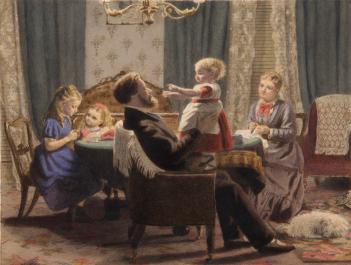
If we’re not careful, love can become like a favorite shirt thoughtlessly tossed into the bottom of a drawer. Over time we tend to pile other things on top of it, passing it over from day to day without even thinking until some random thought, word or action sparks a reminder, and we realize that something very special is missing.

When I was in my early twenties, I began a cross-stitch project that I was sure would be a permanent focal point on my wall. It was a huge, colorful piece of country folk art, and it would have been beautiful. Today, six kids and fifty million ideas later, that piece of art has long been abandoned to the wasteland of forgotten projects.

Recently, my daughters and I were digging through my sewing box to find notions for their latest crafts. Sure enough, they found that old piece of material with the beautiful, but unfinished cross-section of a town, all neatly stitched in bright, bold colors. The finished portion would probably fill a 9×13 frame. They were awestruck. “Mom! This was sooo beautiful! Why would you leave it in a box?! Why don’t you finish it? How could you just put this down and walk away?”

How to explain that things came up? That I was too busy holding babies, doing laundry and feeding kids? And as time passed, my obligations only became greater, running kids from here to there. Other goals. Other plans. I never intended to set it aside for good. In the beginning, I only put it away during a busy time in my life. But then along came something else. And pretty soon, it was relegated to an old sewing box as I focused on making new curtains, pillows and bedspreads for our first house. And then along came the children and there were the sports and the play dates and school. There was always something that kept me from picking up that project.

And now?

I’m no longer interested.

Sadly, many marriages end up in the predicament. Sometimes we cast them aside, with every intention of getting back to them “later,” when life calms down. But then things don’t calm down, and our marriage becomes faded and dingy, lacking the bright color and excitement it once had.

Has our love dwindled?

No.

It’s there; but it might be a little lethargic, perhaps suffering from a lack of oxygen.

It might do us good to breathe a little life back into our marriages – both body and soul.

While challenges in marriage can be complicated, the action of loving is not. Love is a verb. And we must take steps to love our spouses, no matter the condition of our relationship. A simple love offering can go a long way toward reviving that spark. Take some time this week to spend some special time together, sans distractions. And make that a habit. Talk. Listen. Pray together. Attend adoration together. And more than anything else, recognize the privilege you’ve been given by virtue of your sacred union.

There is no magic pill that will liven a marriage relationship. Love takes time. It takes sacrifice. And it takes commitment. Here are just six thoughts to keep in mind regarding this amazing sacrament that is marriage on this very special day. Perhaps contemplating the profound nature of your relationship will help to ignite the flame of desire and spark the passion of commitment:

  1. You have been chosen and called, therefore, as husbands and wives to be for one another the living experiential sign and expression of God’s love by sharing with each other the gifts of uncompromising love, unconditional acceptance, ceaseless dedication, total fidelity, and untiring service. These are the signs of God’s love, and this is what makes God present in the Sacrament of Matrimony. — Dietrich von Hildebrand, Marriage: the Mystery of Faithful Love

  2. How can I ever express the happiness of the marriage that is joined together by the church, strengthened by an offering, sealed by a blessing, announced by angels and ratified by the Father?!!! How wonderful the bond between two believers, with a single hope, a single desire, a single observance, a single service! They are both brethren and both fellow servants; there is no separation between them in spirit or flesh. In fact, they are truly two in one flesh, and where the flesh is one, one is the spirit. Tertullian, quoted in Familiaris Consortio, by Pope John Paul II

  3. The basic error of mankind has been to assume that only two are needed for love; you and me, or society and me, or humanity and me. Really it takes three: self, other selves, and God; you, and me, and God. Love of self without love of God is selfishness; love of neighbor without love of God embraces only those who are pleasing to us, not those who are hateful…Duality in love is extinction through the exhaustion of self-giving. Love is triune or it dies. —Archbishop Fulton Sheen, Three to Get Married, p. 43

  4. In spousal love, the body of the beloved assumes a unique charm as the vessel of this person’s soul, and also as embodying in a unique way the general charm and attraction which femininity has for man, or virility has for woman. Spousal love aspires to the bodily union as a specific fulfillment of the total union, as a unique, deep, mutual self-donation. — Dietrich von Hildebrand, Man and Woman: Love and the Meaning of Intimacy, p. 47

  5. Romance is almost sure to die; love, however, does not have to die with it. Love is meant to mature, and it can do so if that readiness for sacrifice implied in the original self-giving of marital consent is alive or can be activiated. The idea that true love is prepared for sacrifice strikes a chord that perhaps our preaching needs to touch on more. As Pope John Paul II says, “It’s natural for the human heart to accept demands, even difficult ones, in the name of love for an ideal, and above all in the name of love for a person.— Cormac Burke, Covenanted Happiness, pg. 24

  6. Matrimony crushes selfishness, first of all, because it merges individuals into a corporate life in which neither lives for self but for the other; it crushes selfishness also because the very permanence of marriage is destructive of those fleeting infatuations, which are born with the moment and die with it; it destroys selfishness, furthermore, because the mutual love of husband and wife takes them out of themselves into the incarnation of their mutual love, their other selves, their children; and finally it narrows selfishness because the rearing of children demands sacrifice, without which, like unwatered flowers, they wilt and die.— Archbishop Fulton Sheen, The Cross and the Beatitudes, p. 41-42

  7. Do not forget that true love sets no conditions. It does not calculate or complain, but simply loves. – Saint John Paul II, Jubilee of Youth

The Unholy Family

Most of us were born into an unholy family. Actually, that family – unholy as it may be – is the best way for each of us to make our way in this world, the greatest vehicle known to man for our sanctification.

What do you get when two fallen people fall in love and commit to spending the rest of their lives together, struggling through this thing called life, climbing, stumbling, and familyclimbing again; pulling each other up when we fall, sometimes tripping over each other along the way?

You get the precious seed of a holy family.

Your marriage may not be perfect. No worries. So long as you remain committed through the ups and downs and ins and outs of your relationship. Because the commitment itself will provide you both with the room you need for that seed to take root and germinate.

Marriage gives love the structure, the shelteredness, the climate in which alone it can grow. Marriage teaches spouses humility and makes them realize that the human person is a very poor lover. Much as we long to love and be loved, we repeatedly fall short and desperately need help. We must bind ourselves through sacred vows so that the bond will grant our love the strength necessary to face the tempest-tossed sea of our human condition. – Dietrich von Hildebrand, Marriage: The Mystery of Faithful Love

And what do you get when those two people give themselves completely -at least to the extent that two fallen human beings can give themselves – to one another in love?

This is when love can produce life, and through this act that delicate greenery breaks the surface of the ground, growing more beautiful by the day through the waters of baptism, the nutrients of love and sacrifice provided daily by the parents, with the light of Christ shining down from above in grace and mercy.

This is when you get a family.

You may be thinking, My family doesn’t come close to that image. When you look at your family, you may be discouraged by what you consider to be an infestation of individualism and idiosyncrasies. No one seems on the same page at the same time and polar opposites can be found in every corner. You may be worried that your family may never blossom.

Yours may not be a holy family.

In fact, yours may be an unholy family.

That’s OK.

Most of us were born into an unholy family. Actually, that family – unholy as it may be – is the best way for each of us to make our way in this world, the greatest vehicle known to man for our sanctification.

The modern writers who have suggested, in a more or less open manner, that the family is a bad institution, have generally confined themselves to suggesting, with much sharpness, bitterness, or pathos, that perhaps the family is not always very congenial. Of course the family is a good institution because it is uncongenial…

…The best way that a man could test his readiness to encounter the common variety of mankind would be to climb down the chimney into any house at random, and get on as well as possible with the people inside. And that is essentially what each one of us did on the day he was born.

This is, indeed, the sublime and special romance of the family. It is romantic because it is a toss-up…

…When we step into the family, by the act of being born, we do step into a world which is incalculable, into a world which has its own laws, into a world which could do without us, into a world that we have not made. In other words, when we step into the family, we step into a fairytale. – G.K. Chesterton, On Certain Modern Writers and the Institution of the Family

But how, given the widely varied personalities involved in a family, the different values and goals, the wild adventures and the unknown outcomes, do we grow holy in that environment? How can we begin to turn in the same direction, linking arms as we walk through this vale of tears, climbing together to the summit of heaven?

We sacrifice.

We serve.

We let go.

We love.

(15) The human family, disunited by sin, is reconstituted in its unity by the redemptive power of the death and Resurrection of Christ.[37] Christian marriage, by participating in the salvific efficacy of this event, constitutes the natural setting in which the human person is introduced into the great family of the Church.

(21) Family communion can only be preserved and perfected through a great spirit of sacrifice. It requires, in fact, a ready and generous openness of each and all to understanding, to forbearance, to pardon, to reconciliation. There is no family that does not know how selfishness, discord, tension and conflict violently attack and at times mortally wound its own communion: hence there arise the many and varied forms of division in family life. But, at the same time, every family is called by the God of peace to have the joyous and renewing experience of “reconciliation,” that is, communion reestablished, unity restored. In particular, participation in the sacrament of Reconciliation and in the banquet of the one Body of Christ offers to the Christian family the grace and the responsibility of overcoming every division and of moving towards the fullness of communion willed by God, responding in this way to the ardent desire of the Lord: “that they may be one.” -Saint John Paul II, Familiaris Consortio 

So we keep working. In our roles as parents, and in our roles as children, we sacrifice. We serve. We let go. We love.

And when we fall, we get back up and we begin again. Through reconciliation.

Through the life-giving love of the sacraments, the nutrients of our daily sacrifice, and by the grace-filled rays of Christ’s mercy, little by little, our families can become holy. That is when that tiny seed, planted in marriage, germinated in love to become a family, will begin to bloom. And the fragrance will intoxicate the world with its beauty.

But for now…

Face it. Your unholy family is the most amazing adventure you’ll ever find in this life. And the more wild the adventure and the higher the mountain you must climb together, the sweeter the victory when you reach the top.

Let us be grateful for our unholy families, and let us pray that we can unite ourselves to His Cross; that the Blood of Christ will wash away our sins, our pain and our tears along the way. Ultimately, may our families experience the joy of a love that is absolutely and completely self-giving, and together may we find the fruit of salvation through the embrace of the cross.