Has Your Child Left the Church? You are not Alone, but Elisabeth Leseur Can Help

In a recent homily, our parish priest discussed the staggering fact that 80 percent of baptized young people are leaving the Faith before they are 25 years old.

In a recent homily, our parish priest discussed the staggering fact that 80 percent of baptized young people are leaving the Faith before they are 25 years old. He was sharing the findings of a newly published study conducted by St. Mary’s Press, in conjunction with Georgetown University. The report —  Going, Going, Gone! The Dynamics of Disaffiliation in Young Catholics — discusses the self-reported reasons Millennials give for leaving the Church. Our pastor mentioned three:
  1. They do not believe in God
  2. The Church is full of Hypocrites.
  3. What the Church has to say about morality (particularly sexual morality) is diametrically opposed to what the culture is teaching Millennials.
Elisabeth intuitively recognized and understood each of these reasons, and sought to eradicate them through the only productive means possible —  personal transformation. May each of us be inspired to adopt her resolutions, that His light may be encountered by every soul we meet:
Elisabeth_LeseurIt is not in arguing or in lecturing that I can make them know what God is to the human soul. But in struggling with myself, in becoming, with His help, more Christian and more valiant, I will bear witness to Him whose humble disciple I am. By the serenity and strength that I mean to acquire, I will prove that the Christian life is great and beautiful and full of joy. By cultivating all the best faculties of my mind, I will proclaim God is the highest Intelligence and that those who serve Him can draw without end from that blessed source of intellectual and moral light. The Secret Diary of Elisabeth Leseur, p. 10


Elisabeth Leseur, Pray for us!


Important Note: The brief reflection above was written for a wonderful website promoting the cause for Elisabeth Leseur’s canonization – an effort I pray will be fruitful, as there is so much we can learn from this holy woman. Please check out elcause.org for more information and join EL Circle of Friends!


Don’t Shy from Adoration Because You Get Distracted in Prayer – Take Your Cares to Your Lord!

Some of us, maybe, are deterred from visiting our Lord in the Blessed Sacrament by a false conception of what a visit should be.  We suppose that the occupations which fill our heads and our hands from morning till night must all be laid aside at the church door and sternly forbidden entrance, much in the same way as we bid our dog lie down in the porch and wait for us. 

coram sanctissimo

Coram Sanctissimo
by Mother Mary Loyola

V
What Things?


“Art Thou a stranger and hast not known the things that have
been done
in these days?” To whom He said: “What things?”
(Luke xxiv. 18, 19.)


Some of us, may-be, are deterred from visiting our Lord in the Blessed Sacrament by a false conception of what a visit should be.  We suppose that the occupations which fill our heads and our hands from morning till night must all be laid aside at the church door and sternly forbidden entrance, much in the same way as we bid our dog lie down in the porch and wait for us.  We read that St. Bernard thus dismissed all secular thoughts, and we conclude—though his biographer does not say so—that they returned at the end of his prayer, and not before. Self-mastery such as this demands an effort to which few of us feel equal.  Do what they will, the mind of the doctor and the lawyer will run more or less upon their anxious cases, the student’s head will be full of his examination, the mother’s of her household cares.  These thoughts, if indeliberate, will be at least persistent, and if quite deliberate will become sinful.  In either case they render prayer an impossibility—hence we stay away.

Now do we find this view of prayer borne out by the practice of God’s servants?  Of David in perplexity and trouble we read: “And the Philistines coming spread themselves in the valley of Raphaim.  And David consulted the Lord, saying: Shall I go up to the Philistines? and wilt Thou deliver them into my hand?  And the Lord said to David: Go up, for I will surely deliver the Philistines into thy hand…And the Philistines came up again…And David consulted the Lord: Shall I go up against the Philistines?…He answered: Go not up against them.”(2 Kings v. ) 

Of David in a mood of joy and thankfulness we are told: “And King David came and sat before the Lord, and said: Who am I, O Lord God, that Thou shouldst give such things to me?” (1 Par. xvii.)  

See, too, the simplicity and confidence of Ezechias on receiving the threatening message of Sennacherib: “And Ezechias took the letter from the hand of the messengers, and read it, and went up to the house of the Lord, and spread it before the Lord.”(Isa. xxxvii.) 

A common complaint is that daily worries and anxieties so invade our minds that our prayer has no chance.  But is this our feeling about a talk with a trusty friend—a man of sound judgment, wide experience and influence, on whose interest in all that concerns us we can count with certainty?  Should we say: “I had half an hour with him this morning, but my mind was so full of that affair I could find nothing to say”; or: “I had it all out with him this morning, and am ever so much better already”?

Why not deal thus familiarly with our best Friend?  If Ezechias could spread out his letter before the Lord in that old Temple, which was but a shadow of the better things to come, why may not we carry our good news and our bad before the pitying human Heart of Christ, with us all days on purpose to hear every day—and, if we will, every hour of the day—all we have to tell Him, and hearing all, to help in all?

Had our Lord said to us: “I will prosper any spiritual concerns that you commend to Me, but really you must look after your own temporal affairs, and I shall count it an irreverence if you bring such things into My presence”—had He said this, there might be some excuse for the pains we take to shut Him out of the cares and business of everyday life.

But has He said this, or does all we know of Him go to prove the exact contrary?  Did He count it an irreverence when the sick were thrust upon Him at every step; when a paralytic let down from the roof and laid at His feet stopped His teaching; when messengers came one upon another to draw Him here and there for some temporal need: “Lord, he whom Thou lovest is sick”(John xi); “Lord, come down before that my son die” (Ibid. iv)? Did He refuse the invitation at Cana?  And if, for a brief space, He delayed the miracle designed from all eternity to manifest His tender interest in the joys as well as in the sorrows of home life, was it not obviously to show how Mary’s heart beat in unison with His, and to honour His Mother’s prayer?

“Lord, come and see,” said the weeping sisters as they led the way to the grave.  Look at Him between them, listening now to one, now to the other, as they tell the history of the past three days—how they had watched and waited for Him, and counted on His coming, and He came not. See their tearful eyes.  See the eager Heart, longing for the moment when He may reward their trust and turn their mourning into gladness.

What should we have felt and said that day at Bethany if, after raising Lazarus, He had turned to us and made Himself our listener, placing Himself, as was His wont, at the complete disposal of the one who wanted Him?  Should we have felt shy of trying to interest Him in the details of our life, in our little joys and troubles?  Or would our hearts have opened out to Him, and simply emptied themselves in His presence?

Do we want an ideal visit to Christ?  Let us seek it in Nicodemus’ talks by night; in the centurion’s urgent pleading for his servant; in the unburdening of soul that we see in Zaccheus and in the sisters at Bethany. And let us frame our own visits on such models.  If a big worry threatens to invade prayer, why not take it straight away into prayer, giving it the place and time it wants, making it the subject-matter of our intercourse with God, and so turning a hindrance into a help!

Of course we must do all this with reverence and a certain amount of watchfulness, or our prayer will be no prayer at all, but distraction pure and simple.  But if we put our case before our Lord and talk it over with Him, representing our difficulty, asking His advice, listening to His whispered word in answer, our time of prayer will be what He wants it to be—a time of rest, and light, and strength.

Some may say that this so-called prayer is very unsupernatural, and that the results of such a compromise between prayer and distraction will not be very satisfactory. It may be so; we can only reply that there are times without number when this is the only method of getting results at all, and that our Lord’s method of dealing with His own and theirs with Him was eminently natural. 

No, surely, our difficulty is not due to want of sympathy on the part of Christ our Lord.  It can only come from our failing to recognise the full purpose of the Incarnation and its bearing on every detail of human life.  Had His act of Redemption been His one motive in coming amongst us, He might have come straight from His throne at the right hand of the Father to the cross on Calvary.  But the proof of love greater than which no man can give did not satisfy Him.  He wanted, as “Firstborn amongst many brethren,”(Rom. viii) as Head of the human family, to place Himself in intimate communication with it on every side—to touch, as far as might be, every point, every experience of human life, entering personally into its mysteries of joy, and fear, and love, and sorrow.  And so we have the years of infancy and childhood and youth, and—precious above all— the blessed years of the public life, when “the Lord Jesus came in and went out among us,”(Acts i.) proving by every word and act His desire to be associated with us His brethren, His right to His name of predilection—the Son of Man. 

He it is Whom we find waiting for us when our turn comes to pass across the short stage of life on earth.  He calls us to Him, calls us by our name, one by one.  He bids us take Him to our hearts as the nearest and dearest of our friends, Who alone can stand by us when all others fail.  He bids us cultivate His friendship, and try it and prove it.  And He promises that we shall find Him what all have found Him who have put their trust in Him—what Martha and Mary, and Paul and Bernard, and Teresa and Margaret Mary have found Him—the “Faithful and True,”(Apoc. xix)  “Jesus Christ yesterday, and to-day: and the same for ever.”(3 Heb. xiii) 


image001

Thank you so much to St. Augustine Academy Press for cooperating with this endeavor! If you are interested in this or other works by Mother Mary Loyola (as well as many other great books for spiritual growth and meditation), please check out their website.You will find many wonderful treasures from which to choose!

When Jesus Speaks from the Tabernacle

There will be no more visitors for Me today, none through the long hours of the night.  Stay with Me because it is towards evening.

coram sanctissimo

Coram Sanctissimo
by Mother Mary Loyola

IV
The Son of Man


“I also have a heart as well as you.”
(Mark x. 38, 39.)


Our Lord does quite simply what some of us are too proud to do.  He owns to the yearning felt by every human heart for the sympathy of its kind. He speaks plainly of His desire to share His joy and sorrows with His friends, and is at no pains to conceal His need of their support, His gratitude for their devotedness, His distress at their unfaithfulness and desertion.  “Father, I will that where I am, they also whom Thou hast given Me may be with Me: that they may see My glory.”(John xvii)  “You are they who have continued with Me in My temptations.”(Luke xxii)  “My soul is sorrowful even unto death: stay you here, and watch with Me…Could you not watch one hour with Me?”(Matt xxvi)  “The hour cometh…that you shall be scattered every man to his own, and shall leave Me alone.”(John xvi) 

He comes to a weak woman for her compassion and her help.  He asks her to spread abroad among His friends the words in which He unburdened His heart to her, and beg them to come and bear Him company in His life of solitude and neglect.  To each one of us He says from the tabernacle: “Stay you here, and watch with Me…Could you not watch one hour with Me?” Or if not one hour, one quarter?

Stay with Me because I am going to offer My morning sacrifice, and men are too busy to assist at the oblation of Myself for them.

Stay with Me for a few moments at midday, when the glare of the world and its rush and its din are fiercest. Turn off the crowded pavement into the quiet church, “Come apart…and rest a little.”(Mark vi) 

Stay with Me because it is towards evening and the day is now far spent.  There will be no more visitors for Me today, none through the long hours of the night.  Stay with Me because it is towards evening.

O Lover of men, so lonely, so forsaken, if Your object in staying with us day and night was to win our love, have You not failed? Has it been worth Your while to work miracle after miracle to produce Your Real Presence upon the altar?  Have I made it worth Your while to be there for me?   Jesus, dear Jesus, I bury my face in my hands; I know of no heart more ungrateful, more callous than my own.  I have been miserably unmindful of Your Presence here for me. I have let self, pleasure, troubles even—anything and everything furnish an excuse for keeping away from You and neglecting You in that sacramental life which is lived here for me.


image001

Thank you so much to St. Augustine Academy Press for cooperating with this endeavor! If you are interested in this or other works by Mother Mary Loyola (as well as many other great books for spiritual growth and meditation), please check out their website.You will find many wonderful treasures from which to choose!

What Can We Promise in Response to Our Lord?

“Can you come after Me by taking up your cross daily— the cross I have laid upon you to liken you to Myself?” 

As we continue our Thursday Lenten meditation series for adoration, join us in reading Chapter III of Mother Mary Loyola’s Coram Sanctissimo.


coram sanctissimo

Coram Sanctissimo
by Mother Mary Loyola

III
“Possumus.”
[We can.]

“Can you drink of the chalice that I drink of?” “We can.”
(Mark x. 38, 39.)


Far back in the ages before the world was, “in the beginning,” I hear the Eternal Father treating with His co-equal Son about my redemption:

“Canst Thou for that soul and for its salvation go down from heaven and be made man?”

And the Divine Word answered: “I can.”

“Canst Thou live a life of thirty-three years, toiling and teaching and instituting Divine means for its salvation, and end that life of hardship and suffering by a death of pain and shame?”

I can.”

“Canst Thou perpetuate that Incarnation and annihilation even to the end of time; hiding Thyself under the form of bread in order to meet it on its entrance into life, to be its companion, its refuge, its food all the days of its pilgrimage?”

I can.

“And when, O Lover of that soul, it shall meet Thy love, Thy advances, Thy sacrifices as Thou knowest it will meet them, canst Thou bear with it still, supporting its coldness, its waywardness, its indifference, its ingratitude?”

And Jesus said, “I can.”

And now my Redeemer turns to question me in my turn:

“Can you for the sake of your salvation co-operate with Me and turn to your own profit all I have done and am ready to do for you, resolving to avoid everything that would imperil the great work we have undertaken—all grievous sin and all venial sin that leads to mortal?”

What can I answer but, “O Lord, I can”—?

“Can you, as some return for My love, find it in your heart to avoid not only sin, but the infidelities which impede My work in your soul, obstruct My grace and hinder union between us?”

What is my answer now?

“Can you, with the eye of faith, see Me in My suffering members—the poor, the sick, the outcast, the unprotected, the little helpless children—and for My sake sacrifice leisure, or ease, or worldly means to succour and serve them?”

“Give me the faith, Lord, to recognise You in all these, and in the strength of that faith, I can.

“Can you come after Me by taking up your cross daily— the cross I have laid upon you to liken you to Myself?”

“Yes, Lord, for beneath will be the everlasting arms.  You will not leave me alone, and with Your help, I can.”

“Can you uphold My cause in the face of ridicule and disgrace—ready, if not glad, to suffer reproach for My name?”

“In Him Who strengtheneth me, Lord, I can.”

“Can you bear to be overlooked, set at naught, despised by the world as one at variance with its principles, as following another leader?  Can you bear the taunt: ‘And thou also wast with Jesus of Nazareth’ —? ”

“Look on me, Lord, in hours of trial as You looked on Peter, and sustained by that glance, I can.”

“Can you drink still deeper of My chalice—the chalice I drained for you—bearing with constancy desolation of spirit and the hiding of the Father’s Face, content to serve Him for Himself rather than for His gifts?”

“In union, O my Lord, with Your desolate soul on Calvary, I can.”


image001

Thank you so much to St. Augustine Academy Press for cooperating with this endeavor! If you are interested in this or other works by Mother Mary Loyola (as well as many other great books for spiritual growth and meditation), please check out their website.You will find many wonderful treasures from which to choose!

11 Inspirational Quotes about Sacrifice

We are called to give everything, without holding back. Sometimes it’s hard to comprehend the lengths to which we are asked to extend ourselves. Perhaps the quotes below will help to inspire you to desire the love that He desires for you; if not, perhaps at the very least they will provoke a deeper reflection of your Christian vocation.

We have entered the second week of Lent. Most of us are hopefully at least ankle-deep in Lenten devotions, carving time out of daily schedules for prayer, fasting and almsgiving. jesus carrying crossJust in case you need a little motivation, perhaps you could be inspired by Christ’s Summons to His would-be followers:

If any man would come after me, let him deny himself and pick up his cross and  follow me. For whoever would save his life will lose it, and whoever loses his life for my sake will find it. For what will it profit a man, if he gains the whole world and forfeits his life? — Matthew 16: 24-26

Christ does not mince words here. We can slice and dice this quote all we want; but as Christians, we are called to love with a special kind of devotion. We are called to give everything, without holding back. Sometimes it’s hard to comprehend the lengths to which we are asked to extend ourselves. Perhaps the quotes below will help to inspire you to desire the love that He desires for you; if not, perhaps at the very least they will provoke a deeper reflection of your Christian vocation:

  1. The sacrifice the good Lord wants of us is to die to ourselves. – St. Charles of Sezze

  2. A sacrifice to be real must hurt, and must empty ourselves. Give yourself fully to God. He will use you to accomplish great things on the condition that you believe much more in His love than in your weakness. — Saint Teresa of Calcutta

  3. He gave Himself wholly to you: He left nothing for Himself. – Saint John Chrysostom

  4. There is no place for selfishness-and no place for fear! Do not be afraid, then, when love makes demands. Do no be afraid when love requires sacrifice. — Pope John Paul II

  5. The day men forget that love is synonymous with sacrifice, that day they will ask what selfish sort of woman it must have been who ruthlessly extracted tribute in the form of flowers, or what an avaricious creature she must have been who demanded solid gold in the form of a ring, just as they will ask what cruel kind of God is it who asks for sacrifice and self-denial. — Archbishop Fulton Sheen

  6. In the cross alone do we find the soul’s eternal salvation and hope of everlasting life. Take up your cross, therefore, and follow Jesus and you will pass into unending life. — Thomas A’ Kempis

  7. The more intense the love, the less we think of a sacrifice involved to secure what we love. — Archbishop Fulton Sheen

  8. I have found the paradox, that if you love until it hurts, there can be no more hurt, only more love. — Saint Teresa of Calcutta

  9. I have seen clearly what I can do in my own corner of life. Above all, to work on myself, to try to develop in myself all the instincts God has given me; to strengthen my will by regular work; to elevate my soul unceasingly by sacrifice and the acceptance of my usual sufferings, and by a constant and tender sympathy for all who approach me. — Elisabeth Leseur

  10. Love is the soul of sacrifice. — Archbishop Fulton Sheen

  11. It is right to offer sacrifice to God as a sign of adoration and gratitude, supplication and communion: “Every action done so as to cling to God in communion of holiness, and thus achieve blessedness, is a true sacrifice.” — CCC  #2099 (quoting St. Augustine)

Lord, Teach me to Praise You

Do this for me, O dearest Lord.  Praise does not come easily to these lips of mine. The cares of life, and its failures, and its pains; heaviness of soul, and the weight of the corruptible body, with all the engrossingness of self, wring my heart dry of praise. 

As we continue our Thursday Lenten meditation series for adoration, join us in reading Chapter II of Mother Mary Loyola’s Coram Sanctissimo.


coram sanctissimo

Coram Sanctissimo
by Mother Mary Loyola

II
Praise 

Give praise to our God, all ye His servants, and you
that fear Him, little and great. 
(Apoc. xix. 5.)

When heaven is opened for an instant it is to let out a burst of praise.  “Glory to God in the highest!” (Luke ii.)  Thou art worthy, O Lord our God, to receive glory, and honour, and power!”(Apoc. iv.) “The Lamb that was slain, is worthy to receive power, and divinity, and wisdom, and strength, and honour, and glory, and benediction…To Him that sitteth on the throne, and to the Lamb, benediction and honour and glory and power for ever and ever.” (Ibid. v)

We lift up our heads; we are rapt. It is an unexpected strain from fatherland that catches the exile’s ear and thrills through every fibre of his being.  It finds an affinity, that burst of praise, in every human soul on which the sense of exile weighs.  For it is the strain to which every soul is attuned by the very fact of its creation.  The language of praise is our mother-tongue. Gementes et flentes in hac lacrymarum valle [For you, moaning and weeping in this vale of tears] was no part of God’s original design for us.  We took the golden harps out of His hand and strained and broke the strings, and now the notes are plaintive when not discordant.  But Christ has restored all things. He has brought back our joy by taking our sorrow on Himself.  Because here on earth He prayed “with a strong cry and tears” (Heb. v.) the song of praise is to be put again upon our lips. Yet a little while and “God shall wipe away all tears…and death shall be no more, nor mourning, nor crying, nor sorrow shall be any more” (Appoc. xxi).  He is here upon the altar, waiting to catch up the faint accents of my praise, and bear them with His own before the throne of God.

Do this for me, O dearest Lord.  Praise does not come easily to these lips of mine.  The cares of life, and its failures, and its pains; heaviness of soul, and the weight of the corruptible body, with all the engrossingness of self, wring my heart dry of praise.  A sudden revelation of Your goodness in the removal of a trial, or the advent of an unlooked-for joy, will lighten it for a moment and lift it up to You in benediction.  Yet even this impulse of thankful love is weak and cannot long sustain itself, and I fall again humbled at Your feet, to feel how little I can do and say even at my best.  As to the pure praise of heaven—free of all thought of self, where self is drowned in the glad, triumphant, all-absorbing sense of Your greatness, and grandeur, and all-sufficingness—of this I know nothing.  Yet it is the language of my country, the tongue I shall speak for ever—should I not be learning it here in time?  A language may be learned in a foreign land though the accent we only catch on its own soil.

Often and often, dear Master, I say to You with the Twelve, “Teach me to pray.” I say to You now, “Teach me to praise.” Teach me that highest, purest prayer which will be the incense rising for ever from my heart when other prayer has ceased.

Fuller and richer every hour grows the heavenly harmony, as part after part is taken up by the blessed choristers arriving from earth and purgatory.  But for whom are reserved the richest notes in the anthem, entoned with human voice by Christ Himself?  Surely for those who have practised that praise even here in hac lacrymarum valle [in this vale of tears].  Whose hearts have never been allowed, even in exile, to forget the tongue of fatherland. Which have leaped up day by day in the Gloria in excelsis and the Magnificat, in the Benedictus and the Te Deum. Which have persisted in praise when the heart was weighted heaviest; when doubt, repining, rebellion even, sought to stifle its voice.  They heard the call:  “Arise, give praise in the night (Lament. ii.). And answered: “The Lord gave, and the Lord hath taken away, as it hath pleased the Lord, so is it done: blessed be the name of the Lord (Job i).  It is this praise in the night that sounds sweetest in the ear of God.  It is of these His faithful servants that He says: “They shall praise Me in the land of their captivity, and shall be mindful of My name (Baruch ii).

What wonder that their song shall be sweetest in the City of Peace; that their voices shall mingle more intimately than the rest with hers whose heart was singing Ecce ancilla—even in its agony—with His Who, having sung a hymn, went forth to Calvary!


image001

Thank you so much to St. Augustine Academy Press for cooperating with this endeavor! If you are interested in this or other works by Mother Mary Loyola (as well as many other great books for spiritual growth and meditation), please check out their website.You will find many wonderful treasures from which to choose!

Before the Most Holy – A Lenten Meditation Series

As you make preparations for Lent, perhaps you plan to carve out some time for Eucharistic Adoration. If so, we invite you to join us in reading a wonderful book by Mother Mary Loyola. 

As you make preparations for Lent, perhaps you plan to carve out some time for Eucharistic Adoration. If so,  we invite you to join us in reading a wonderful book by Mother Mary Loyola.

If you’ve followed my posts at all, whether here or at spiritualdirection.com, you know that Mother Mary Loyola is one of my favorite spiritual writers. Beginning with The King of the Golden City (a children’s book) many years ago, I have eagerly sought her work. Imagine how thrilled I was to learncoram sanctissimo
that St. Augustine Academy Press has beautifully reprinted all her books, that pilgrims in the 21st Century might be as blessed as those in her own generation.

Beginning on Ash Wednesday, Pelican’s Breast is so excited to share excerpts from Mother Mary Loyola’s book, Coram Sanctissimo (Before the Most Holy). With 40 chapters, intended as reflection for 40 hours of prayer before the Blessed Sacrament, this book beautifully lends itself to Lenten contemplation. As we humble ourselves before the Almighty, offering from the depths of our hearts acts of repentance, prayer and fasting, we can be inspired by the words of Mother Mary Loyola, whose sole desire is to draw us ever closer to Him.

On Ash Wednesday I will post the Preface, and then every Thursday throughout Lent,  – and perhaps thereafter – I will post one chapter from Coram Sanctissimo. I pray it will give you much fodder for thought as you approach Our Lord in the Blessed Sacrament. No doubt time spent with the insightful words of Mother Mary Loyola will help you to grow in humility and love, two great virtues necessary for true sacrifice.


image001

Thank you so much to St. Augustine Academy Press for cooperating with this endeavor! If you are interested in this or other works by Mother Mary Loyola (as well as many other great books for spiritual growth and meditation), please check out their website.You will find many wonderful treasures from which to choose!

Five Ways to Model Your Family after the Holy Family

The Holy Family is the ideal to which all other families should subscribe, if they hope to find joy and fulfillment in this life.

“The triangle of truisms, of father, mother and child, cannot be destroyed; it can only destroy those civilizations which disregard it.” — G.K. Chesterton, The Superstition of Divorce

The family is the cornerstone of all the institutions in the world, and yet has suffered from an unbelievable assault over the past few decades; an assault that has produced The_Holy_Family_-_Francesco_Vanniunfathomable damage, including everything from divorce to elective single parenthood, to lower marriage rates and a new definition so freewheeling and loose that the core identity of the family seems to have been irreparably weakened.

Whether due to circumstance or choice, it is true that families come in all shapes and sizes. However, the Holy Family serves as a model of the family that God intended, and the family that until just a few decades ago, was considered standard form in every social circle. The Holy Family is not the Universal family, for there is no such thing. Rather, the Holy Family stands as the pinnacle of all families throughout the history of the world. The Holy Family is the ideal to which all other families should subscribe, if they hope to find joy and fulfillment in this life.

Families matter. And your family can be an incredible light to the rest of the world. Not by being perfect. By being a family. I speak from personal experience. When I was growing up, God used family after family to inspire me to seek His truth. Again, these weren’t perfect families. But they were families. And I’m willing to bet that not one of them has any idea of the impact their faithfulness had on my life. But it did. Families are beacon to the world of the Light of Christ. And the contribution of the family is critical to society. As Saint John Paul II said in Familiaris Consortio, “The future of the world and of the church passes through the family” (75).

So what better way to affect the future for good than to have a great family?! And where better to seek inspiration than in the Holiest of Families?!

Here are five ways to model your family after the Holy Family:

  1. Be grateful. Mary said, “My soul magnifies the Lord and my soul rejoices in God my savior…” (Luke 1:46-47). Think about those words every day. We are His handmaids in this family with which He has so blessed us. Rather than think, If only this child would cooperate, or if only my husband would be more patient – thank God for those beautiful, amazing personalities that He has deigned you worthy to serve.
  2. Be joyful. Think of the Joyful mysteries – those mysteries associated with the Holy Family. Mary was overwhelmed with joy when the Holy Spirit overshadowed her and she conceived by the Holy Spirit. St. John the Baptist was overjoyed when he beheld Christ in the womb of Mary, His mother. Heaven and earth rejoiced at the birth of Christ. Simeon was overcome with joy when he held the baby Jesus. And Mary and Joseph were overwhelmed with joy upon finding Jesus in the temple.

    Paul said to the Philippians, “Rejoice in the Lord always; again I will say, Rejoice” (4:4). So rejoice! Your family will love you for it!

  3. Be Absolutely Devoted. From the moment the angel appeared to Joseph and secured his understanding of the situation at hand, Joseph was absolutely devoted to his wife and foster child. He led them to Bethlehem, showing particular care and consideration as he guided his expectant wife to shelter. Shortly thereafter, upon receiving further direction in a dream, he immediately woke his wife and child and led them to safety in Egypt. When the family returned to Nazareth, Joseph devoted his life to quiet, but diligent work in order to serve his family.
  4. Spend Time Together. Jesus, Mary and Joseph were together. Presumably until Joseph died, the three were very much a single unit. In fact, St. Joseph is the Patron of happy deaths; particularly because tradition teaches us that he died in the arms of Mary and Jesus.
  5. Sacrifice. Ultimately, each member of the Holy Family sacrificed his own life for those he loved. Joseph raised a child that wasn’t even his own, while remaining a celibate man for his entire married life. Mary was told from the moment she presented her son at the temple that she would suffer as a result of her motherhood. She didn’t balk. Rather, she loved with a devotion that none of us can fathom. Her seven sorrows were a result of her love, and yet no doubt her love was strengthened in her sorrow. And Christ? Well, in addition to sacrificing his very life for each and every one of us, the God of the Universe lowered himself to the level of a child, and “was obedient” to his parents all the days of his life. If that’s not sacrifice, then I don’t know what is.

The family, as a community of persons, is thus the first human “society.”  — Saint John Paul II, Letter to Families.

Family is sacred. And God is so good that He allowed each of us the privilege of entering the world by way of a family.  Even more, many of us are married and blessed with children of our own. Family is a gift that we must cherish beyond all things. There is no argument that trumps that bond. There is no disagreement, no selfish action, no betrayal, nor any sin that should break that union. Pain and suffering may make it more challenging, but regardless, always cherish that beautiful family you’ve been given the opportunity to love.


Note: If you’re not already following the conversation and you like what you just read, please click the “follow” button to the right and don’t forget to comment below! 


Artwork: La Santa Famille by Francesco Vanni, 1871

What Can I Give Him – Poor as I Am?

Lord, take my energies, fears and delights
Swaddled as gifts for this holiest night
Find in me merit to offer as well
May all my actions of You always tell

by Paula Zwenger


Infant of Bethlehem, born as a King,
hear my Hosanna, so lowly to bring.
Naught finds me worthy of gifts you acclaim,
cradled in manger of Bethlehem’s fame.

Wise men on bended knee knew of Your worth,
hidden in essence of lowliest birth.
Keep from my simple heart lure beyond love.
Shield me from lies, under wings of the dove.

Spirit my rescue, as advocate now.
Many, unknowing, continue to plow
furrows so worldly of death and decay,
burying freedoms You’ve planted this day.

~~~

Child, He says lovingly, all that you need
find there inside you as grace given seed.
Here, your compassion – for mercy to start;
here I’ve placed talents to serve broken hearts.

Here your humility, born of the Son,
showing how meekly the battle is won.
No need for distance to seek for a star.
Offer Me everything, right where you are.

Hold nothing back as if measuring worth;
I am Redeemer who called you at birth.
Lo, in your forming, no love has been spared;
trust in My power and never be scared.

~~~

Lord, take my energies, fears and delights,
swaddled as gifts for this holiest night.
Find in me merit to offer as well;
may all my actions of You always tell –

here is an offering of my next breath,
whether spent joyful or feeling bereft.
Here is my poverty, here is my pain,
here every gift You have poured in Your reign.

Yes Lord, I understand, all is from You,
bounty for offering, mercies so true.
All from my poverty; riches to place
here at Your manger, proclaiming Your grace.

~~~

Years from this instant, salvation spread far,
still we’ll be guided by Christ-naming star.
Bright for posterity, wonder-marked sign –
lighted for healing of your heart and mine.


——————————————————————————————

image1
Paula Zwenger
is a wife, mother, and grandmother who, upon finding herself an empty nester, tried on the hat of rhyme loving writer. It fit very well. Her joy manifests completely while taking the ups and downs of life and wrangling them into poetry. She also has a passion for creating rhymed treasure hunts with a Catholic flare to celebrate the faith and learn a thing or two along the way. You can find her musings at RhymeLovingWriter.com.

Charity: Divine Love Poured Out

Divine Revelation has shown us that God is a free and total outpouring and exchange of charity as Father, Son, and Holy Spirit.  What is more is that He has destined us to share in this great and mysterious exchange of divine love!

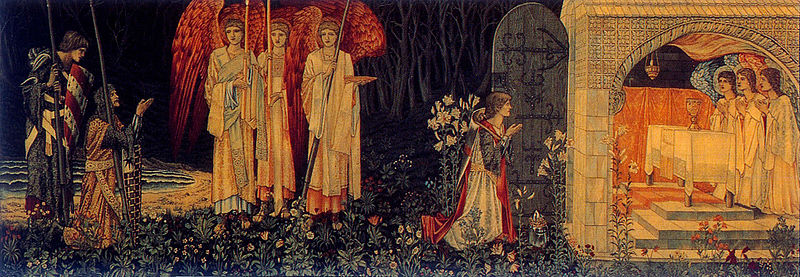
Galahad_grailby Fr. Jeff Loseke

When most people hear the word charity, they probably associate it with donations for the poor, such as food, clothing, toys, money, and so forth.  Others probably think of worthy causes, nonprofit organizations, and tax-deductible donations that help those in need.  The problem with these ideas is that they reduce charity to seasonal or occasional acts of goodwill that are drawn from one’s excess resources.  Charity, then, becomes a thing—and an optional one at that.

A Christian, however, must approach charity not as a something but as a Someone.  Saint John’s first letter attests to the fact that “God is love” (4:8) and that “love is of God” (4:7).  In the original language of this letter, the Apostle uses the Greek word agape to describe this kind of love that is divine in origin.  The Greek language possesses several different words for love, making the author’s choice to describe God in terms of agape most significant for us.  Agape suggests a love that is unconditional and freely given.  Traditionally, this has been rendered in Latin as caritas and then into English as charity.  This revelation gives our understanding of charity an entirely different dimension: God is charity, and charity is of God (cf. 1 John 4:7-8).  We realize that God is selfless, unconditional charity that seeks to pour out Himself for the good of another.  Theologically, this divine outpouring is referred to as kenosis, and it remains a central—if not the most central—characteristic of who God is.  Indeed, Divine Revelation has shown us that God is a free and total outpouring and exchange of charity as Father, Son, and Holy Spirit.  What is more is that He has destined us to share in this great and mysterious exchange of divine love!

God has invited us to share in the eternal banquet of His charity (cf. Revelation 19:7-9).  The question remains: How do we respond?  At the Last Supper, Jesus connected His own Sacrifice on the Cross to the ritual of the Passover and told His disciples to “do this in memory of me” (Luke 22:19).  By commanding His disciples to perpetuate His Sacrifice through the Holy Eucharist, Jesus invited them into the participation of His total outpouring of charity.  To further demonstrate His desire for them, He gave His disciples an example of charity as He washed their feet and said to them, “I have given you a model to follow, so that as I have done for you, you should also do” (John 13:15).  Our response to God’s charity to us is a charitable return of ourselves to Him and to each other.  Our gift of self must not be occasional or seasonal.  It must not be limited or conditional.  It must be continual and relational.  We have been called to love as God loves, and that means that we must lay down our lives for others (cf. John 9:15-17).  Charity is not an option for the Christian.  Charity is a way of life.

The Reverend Jeffery S. Loseke is a Priest of the Archdiocese of Omaha and is currently the pastor of  St. Charlccn_father-les Borromeo Parish in Gretna, Nebraska.  Ordained in 2000, Fr. Loseke holds a Licentiate in Sacred Theology (S.T.L.) from the Pontifical Athenaeum of St. Anselm in Rome and is working to complete his doctoral degree (Ed.D.) in interdisciplinary leadership through Creighton University in Omaha.  In addition to parish ministry, Fr. Loseke has served as a chaplain in the U.S. Air Force, taught high school theology and college-level philosophy, and has been a presenter for various missions, retreats, and diocesan formation days across the country.

Art: The Attainment: The Vision of the Holy Grail to Sir Galahad, Sir Bors, and Sir Perceval by Sir Edward Burne-Jones, 1895-96 (Wikimedia Commons)